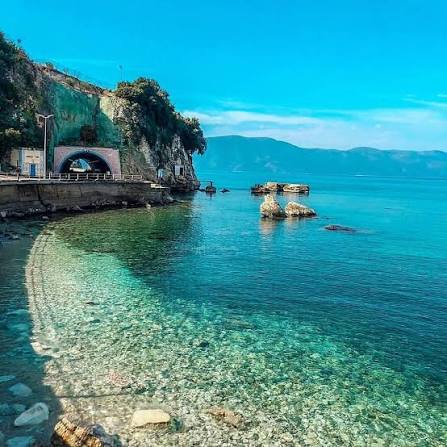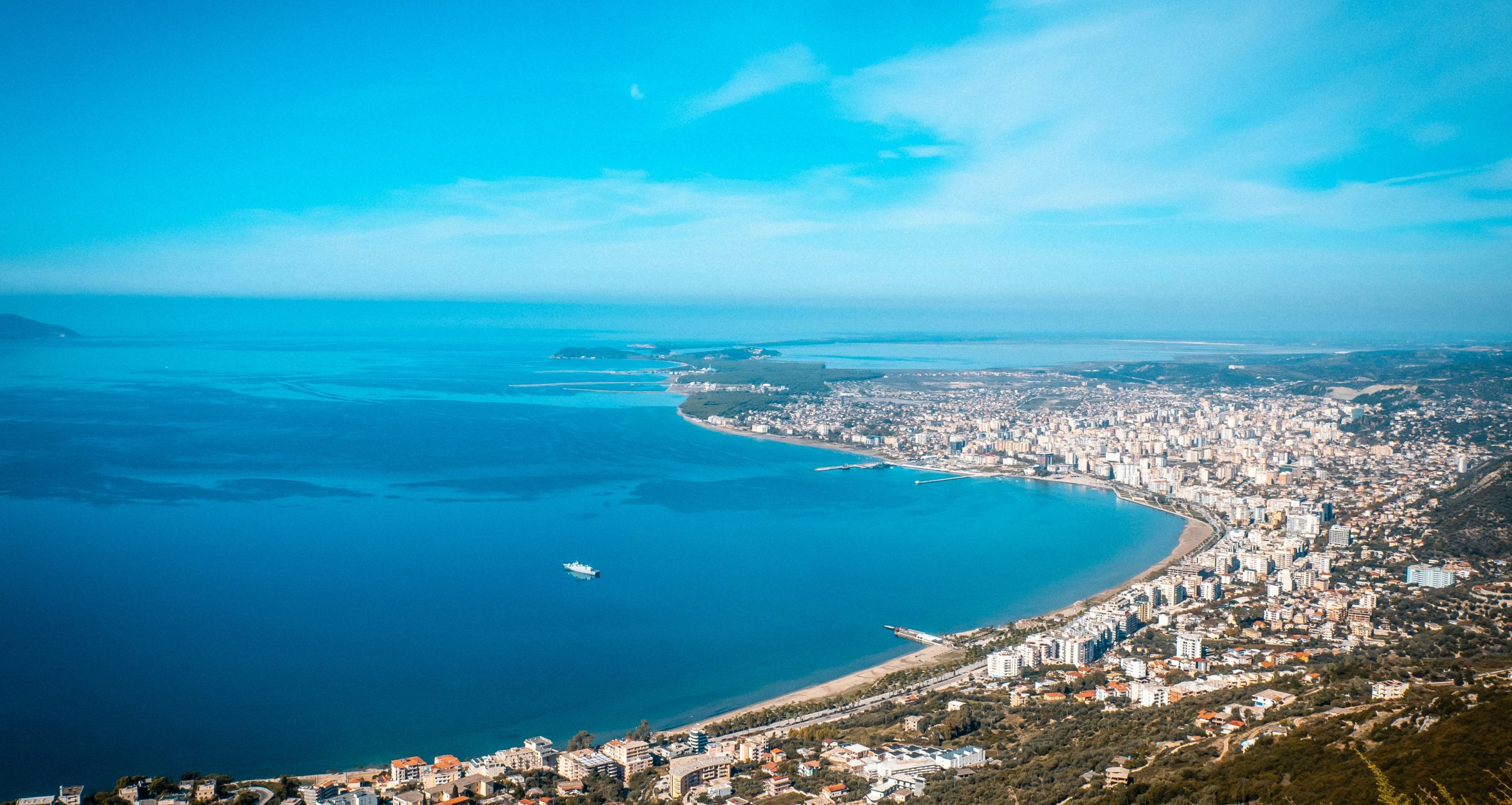
There is a point along the waterfront of Vlore where the city begins to change. The promenade continues, but the coastline becomes rockier. The terrain starts to rise. Smaller beaches appear between sections of stone. Across the Bay of Vlora, the Karaburun Peninsula becomes part of the horizon, while the road ahead leads towards Jonufër, Radhimë, Orikum and the increasingly dramatic landscapes of southern Albania.
This place is Uji i Ftohtë, a coastal neighbourhood on the southern side of Vlore.
Its Albanian name translates literally as “Cold Water.” The name is not a tourism invention. Albania’s National Tourism Agency connects it directly with the natural freshwater springs that emerge along this section of the coast and flow towards the sea. But water is only the beginning of the story.
Within a relatively small stretch of coastline, Uji i Ftohtë brings together geology, changing relief, Mediterranean landscape, twentieth-century political history and the rapid transformation of modern Vlore. Understanding the neighbourhood means reading all of those layers together.
Official reference:
Albania National Tourism Agency – Cold Water Beach
https://akt.gov.al/en/attractions/cold-water-beach/
The 32 Springs Behind the Name
The most distinctive natural story of Uji i Ftohtë lies partly underground. Hydrogeological research into the coastal aquifer of Vlora documents an exceptional system of springs associated with this coastline. Research describes 32 springs emerging at sea level along approximately 1.7 kilometres at Uji i Ftohtë. The springs belong to a much larger carbonate karst aquifer system around the Bay of Vlora. In karst landscapes, groundwater can move through fractures, cavities and permeable carbonate formations before reappearing at springs or discharging towards the sea. This means that the neighbourhood’s name records something much deeper than a characteristic of a beach. “Cold Water” is the English translation of the actual Albanian place name, and that name reflects a hydrogeological phenomenon that forms part of the natural history of Vlore’s coastline. It is a small example of something found throughout the Mediterranean: geology becoming geography, and geography eventually becoming identity.
Scientific references:
Hydrogeological Aspects of the Municipal Water Supply of Albania
https://www.mdpi.com/2306-5338/10/10/193
Carbonate Coastal Aquifer of Vlora Bay and Groundwater Submarine Discharge
https://www.researchgate.net/publication/229013756_Carbonate_Coastal_Aquifer_of_Vlora_Bay_and_Groundwater_Submarine_Discharge_Southwestern_Albania
Karst Brackish Springs of Albania
https://www.mdpi.com/2306-5338/9/7/127
Where the Coast Begins to Change
The transformation is visible above ground as well. Central Vlore and much of the Lungomare have the character of an urban waterfront. Beaches, cafés, restaurants, buildings and the promenade exist close together. Moving south through Uji i Ftohtë, the physical landscape gradually changes. Mixed seabeds increasingly give way to pebbles, stones and rocky sections. Smaller swimming areas interrupt the more continuous urban shoreline. Behind them, the terrain begins to rise. The sea can look different too.
Sandy seabeds can be disturbed by waves, currents and swimmers, temporarily increasing suspended material in shallow water. Rocky and pebbled seabeds create different optical conditions, while pale stones beneath clear water can intensify blue and turquoise tones under Mediterranean sunlight. This should not be interpreted as a rule that rocky beaches always have better water quality. Water quality depends on multiple environmental factors.
The visual transition, however, is easy to observe.
As the coastline changes, so does the way the Bay of Vlora appears from the shore. Rock, Water and Rising Relief
Uji i Ftohtë is not defined by the sea alone. The flatter urban landscape of Vlore gradually meets rising terrain, exposed rock and Mediterranean vegetation. Across the bay, Karaburun forms a long natural horizon. Together, these elements create a landscape built on contrasts.
Blue water meets pale stone. Green vegetation interrupts the rock. Modern buildings rise above a coastline that becomes progressively less urban. The city remains close, while the geography ahead already begins to suggest something different.
Albania’s National Tourism Agency specifically identifies the area’s rocks, greenery and views towards the Bay of Vlora and Karaburun among its natural attractions.
This is why Uji i Ftohtë should not simply be understood as another beach district.
It occupies a geographical threshold.
A Natural Balcony Over the Bay of Vlora
Relief changes perspective.
Parts of Uji i Ftohtë rise above the immediate shoreline, creating views that cannot be experienced from beach level alone.
From elevated streets, terraces and buildings, the geography of the bay becomes easier to read.
Vlore curves around one side.
Karaburun defines the opposite horizon.
The water occupies the space between them.
And the southern coastline directs the eye towards progressively more pronounced terrain.
Late afternoon adds another dimension. As the sun moves lower, the city, water, peninsula and relief separate into layers of light and shadow.
Sunset here is therefore not simply an event in the sky.
It changes the entire geography of the view.
A Coast Made for Photography
Uji i Ftohtë does not depend on a single official viewpoint.
Its photographic appeal comes from combinations.
Turquoise water against pale stones. Rock beside Mediterranean vegetation. Small beaches beneath rising terrain. Boats crossing the bay. Karaburun on the horizon. The city in one direction and a progressively more open coastline in the other.
For photographers, travel writers and visitors interested in landscape, this provides considerable visual variety within a relatively compact area.
Morning often offers quieter water and cleaner coastal compositions.
Late afternoon brings greater depth to the relief.
Sunset transforms the bay through changing light, reflections and silhouettes.
There is no single photograph that defines Uji i Ftohtë.
That is precisely what makes the area interesting to photograph.
Geology You Can Actually See
Geology can sound abstract until it becomes visible.
In Uji i Ftohtë, several elements of the geological story can be experienced directly.
The freshwater springs reveal an underground karst system.
The shoreline shows changing coastal materials.
The rising terrain introduces stronger relief.
Different seabeds influence the visual character of the shallows.
Karaburun provides the larger geographical frame across the bay.
Scientific research into the Vlora Bay aquifer describes a significant carbonate coastal aquifer and groundwater discharge system, placing what visitors see at Uji i Ftohtë within a much larger hydrogeological landscape.
This gives the neighbourhood an interesting geotourism dimension, where understanding the landscape becomes part of the reason for exploring it.
No specialist knowledge is required.
Walk along the coast and observe.
Notice the changing seabed. Look at the rock. Watch the terrain rise. See how the perspective across the bay opens. Continue south and observe how these characteristics become progressively stronger.
The landscape begins to explain itself.
A Coast Once Associated With Political Privilege
There is another layer to Uji i Ftohtë that cannot be understood through geology.
During Albania’s communist period, part of this attractive coastline was occupied by government villas and holiday residences associated with the country’s senior political leadership.
Historical and archival accounts place Enver Hoxha and members of his family at government residences in Uji i Ftohtë, while other senior figures of Albania’s communist leadership also had villas in the area.
The location offered obvious advantages: elevated positions, sea views, greenery, direct proximity to the water and separation from the denser urban centre.
The choice was hardly accidental.
Many of the natural characteristics celebrated by visitors today were precisely what made this section of the coast particularly desirable decades earlier.
Access, however, existed in a very different political context.
Historical reporting and local recollections describe controlled and fenced spaces around government residences, protected by security and separated from ordinary public use. Rather than claiming that the entire Uji i Ftohtë coastline was permanently inaccessible, the historical evidence supports a more precise conclusion: access to areas surrounding these privileged government residences was considerably more controlled than it is today.
The contrast remains historically significant.
A political system publicly founded on egalitarian principles maintained secluded seaside residences for its ruling elite on one of Vlore’s most attractive stretches of coast.
Some former government properties remain in the Uji i Ftohtë area today, providing physical traces of that period.
They are not simply old villas.
They are part of the political landscape of twentieth-century Albania.
Historical references:
Historical account of the government villas at Uji i Ftohtë
https://memorie.al/en/in-the-final-years-the-main-leader-did-not-come-to-occupy-the-villa-of-uji-i-ftohte-cold-water-it-was-frequented-by-the-children-who-the-unknown-reportage-of-the-mediterraneo/
Archival account placing Enver Hoxha at Uji i Ftohtë in April 1976
https://memorie.al/en/abdyl-kellezi-together-with-koco-theodhosni-admitted-that-they-have-never-been-for-communism-he-talked-with-the-son-of-an-albanian-revisionist-in-yugoslavia-envers-conversation-in-vlora/
From Restricted Coast to Modern Uji i Ftohtë
The political changes of the early 1990s altered Uji i Ftohtë profoundly.
A coastline partly characterised by government residences, controlled spaces and relatively limited urban development entered a period of rapid transformation.
Much of the contemporary neighbourhood developed during the post-communist decades.
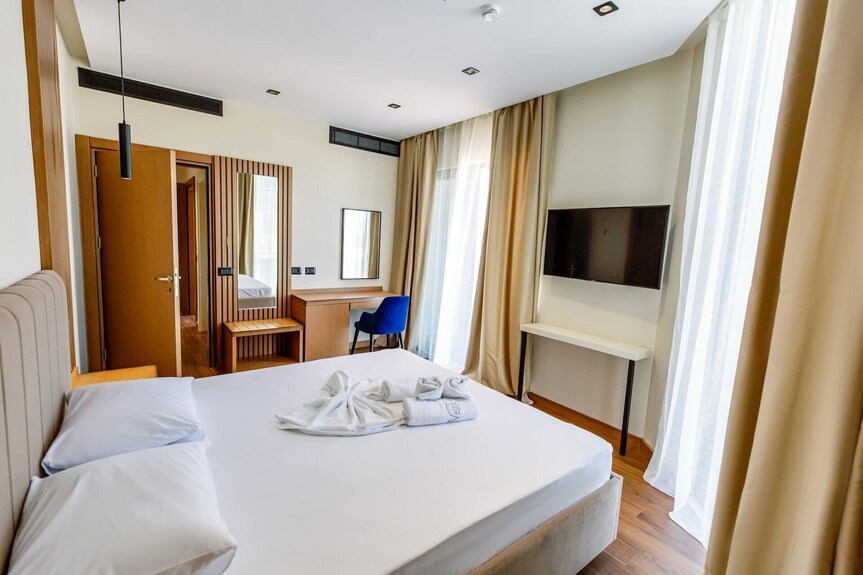
Residential buildings expanded along the coast. Hotels appeared. Restaurants, cafés, beach businesses and other services followed. Private investment changed both the skyline and the way the area was experienced.
This created one of the most revealing contrasts in modern Vlore.
Land once valued partly for privacy and political privilege became increasingly connected with residences, hospitality, tourism and public coastal life.
The geography did not change.
Who could experience it did.
Reading Albania’s Recent History in One Neighbourhood
That transformation makes Uji i Ftohtë interesting beyond its tourism value.
Different periods of Albanian history remain visible beside one another.
Former government properties recall the hierarchy and controlled spaces of the communist era.
Newer residential buildings, hotels, restaurants and other businesses reflect the speed of Albania’s post-1990 economic and urban transformation.
Between them lies the same coastline.
The sea views, rising relief, greenery and distance from the densest parts of central Vlore that once attracted the political leadership later attracted residents, investors, hospitality businesses and visitors.
Few areas of Vlore illustrate that transition as visibly.
A coastline once partly defined by exclusivity became one of the places where contemporary Vlore expanded most visibly towards the sea.
Not One Beach, but a Sequence of Beaches
Modern Uji i Ftohtë is better understood as part of a coastline than as a neighbourhood built around one famous beach.
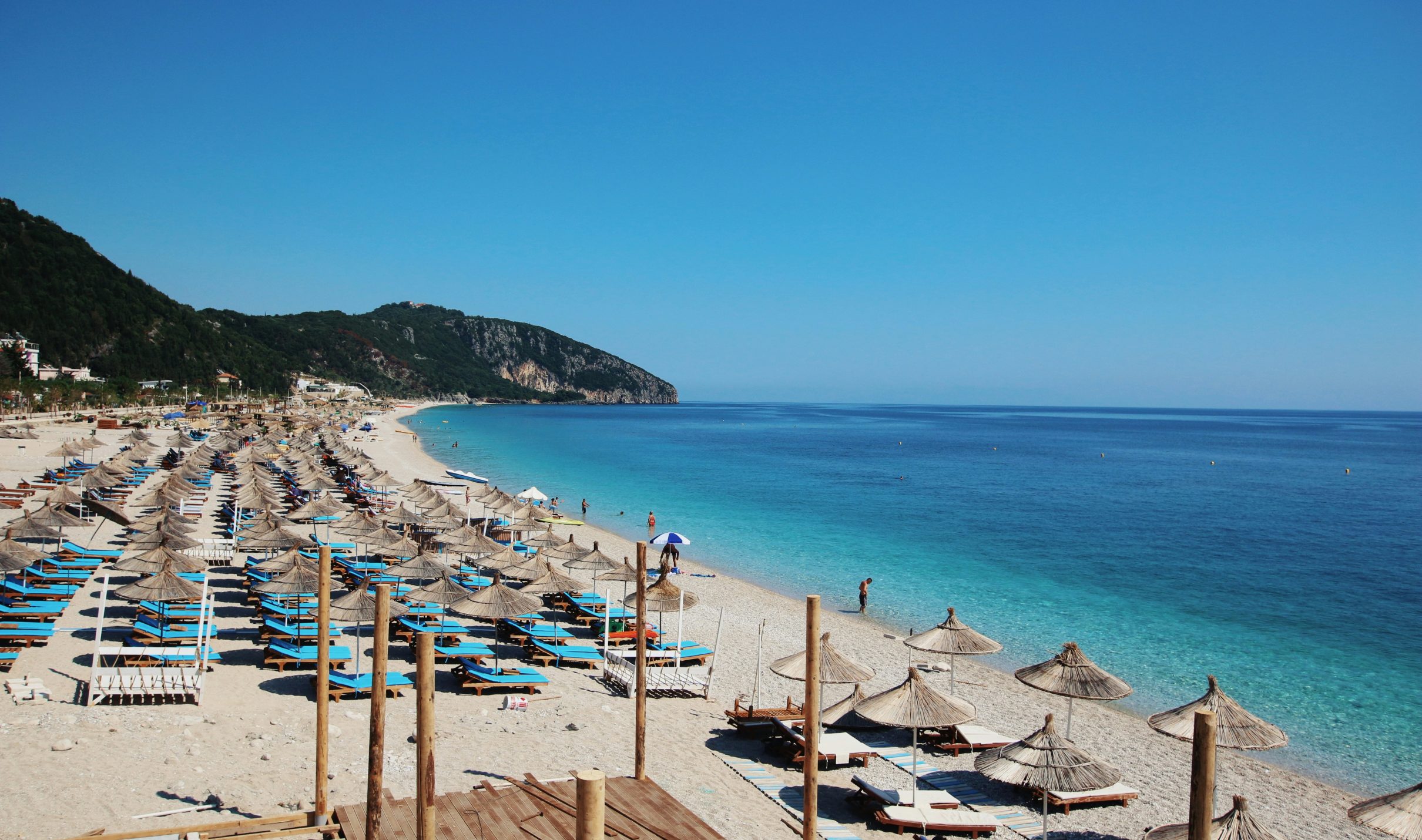
Swimming areas and beaches can be found along this section of the waterfront, including options accessible on foot.
Continue south and the possibilities multiply.
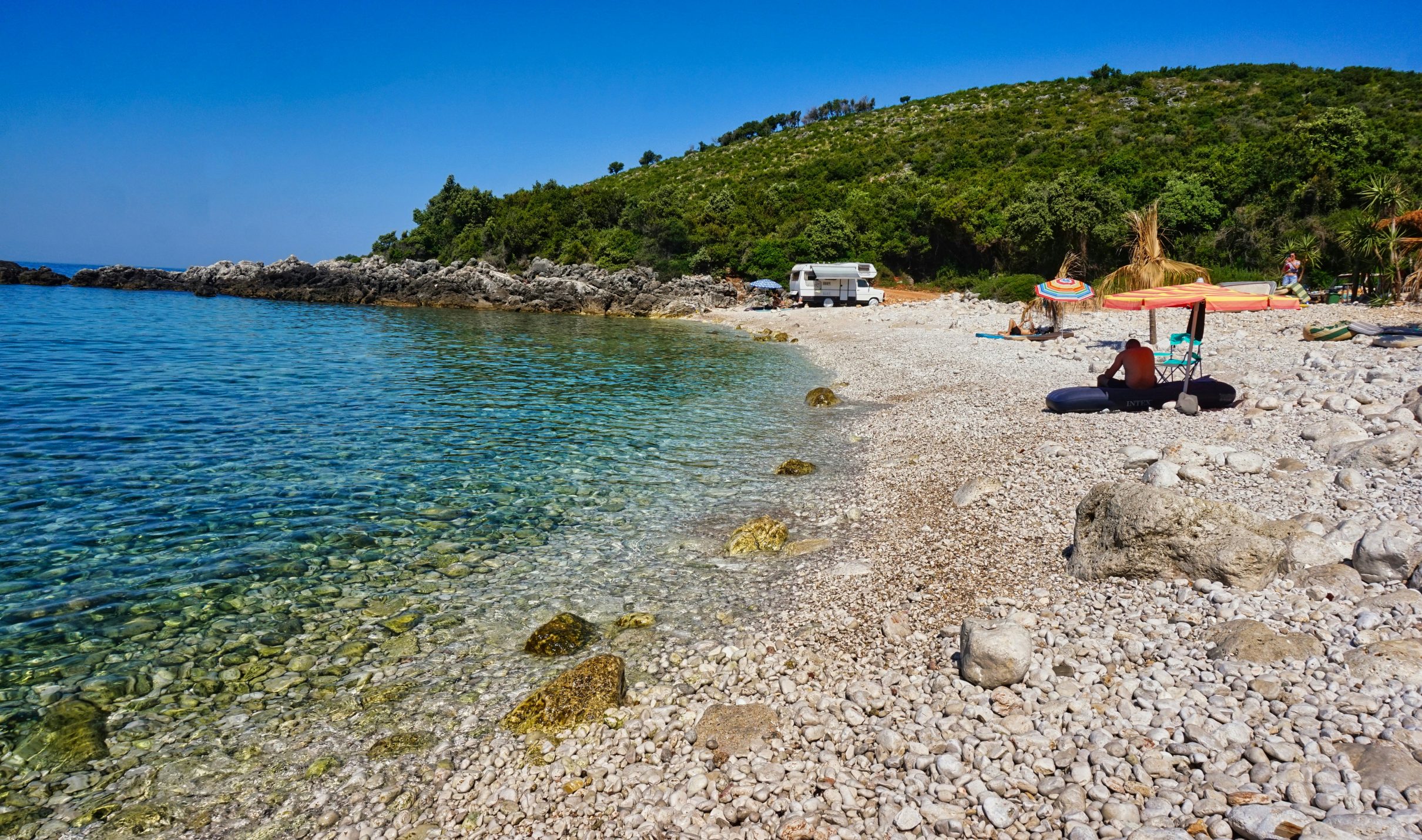
Towards Jonufër, Radhimë and Orikum, visitors encounter organised beaches, smaller coves, rocky swimming areas and beach clubs.
This creates freedom.
A family may choose an organised beach with umbrellas and restaurants.
A couple may look for a smaller, quieter section of coast.
Friends may prefer music and a beach club atmosphere.
Another traveller may simply follow the road until somewhere looks inviting enough to stop for a swim.
The advantage is not one supposedly perfect beach.
It is having a coastline full of alternatives.