The Albanian Riviera from Vlorë: one road, five different days

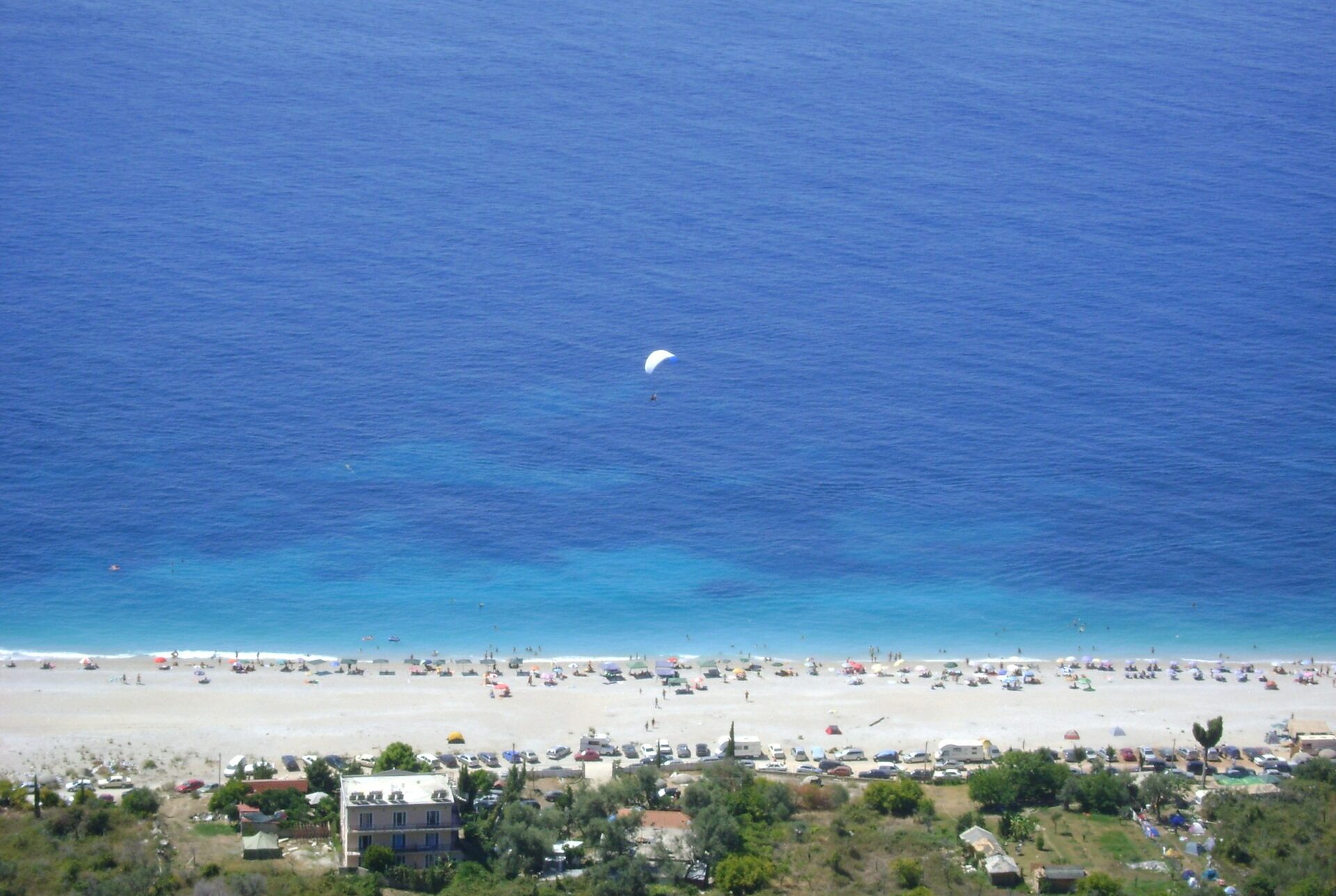
The long pebble beach of Dhërmi on the Albanian Riviera, with turquoise water and the mountains rising behind

The Albanian Riviera starts less than an hour from Vlorë, and the hard part is choosing where to stop. The SH8 runs south over the Llogara Pass or through the Llogara Tunnel, then down to Dhërmi, Gjipe, Himarë and Porto Palermo. From Valza Boutique Hotel, Dhërmi is about 40 minutes away through the tunnel and Himarë about 60 km. Leave after breakfast, choose two or three stops, and be back for dinner.

The Riviera at a glance

What it is
About 60 km of coast road, the SH8, with a mountain pass, canyon beaches, old villages and two castles.
Where
South of Vlorë: Dhërmi is about 39 km from Valza Boutique Hotel in Uji i Ftohtë through the tunnel, Himarë about 60 km, Porto Palermo about 8 km beyond.
Time needed
One day for one part of the coast; two day trips or two nights to see most of it.
Best time
June and September: warm sea and calmer roads than in July and August.
Cost
The road is free; a toll has been announced for the Llogara Tunnel, so check the current fee. Parking at Gjipe is paid in summer, and castle fees are paid on site.
Good for
Couples, families with older children, walkers and swimmers.

The Riviera’s real problem: too much in 60 km

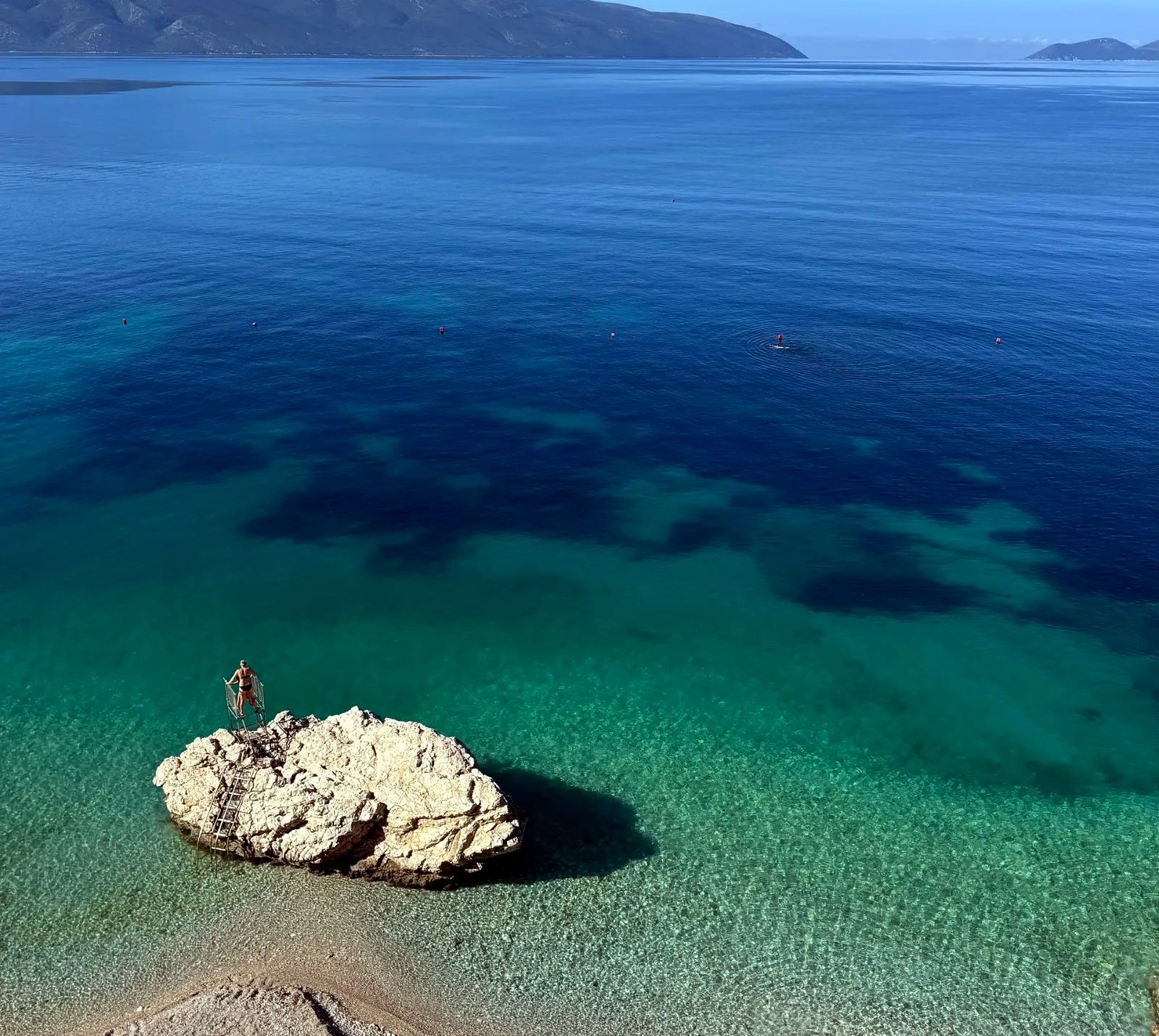
Ask anyone in Vlorë about the Riviera and the question is never what to see. It is what to leave out. In about 60 kilometres the road gives you a mountain pass with the sea below it, a beach where Julius Caesar may have landed, a canyon that ends in sand, a cove so clear it is called the Aquarium, a castle town with a cave on its beach, a fortress on a bay, and an old village that most people drive past.

Try to do all of it in one day and you will see it through a windscreen. So we don’t plan the Riviera by kilometre. We plan it by mood.

The road, stop by stop

  • Dukat: the road splits. The tunnel goes through the mountain; the old road climbs to the Llogara Pass.
  • Palasë: the first beach after the mountain, and possibly the bay where Caesar landed in 48 BC.
  • Dhërmi: an old village above, a long beach below.
  • Gjipe: a beach at the end of a canyon, reached on foot.
  • Vuno and Jala: a stone village on the hill, a beach below it, and Aquarium Beach along the coastal path.
  • Himarë: a castle, town beaches, and the end of most day trips.
  • Porto Palermo: about 8 km and 15 minutes beyond Himarë. Qeparo: about 13 km and 20 minutes beyond, with an old village high above the sea.

Distances and times from Google Maps, fastest route through the tunnel, without stops.

Pass or tunnel: a 40-minute decision

For decades there was only one road to the Riviera: up through the pines of Llogara, until the Ionian Sea appeared all at once, far below. In July 2024 the Llogara Tunnel opened beneath the mountain: about 6 km long, it cut the drive from Dukat to Palasë from around 30 minutes to about 7, according to the Albanian government. A toll has been announced: check whether it is charged and the current fee.

From Valza Boutique Hotel to Dhërmi that means about 40 minutes through the tunnel, or about 1 hour 20 minutes over the pass. Our advice: the pass in the morning, when the light is clear and you are fresh, and the tunnel on the way back, because the Ionian side has tight bends and few places to pull over. The tunnel saves time; the pass is the reason this road became famous.

Over the Llogara Pass or through the tunnel: the road from Valza Boutique Hotel to DhërmiElevation profile of the two roads from Valza Boutique Hotel in Vlorë to Dhërmi: over the Llogara Pass at 1,027 metres, about 49 km, or through the 6 km Llogara Tunnel, about 39 km.0 m250 m500 m750 m1,000 mLlogara Pass · 1,027 mLlogara Tunnel · 6 kmValza Boutique HotelOrikumDukatPalasëDhërmi0 km25 km50 kmOver the pass: about 49 km, the view roadThrough the tunnel: about 39 km

The two roads from Valza Boutique Hotel to Dhërmi, drawn from real elevation data. Over the pass the road climbs from the sea to 1,027 metres and drops back to the Ionian; through the tunnel it stays below about 430 metres. Distances: OpenStreetMap routing; elevations: SRTM satellite data.

On the way to Dukat you pass the olive groves and coves of Radhimë and the ancient harbour of Orikum: keep them for another day, because today the mountain is waiting.

Choose your Riviera: five days on one road

Every one of these days starts the same way, right after breakfast, and ends the same way, back in Vlorë for dinner. What changes is everything in between.

The Albanian Riviera from Valza Boutique Hotel: five days on one roadMap of the coast from Vlorë to Porto Palermo with the road south, the Llogara Pass and tunnel, and the stops of the five Riviera days: Llogara and Palasë, Dhërmi, Gjipe, Vuno and Himarë with Porto Palermo.Valza Boutique HotelOrikumDay 1 · Llogara PassDay 1 · PalasëDay 2 · DhërmiDay 3 · GjipeDay 4 · VunoDay 5 · HimarëDay 5 · Porto PalermoBay of VlorëIonian SeaThe coast road south, through the tunnelOver the Llogara Pass, the view roadNorth10 km

One road, five days: every stop below is on or just off the coast road south from Valza Boutique Hotel. Coastline and roads © OpenStreetMap contributors.

1. The view day: Llogara, Caesar and a first swim

Drive over the pass, not through it. The climb crosses Llogara National Park, protected since 1966, where the wind has combed a lone pine near the road into the shape of a flag. Stop at the viewpoints, then look for the white roads of Caesar: limestone traces off a footpath, where the forest opens and pale stone replaces soil, that local memory links to Julius Caesar. They are not marked. You find them by paying attention.

The memory has a reason. In January 48 BC Caesar crossed from Brundisium with seven legions, and in his own account of the Civil War (III.6) he writes that he landed them “at a place called Palaeste”, which may be modern Palasë, right below the pass. The Julius Caesar Trail follows the mountainside down to that bay. End with a swim at Palasë: about 1.5 kilometres of shore, deep water close in, and octopuses and cuttlefish hiding between the rocks if you bring a mask.

This is the shortest of the five days. Our guide to the Llogara Pass and the Flag Pine has the details, and another piece explores the forests and legends of Llogara National Park.
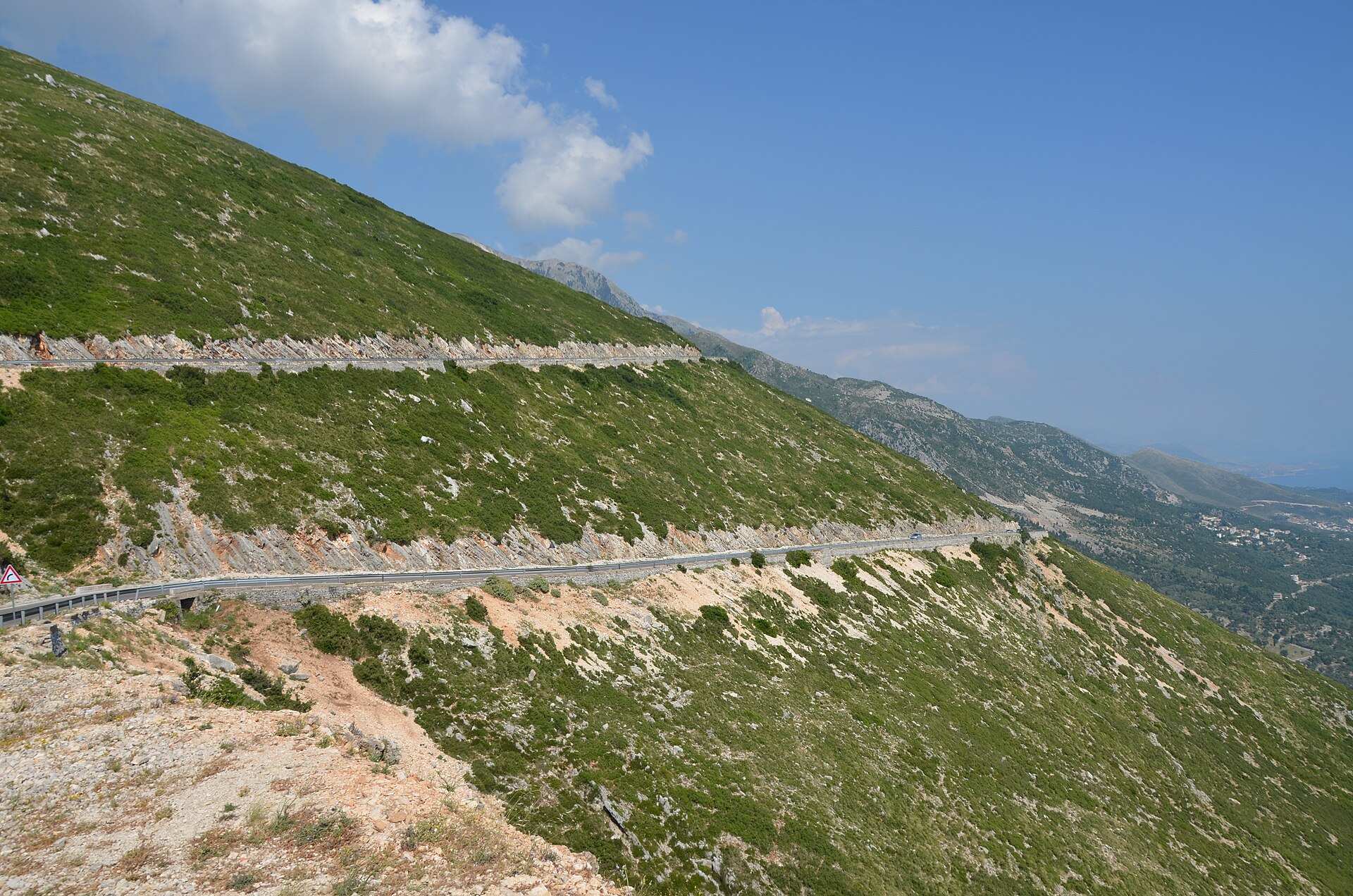
The SH8 coast road cutting across a steep green mountainside above the Ionian coast in the Dhërmi area

The SH8 on its way down from the Llogara Pass towards Dhërmi. Photo: Carole Raddato, CC BY-SA 2.0, via Wikimedia Commons

2. The swimmer’s day: from Dhërmi to the Aquarium

Start at Dhërmi, 40 minutes from Valza Boutique Hotel through the tunnel, while the beach is still quiet. Then move south to Jala, below Vuno. From Jala a marked coastal path runs over the cliffs past Aquarium Beach, where the water is so clear it seems to dissolve depth, to Livadhi Beach in Himarë: one hour to an hour and a half on foot. Plan the return before you start: walk back, or take a taxi from Himarë.

If you would rather drive than walk, finish on the beaches of Himarë: Spile in town, then Livadhi, Maraci and Potami. Whatever else you cut from the day, don’t cut the last swim.

3. The walker’s day: Gjipe and its canyon

Gjipe is the beach you earn. It lies at the mouth of a canyon between Dhërmi and Vuno, about 800 metres long and only 10 to 20 metres wide, a protected landscape.

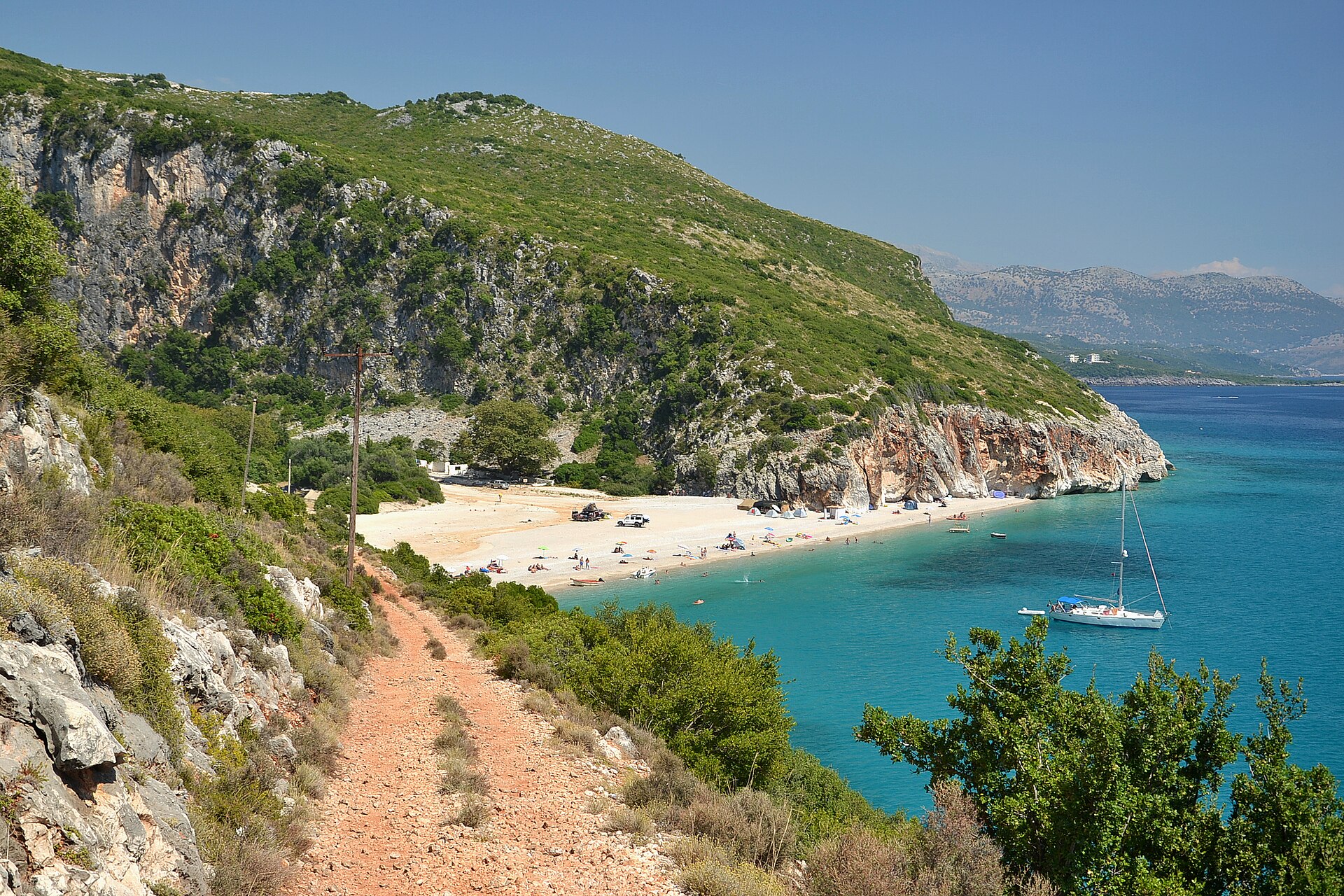
Between Dhërmi and Vuno, turn off the SH8 following the signs for the Monastery of St Theodore and Gjipe, and drive until the paved road ends. Park there (in summer, expect to pay) and walk down a rough track to the sea, about 20 to 30 minutes. There is almost no shade, and the climb back, about 120 metres, is harder than the way down: go early, carry water and wear proper shoes. In season you can also arrive by boat.

At the bottom, swim first, then walk a little way into the canyon, between walls only 10 to 20 metres apart. Few beaches on this coast give you a beach and a canyon in the same morning.


A dirt track running down a scrubby hillside to the white beach of Gjipe, with cliffs, turquoise water and a sailing boat in the bay

The track down to Gjipe Beach. Photo: Pudelek (Marcin Szala), CC BY-SA 3.0, via Wikimedia Commons

4. The village day: churches, a square and a village above the village

The beaches made the Riviera famous; the villages are where it keeps its memory. Dhërmi is two places: the old village of stone houses and churches, about 200 metres up the slope of the Ceraunian Mountains, and the beach with its newer resorts below. Walk up and step inside one of the small churches, such as the monastery church of St Mary.

In Vuno, our guide to the village covers the alleys and the old houses; on this day, what matters is the square. Sit with a coffee in the centre and let the village go by. A story is often told here: when men left Vuno, they would place a small stone at the entrance of their home, a quiet promise that they would return. Some did, some did not. The stones remain.

Then keep going to Qeparo, about 20 minutes beyond Himarë. Qeparo is two villages too: the newer one by the sea and the old stone village high on the mountainside. Swim below, then drive up. Most visitors never do, and that is exactly why you should.

5. The history day: a castle town, a cave and Ali Pasha’s bay

Himarë is where most road trips turn around. Climb to the old castle town above the modern one: local storytelling calls Himarë an enchanted princess asleep, and from up there it is easy to see why. Down on Spile, the town beach, look for the cave in the rocks. Our Himarë travel guide and our plan for a day in Himarë cover the town in detail.

Then drive about 15 minutes south to Porto Palermo. An inscription above the entrance says the castle was built in 1804 by French engineers for Ali Pasha of Tepelena: three sides, with a large gun bastion at each corner. The site was once a small island; when the French traveller François Pouqueville saw it in 1806, a low, narrow isthmus linked it to the shore. Ali Pasha raided Himarë in 1797, then courted the region with public works and churches; one of them stands on the shore facing the castle. Around the bay, bunkers recall a once restricted military zone. Check opening times and the fee on site, then swim: the bay is calm and protected.

Five mistakes we see every summer

  1. Trying to do everything in one day. Llogara, Dhërmi, Gjipe, Vuno, Himarë and Porto Palermo before dinner means you see the Riviera through a windscreen. Choose one of the five days above and leave the rest for next time: the road will still be there.

  2. Walking down to Gjipe at midday. The way down takes 20 to 30 minutes and feels easy. The way back is the real test: about 120 metres of climbing on a track with almost no shade. Go in the morning, and the canyon is yours before the heat.

  3. Driving the pass back in the dark. In the morning the pass is the most beautiful part of the trip. After sunset, the tight bends and the few places to pull over on the Ionian side turn it into hard work. Come back through the tunnel.

  4. Leaving late in July and August. These are the months when traffic and parking are at their hardest. Leave right after breakfast and you reach the first beach before the crowds do.

  5. Seeing only the beaches. The old villages of Dhërmi and Qeparo are a few minutes uphill from the sea, and most visitors never go up. That is where the Riviera keeps its churches, its stone houses and its stories.

What visitors never find out

Myth“The Flag Pine was shaped by people.”Tap to see the reality

Reality No gardener and no legend: at Llogara the wind has combed a lone pine near the road until it grew flat, like a flag. Stand next to it and you understand the mountain before you see the sea.

Myth“Porto Palermo castle always stood on the mainland.”Tap to see the reality

Reality According to the inscription over its gate, French engineers built it in 1804 for Ali Pasha of Tepelena, the ruler of Ioannina, on what was a small island. When the French traveller François Pouqueville saw it two years later, only a low, narrow isthmus tied it to the shore.

Myth“Caesar’s landing is only a school story.”Tap to see the reality

Reality In 48 BC, in his war against Pompey, Julius Caesar crossed the sea from Brundisium and landed his army at a place ancient writers call Palaeste. It may be today’s Palasë, the first beach below the Llogara Pass. Few swimmers there know they may be floating over the start of a Roman campaign.

Two more things most visitors miss. Himarë’s springs have a memory older than the town you see: the Silver Spring, mentioned by Pouqueville, is traced to references by Pliny the Elder, and in later accounts of the Royal Spring, legend says even emperors would stop to drink. And the pass has been protected for 60 years: Llogara became a national park in 1966, long before the Riviera filled with summer traffic.

Did you know?

  • 1,027 m

    The height of the Llogara Pass

  • 6 km

    The length of the Llogara Tunnel, opened in July 2024

  • 1966

    The year Llogara became a national park

  • 800 m

    The length of the canyon at Gjipe, only 10 to 20 metres wide

Test yourself: how well do you know the Riviera road?

1. How high is the Llogara Pass?

  • 627 metres
  • 1,027 metres
  • 2,027 metres
Show the answer

1,027 metres. The SH8 climbs to the Llogara Pass at 1,027 metres, in the Ceraunian Mountains.

2. How long is the Llogara Tunnel?

  • About 6 km
  • About 600 metres
  • About 16 km
Show the answer

About 6 km. It opened in July 2024 and cut the drive from Dukat to Palasë from around 30 minutes to about 7.

3. How do you reach Gjipe Beach?

  • By a paved road to the sand
  • By cable car
  • By a rough track on foot, or by boat in season
Show the answer

By a rough track on foot, or by boat in season. The paved road ends, then a rough track leads down in about 20 to 30 minutes, with almost no shade.

Plan your visit

From Valza Boutique Hotel

To Dhërmi there are two routes: about 40 minutes through the Llogara Tunnel, or about 1 hour 20 minutes on the scenic road over the Llogara Pass, through the national park. Himarë is about 60 km away, around an hour and a half through the tunnel (Google Maps). The road south does not cross the city centre.

Pass or tunnel

Over the pass instead of the tunnel adds about 40 minutes: to Dhërmi, 1 hour 20 minutes instead of 40. Pass in the morning, tunnel on the way back.

Beyond Himarë

Porto Palermo is about 8 km (15 minutes) further, Qeparo about 13 km (20 minutes).

Two or three days

With a base in Uji i Ftohtë, do the view day and the walker’s day on the first trip, the swimmer’s day and the history day on the second. Or sleep on the coast: two nights give you the villages without hurry and Himarë castle at dusk.

Where to eat

Keep lunch simple: fish by the sea in Jala or Himarë, a coffee in Vuno’s square, and on the way back olive oil and honey sold by local families. Places change from season to season, so choose among those with the best recent reviews.

Best plan

Leave right after breakfast, choose two or three stops, and be back in Vlorë for dinner.

When to go

  1. May Cool sea, about 18 °C
  2. June Sea about 22 °C, calmer road
  3. July Sea 24 to 25 °C, hardest traffic
  4. August Sea 24 to 25 °C, hardest traffic
  5. September Sea 24 to 25 °C, calmer road
  6. October Sea about 21 °C, some beach services closed

June and September are the best balance: the road is calmer than in July and August, when traffic and parking are at their hardest. In October the sea is still around 21 °C, although many seasonal beach services have closed.

What to bring

  • Water
  • Sun protection
  • A mask for the clear water
  • Proper shoes for Gjipe and the coastal path
  • A light layer for the top of the pass

Is the Riviera worth a day from Vlorë?

Yes, if…

you want views, swims, villages and castles in a single road trip, and you are happy to pick two or three stops and leave the rest for next time.

Maybe not, if…

you want to see every stop in one day: you would see the coast through a windscreen, and July and August traffic makes it harder.

The fix is simple: choose one of the five days and leave early.

Go deeper

Our corner of Vlorë

Valza Boutique Hotel, a 4-star boutique hotel in Uji i Ftohtë, at the southern end of Vlorë’s seafront, is a natural starting point: the road south does not cross the city centre, and parking is free for guests in our rooms and suites. Our reception team helps with local excursions, and when you come back over the mountain, Eden by Valza, on the sixth-floor rooftop, looks across the Bay of Vlora with a 180-degree view.

Cover photo: Dhërmi beach on the Riviera. Photo: Igiann, public domain, via Wikimedia Commons

Frequently asked questions about the Riviera from Vlorë to Himarë


How long does it take to drive from Vlorë to Himarë?

From Uji i Ftohtë, on the southern side of Vlorë, Google Maps gives about 60 km and around an hour and a half to Himarë through the Llogara Tunnel, without stops. The scenic old road over the Llogara Pass adds about 40 minutes. Allow extra time in July and August.


Can you do the Albanian Riviera as a day trip from Vlorë?

Yes. Leave right after breakfast, choose two or three stops, such as the Llogara viewpoints, a swim at Dhërmi, Jala or Gjipe and an afternoon in Himarë, and you are back in Vlorë for dinner. Porto Palermo and Qeparo fit too if you start early.


Should you take the Llogara Tunnel or drive over the pass?

The Llogara Tunnel, about 6 km long and opened in July 2024, cuts the drive from Dukat to Palasë to about 7 minutes. The pass is slower but gives you the famous view over the Riviera. A good plan: the pass in the morning, the tunnel back in the evening.


How many days do you need for the Riviera from Vlorë?

One day is enough for one part of the coast: the views of Llogara, the beaches from Dhërmi to Himarë, Gjipe, the old villages or the history of Himarë and Porto Palermo. To see most of it, plan two day trips from Vlorë or two nights on the coast.


How do you get to Gjipe Beach?

Between Dhërmi and Vuno, turn off the SH8 towards the Monastery of St Theodore and drive until the paved road ends. Park there and walk down a rough track, about 20 to 30 minutes. There is almost no shade and a climb of about 120 metres on the way back. In season you can also arrive by boat.


Where is Aquarium Beach on the Albanian Riviera?

Aquarium Beach is near Jala, below the village of Vuno, on the marked coastal path from Jala to Livadhi Beach in Himarë, a walk of one hour to an hour and a half. Its water is so clear it seems to dissolve depth, ideal for swimming and exploring the rocks with a mask.


What is there to see at Porto Palermo?

Porto Palermo Castle, built in 1804 for Ali Pasha of Tepelena according to the inscription over its entrance, stands on a former island in a calm bay about 15 minutes south of Himarë. Nearby are a church Ali Pasha paid for and the bunkers of a once restricted military zone.


Sources

  1. Caesar, G. J. The Civil War, Book III, 6, translated by A. G. Peskett (Loeb Classical Library, 1914). Text on LacusCurtius. Caesar sails from Brundisium in January 48 BC and lands his legions at Palaeste.
  2. Trushaj, A. and Elezi, G. (2024). The history of the Porto Palermo Castle and the significance of its Greek inscription. Historia i Świat. The castle of Ali Pasha and its inscription.
  3. Albanian Ministry of Infrastructure and Energy. Llogara Tunnel opens, reducing travel time to the south of the country. The 6 km tunnel, opened in July 2024, and the time saved between Dukat and Palasë.
  4. Albanian Ministry of Tourism and Environment. Public consultation on Llogara National Park. The park, first protected in 1966, and its boundaries.
  5. Tirana Times. Llogara, where mortals experience eternity. The Llogara Pass at 1,027 metres.
  6. Valza Boutique Hotel. Gjipe: the canyon and the beach no road reaches and Dhërmi: the beaches, the old village and the pirates’ cave. Our field guides to Gjipe and Dhërmi, with their own sources.
  7. World Beach Guide. Himarë water temperature. Average sea temperatures by month.
  8. Routes, distances and the map: OpenStreetMap contributors; elevations: SRTM satellite data via OpenTopoData.