The Bay of Vlora: where sea, land and history meet

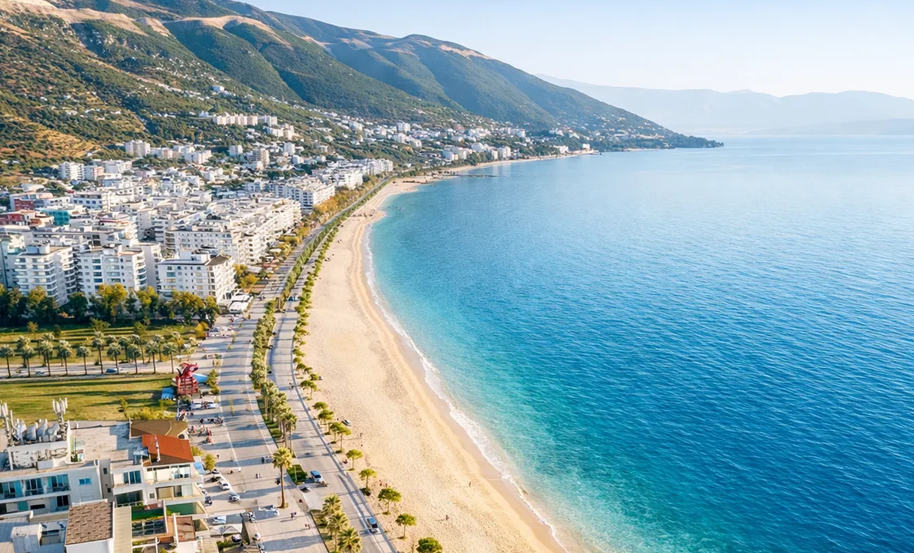
Aerial view of Vlorë's long sandy beach and palm-lined promenade, with apartment blocks and hills behind

The Bay of Vlora in brief

The Bay of Vlora is a sheltered bay on Albania’s Mediterranean coast, close to the Strait of Otranto, where the Adriatic opens into the Ionian Sea. The Karaburun Peninsula protects its western side and Sazan Island stands near its entrance. MAREOGRAPH, an editorial project by Valza Boutique Hotel, explains how its geology, waters, wildlife and people form one landscape.

The 4-star Valza Boutique Hotel stands in Uji i Ftohtë, on the southern side of Vlorë, about 300 metres from the nearest beach; the neighbourhood’s name means “cold water” and is linked to the freshwater springs along this coast. The reception team helps guests book boat trips to Sazan Island and the Karaburun Peninsula, depending on sea and weather conditions. From the sixth-floor rooftop, where Eden by Valza looks across the bay with a 180-degree view, the changing light, the outline of Karaburun and the movement of boats across the water become part of the daily experience of Vlorë. The restaurant’s modern Albanian and Mediterranean cuisine is inspired by local ingredients, seasonal rhythms and the same sea that has shaped the communities around the bay for generations.
About MAREOGRAPH

MAREOGRAPH is an independent editorial project created by Valza Boutique Hotel to document and explain the natural, historical and cultural heritage of the Bay of Vlora and the Albanian Mediterranean.

Each article combines scientific research, historical context, local knowledge and human storytelling, building a long-term digital library about the landscapes, ecosystems, traditions and communities of this coast. The articles follow three threads: the land and history of the bay, its waters and shores, and the wildlife they support.

MAREOGRAPH does not seek to replace a visit to the Bay of Vlora. Its purpose is to make that visit richer, by helping readers understand what they are seeing, how the landscape was formed, why it matters and what should be protected as the coast continues to change.

One landscape, one story

Gjiri i Vlorës, as the bay is called in Albanian, is best understood from more than one viewpoint. From Kanina, it appears as a single geographical form shaped by mountains, lagoons and the sea. From the waterfront, it is part of daily city life; from a fishing boat, it is weather, depth and distance.

From Orikum, on the southern edge of the bay, it is the ancient harbour of Oricum. From Sazan, it becomes a strategic entrance, and from Zvërnec it is lagoon, forest and open sky. Each viewpoint reveals a different bay, and none explains it alone.

Taken together, the viewpoints show a place where physical geography became human history, and where human activity continues to reshape the coast. The bay offered protection without isolation, and it created routes, settlements, livelihoods and memories. Its islands, wetlands, beaches and mountains are parts of the same Mediterranean system, not separate attractions placed side by side.

Seen this way, Karaburun is the natural wall that protects the bay. Sazan marks the point where that shelter opens towards the wider sea, and the lagoons beyond the city are living boundaries between water and land.

Vlorë itself appears differently. The city did not simply grow beside a beautiful coastline: it grew because this particular coastline created the conditions for movement, settlement, protection and connection. The sea, the land and the people of Vlorë are one landscape, telling the same story.

Frequently asked questions about the Bay of Vlora

Where is the Bay of Vlora?

The Bay of Vlora lies beside the city of Vlorë on Albania’s Mediterranean coast, close to the Strait of Otranto, where the Adriatic opens into the Ionian Sea. The Karaburun Peninsula forms its western side, Sazan Island stands near its entrance and, to the north, the bay continues into the Narta Lagoon.

What is MAREOGRAPH?

MAREOGRAPH is an independent editorial project created by Valza Boutique Hotel to document and explain the natural, historical and cultural heritage of the Bay of Vlora and the Albanian Mediterranean. Its articles combine scientific research, historical context, local knowledge and human storytelling about the geology, waters, wildlife and fishing communities of the bay.

Why is the Bay of Vlora described as one landscape?

The Bay of Vlora is described as one landscape because its islands, wetlands, beaches and mountains are parts of the same Mediterranean system. Karaburun shelters the bay, Sazan marks where that shelter opens towards the wider sea and the lagoons form living boundaries between water and land, conditions that shaped the growth of Vlorë.