When Dolphins Enter the Bay What Their Appearance Reveals About the Sea

The child sees the breath before he sees the dolphin.

It rises briefly above the surface, a small burst of air and spray that disappears before anyone else turns towards it.

“There,” he says.

The boat has left the busier waterfront behind. The buildings of Vlora are becoming smaller, Sazan lies ahead in the summer haze, and the long body of Karaburun holds the southern edge of the bay.

For several seconds, nothing happens.

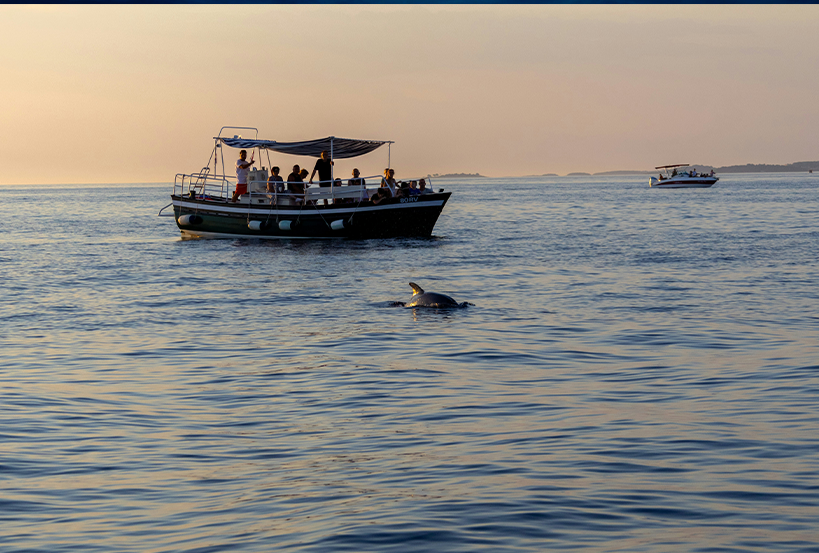
Then a dark back breaks the water.

The dorsal fin follows, travels through the surface and disappears.

Everyone points at once.

A woman reaches for her telephone too late. Two passengers stand and block each other’s view. Someone calls towards the people seated at the back. The child says there were two dolphins, although nobody else is certain.

The older man beside him does not count yet.

He watches the water ahead of the place where the first animal disappeared.

A second fin rises farther from the boat than expected.

Then another.

The captain lowers the engine speed. Conversations stop. People who had been looking at the coast, at the wake or at their screens now face the same direction.

Few animals can reorganise human attention so quickly.

A moment earlier, the water was scenery.

Now it contains an intelligence moving through it.

Yet the dolphins have not entered the Bay of Vlora to create this moment.

They may be travelling, searching for fish, following prey or moving through a route used long before anyone on the boat began watching.

Their appearance is not a performance.

It is the visible edge of a life that continues mostly out of sight.

Every Appearance Begins with a Breath

The dolphin surfaces again.

Its back rises in a smooth curve. The blowhole reaches the air, the dorsal fin follows, and the body returns beneath the surface without a jump or a dramatic splash.

The child had expected something more.

He has seen dolphins in films, almost always leaping beside boats. The animals in front of him seem quieter. They rise, breathe and disappear.

This reveals something simple that human excitement often hides:

Every appearance at the surface begins with the need to breathe.

Dolphins are mammals. They spend their lives in the sea, but they depend entirely on air. They do not breathe automatically in the same way humans do while sleeping. Breathing is part of their conscious rhythm, coordinated with movement and surfacing.

The curve people recognise as graceful is also a precise respiratory act.

The passengers interpret the surfacing as an arrival.

For the dolphin, it is a breath.

In the coastal waters of the Adriatic, the animal most likely to produce this familiar curved back and strong dorsal fin is the common bottlenose dolphin, Tursiops truncatus. Other cetaceans inhabit the wider southern Adriatic and Ionian Sea, particularly in deeper offshore waters, but the bottlenose dolphin is the only cetacean regularly distributed throughout the Adriatic and is particularly capable of using coastal habitats, bays and channels. (Frontiers)

Even then, a distant fin is not enough for certainty.

Light changes the apparent colour of the body. Waves hide its shape. Distance makes size difficult to judge. An observer may see only a small section of the back for less than two seconds.

The child sees a dolphin.

A scientist would want to see the fin again.

A sighting begins with excitement.

Identification begins with restraint.

The Bay the Dolphin Heard First

The people discover the dolphins through sight.

The dolphins have probably discovered the boat through sound.

Before the first fin appeared, the engine was already sending noise and vibration through the water. The propeller, hull and movement of the vessel entered the dolphins’ acoustic environment before anyone on board knew that the animals were nearby.

This reverses the encounter:

People believe the dolphin has entered their view.

From the dolphin’s perspective, the boat may have entered its world first.

Bottlenose dolphins use rapid, high-frequency clicks for echolocation. The sounds travel through the water, strike fish, rocks or other objects, and return as echoes. Dolphins use the information contained in those echoes to investigate their surroundings and locate prey. They also produce whistles and other sounds used in social communication. (Ocean Today)

The passengers look across the surface and see blue water hiding almost everything beneath it.

The dolphin moves through a landscape partly constructed from sound.

A school of fish does not need to be visible in sunlight to be detected. The shape of the seabed, another dolphin and the movement of the boat all contribute to an acoustic world that people above the surface can barely imagine.

For humans, the Bay of Vlora is first a landscape of colour.

For the dolphin, it is also a landscape of echoes.

The older man leans towards the child.

“They knew we were here,” he tells him, “before we knew they were.”

The child looks at the boat differently.

The engine is no longer only the thing carrying them towards Sazan. It is a presence spreading beyond the hull.

Human-generated underwater noise can interrupt communication, affect feeding or movement and cause dolphins to change their behaviour or leave important areas. Unregulated boat traffic can therefore transform an encounter even when nobody intends to harm the animals. (Ocean Noise Strategy)

The captain reduces the engine to its lowest practical level.

For the first time, quietness on the boat feels like part of seeing.
A Voice That Carries Identity

One dolphin surfaces ahead of the others.

Its dorsal fin is taller and more clearly marked. Another animal appears behind it, then turns beneath the surface.

The group does not move in a fixed formation. Individuals separate and return. For a moment, only one fin is visible. Then three animals surface across a wider part of the bay.

Bottlenose dolphins live in flexible social systems. Groups can divide and reform as individuals travel, feed, rest or meet other dolphins.

Their relationships are not maintained only by remaining physically close.

Sound helps them recognise one another.

Individual bottlenose dolphins develop distinctive signature whistles. Experiments have shown that dolphins can extract identity information from the shape of these whistles, even when other features of the caller’s voice are removed. Signature whistles are also exchanged when groups meet at sea. (PMC)

They should not be described carelessly as names in the full human sense.

Language carries meanings, grammar and cultural layers that cannot be assumed from a whistle.

Yet the comparison remains powerful.

The sound communicates something close to:

This is who is calling.

The people on the boat cannot hear the exchange taking place beneath them.

They see backs appearing separately at the surface.

Below, the encounter may contain recognition, contact and information passing between individuals whose lives are tied together in ways that remain invisible from the boat.

The child asks whether the dolphins are speaking.

The older man pauses.

“They are telling each other something,” he says.

It is not a complete scientific answer.

But science has not completed the answer either.

Some discoveries become more interesting when knowledge expands the question instead of closing it.

What One Fin Can Reveal

The woman who missed the first photograph is ready when the largest dolphin surfaces again.

She captures only the dorsal fin.

There is no face, no leap and no shining body above the water.

She looks disappointed.

For a marine researcher, however, it may be the most valuable photograph taken that morning.

Dorsal fins accumulate natural marks during an animal’s life. Small notches, scars and changes along the trailing edge can create a pattern distinctive enough for scientists to recognise an individual dolphin.

The fin becomes an identity document.

Photo-identification is a non-invasive research method. By matching clear photographs taken on different dates, researchers can follow individuals across seasons and years. They can examine movements, survival, social associations, injuries and repeated use of particular coastal areas. (Aquatic Mammals)

This creates another reversal.

The child wants the dolphin’s face.

Science often wants its fin.

A dramatic photograph may attract the most attention.

A plain side view of a dorsal fin may contain more information.

Its value increases when the original image is kept together with the date, approximate location and direction of movement. A photograph without context remains a memory. A photograph with reliable context may become part of a record.

This matters particularly in waters that have not been monitored continuously.

Regional research confirms that bottlenose dolphins regularly inhabit the Adriatic, but detailed information from Albanian waters remains more limited than from several neighbouring parts of the basin. A single photograph cannot fill that gap, but repeated, well-recorded observations can help reveal whether the same animals return and how they use the Albanian coast. (SPA-RAC)

The older man studies the woman’s photograph.

A small notch is visible near the upper part of the fin.

The dolphin is no longer simply one of three animals in the bay.

It is an individual that may have crossed these waters before.

What Brought Them Here

The dolphins continue towards the centre of the bay.

The passengers imagine curiosity.

Perhaps the animals came to inspect the boat. Perhaps they enjoy swimming near people. Perhaps they have recognised the excitement on board.

Human beings naturally place themselves near the centre of an animal encounter.

The more likely explanation is less flattering and more interesting.

The dolphins are following their own needs.

Bottlenose dolphins eat a varied diet that can include fish, squid and crustaceans. They may search alone, cooperate with other dolphins or adapt their feeding methods to local habitats and opportunities. (NOAA Fisheries)

The three fins visible at the surface may therefore be the final link in a much longer ecological chain.

Sunlight supports microscopic plant life.

Small organisms feed in the water.

Small fish follow them.

Larger fish follow the smaller fish.

The dolphins follow the opportunities created by all of them.

What looks like a sudden appearance may be the result of processes that began far below the level of human sight.

This is why dolphins can help scientists understand marine ecosystems.

As long-lived predators that use broad areas and feed at different levels of the food web, bottlenose dolphins can accumulate evidence of changes in prey, pollution, disease and human pressure. Researchers therefore describe them as marine sentinel species.

But the meaning of a sighting must remain precise.

The presence of dolphins does not certify that the sea is healthy.

It means the animals found a reason to be there.

Those are not the same statement.

Dolphins are intelligent and adaptable. They can continue using coastlines affected by boat traffic, pollution, fishing pressure and habitat change. In parts of the Adriatic, bottlenose dolphins regularly interact with trawlers and other fishing activity, demonstrating their ability to exploit human-created feeding opportunities as well as natural ones. (ScienceDirect)

Their adaptability can help them survive.

It can also hide the deterioration of the environment around them.

One dolphin crossing the bay reveals that life is present.

It cannot reveal whether prey populations are stable, whether the same dolphins return regularly, whether calves survive or whether the animals are increasingly forced to change their feeding behaviour.

A photograph records a moment.

Understanding the sea requires a pattern.

The Smaller Fin

The next surfacing changes the mood on the boat.

A large dolphin rises first.

A smaller body appears immediately behind and slightly to one side.

This time, the child’s count is correct.

There are at least three dolphins, including a calf.

Young bottlenose dolphins often swim beside their mothers in a position that allows them to remain close while breathing and travelling. The mother normally surfaces first, while the calf follows just behind and to the side. The position may also reduce the calf’s effort by allowing it to benefit from the movement of water created by the mother’s body. (NOAA Fisheries)

The passengers become louder.

Someone calls for the boat to move closer.

The captain does not.

The calf changes the emotional meaning of the sighting. People who were excited by the speed and intelligence of the adults become protective. The smaller fin makes the group appear more vulnerable.

Yet vulnerability is not the same as helplessness.

The calf is already learning how to live in a complex coastal sea.

It is learning when to surface, how to remain beside its mother, where to travel and how to recognise the sounds around it. It may learn feeding methods and routes through long observation of older dolphins.

The boat is now part of that environment.

Its speed, direction and noise become part of what the young animal experiences.

The mother does not need the passengers to obtain a closer photograph of her calf.

She needs enough space to continue moving naturally.

The older man places a hand lightly on the child’s shoulder as both dolphins surface again.

This time, the child does not ask the captain to follow.

When Watching Becomes Chasing

A second boat appears farther across the bay.

Its course changes when the people on board notice the dolphins.

This is the point at which admiration can become pressure.

One vessel follows because its passengers want another photograph. A second approaches because it sees the first. A third may arrive because the dolphins have become a moving attraction.

The animals gradually find themselves surrounded by human attention.

The transformation can happen without anyone making a deliberate decision to chase them.

It begins with one more minute.

One closer photograph.

One attempt to predict where the dolphins will rise.

Responsible observation requires the opposite instinct.

A careful captain reduces speed before approaching, travels smoothly, avoids cutting across the dolphins’ route and never separates a mother from her calf or one animal from the rest of its group. The boat should not surround, pursue or repeatedly reposition around the dolphins.

Most importantly, the animals must remain free to leave.

ACCOBAMS promotes regulated, environmentally responsible cetacean watching because poorly managed approaches can disturb natural behaviour and turn repeated wildlife encounters into a source of pressure. (accobams.org)

The best encounter is one the dolphin is free to end.

This principle does not weaken the visitor’s experience.

It makes it more honest.

A dolphin that remains because its route has not been blocked is still behaving as a wild animal. A dolphin forced to turn, dive repeatedly or escape a group of boats is no longer offering an encounter.

It is responding to disturbance.

The captain places the engine in neutral.

The second vessel slows before reaching them.

For several minutes, neither boat moves closer.

The bay is allowed to decide what happens next.

The Sea We Have Not Fully Recorded

One dolphin surfaces near the edge of the boat’s wake.

The others appear farther ahead.

Their route seems clear for a few seconds and then becomes impossible to follow.

They may be crossing the bay.

They may be feeding.

They may remain for an hour or continue towards the deeper water beyond Sazan and Karaburun.

Nobody on board knows.

This uncertainty reflects a larger absence in the scientific record.

The Adriatic has been surveyed at regional scale, and bottlenose dolphins are recognised as its most consistently distributed cetacean. Yet the detailed lives of dolphins using Albanian waters remain less documented through long-term local monitoring and photo-identification than populations in several better-studied parts of the Adriatic. (Frontiers)

The honest story is not that dolphins are absent from Albania.

It is that their movements have not yet been followed closely enough.

Does the dolphin with the notched fin return to the Bay of Vlora every year?

Does it travel along the Karaburun Peninsula?

Does it cross regularly between the Adriatic and Ionian Sea?

Are the same mothers returning with new calves?

Does summer boat traffic change when or where they enter the bay?

One sighting cannot answer these questions.

Neither can ten photographs taken on the same morning.

Research requires repetition: the same coastline observed across seasons, the same fins compared over years and the same behaviours recorded in changing conditions.

The child asks the older man whether these dolphins live in the bay.

“Perhaps they use it,” he answers.

The difference matters.

To live somewhere suggests a boundary.

A dolphin’s territory may be defined instead by routes, prey, relationships and remembered places spread across a sea that humans have divided into bays, municipalities and national waters.

The animals move through those divisions without seeing them.

The Point Where They Disappear

The largest dolphin surfaces once more.

The notched fin remains visible for a moment against the darker water.

The second adult follows.

The calf appears last.

Then the surface closes behind them.

People continue looking towards the place where the dolphins disappeared, although there is nothing left to see.

The woman checks her photographs.

The child waits for another breath.

The older man looks farther towards the open water, not because he can see the dolphins, but because he understands that their journey continues beyond the encounter.

“Will they come back?” the child asks.

“Perhaps.”

The bay offers no schedule.

That uncertainty is part of what separates wildlife from entertainment.

The dolphins may return the next morning, several months later or when no boat is present to record them. They may cross another part of the bay without being noticed.

Their lives do not become incomplete when people fail to see them.

The human sighting is incomplete because people see so little.

Conclusion

When dolphins enter the Bay of Vlora, they seem to arrive suddenly.

In reality, the event begins before the first fin appears.

It begins with prey moving through the water, with sound travelling ahead of the boat and with routes understood by animals whose knowledge of the coast does not need to be written on a map.

The passengers see a breath, a back and a dorsal fin.

Science sees questions of identity, communication, food, movement, reproduction and pressure from human activity.

The dolphin reveals that the bay is connected to a larger living sea.

Its presence shows that the animal found a reason to enter.

It does not, by itself, prove that the entire ecosystem is healthy.

For that, the bay must be watched over time. Individual dolphins must be recognised. Their calves, movements, injuries, feeding behaviour and responses to increasing human activity must become part of a continuous record.

At the beginning of the journey, the child believed that seeing the dolphin was the discovery.

By the time the boat turns back towards Vlora, he understands something else.

The discovery is how much remains unseen.

A dorsal fin crosses the surface for two seconds.

Beneath it moves an animal with a history, relationships, a voice, a route and reasons for entering the bay that may have nothing to do with the people watching.

The dolphin does not make the sea alive.

It allows human beings to notice that it already was.

Editorial Note

This article is part of the MAREOGRAPH Editorial Project, an independent editorial initiative founded and developed by Valza Boutique Hotel to document the landscapes, history, biodiversity, culture and living systems of Vlora and the Albanian Mediterranean through research-based storytelling.

Experience the Place

Dolphins may occasionally be encountered in the Bay of Vlora and in the waters around Sazan Island and the Karaburun Peninsula, but their appearance should never be promised or aggressively pursued. Responsible boats reduce speed, maintain space, avoid blocking the animals’ direction and allow every encounter to end according to the dolphins’ own movement.

Valza Boutique Hotel overlooks the wider marine landscape connecting Vlora with Sazan, Karaburun and the open Mediterranean, while Eden by Valza offers a front-row perspective across the waters where the visible life of the bay may appear for only a few seconds before returning beneath the surface.

www.valza.al