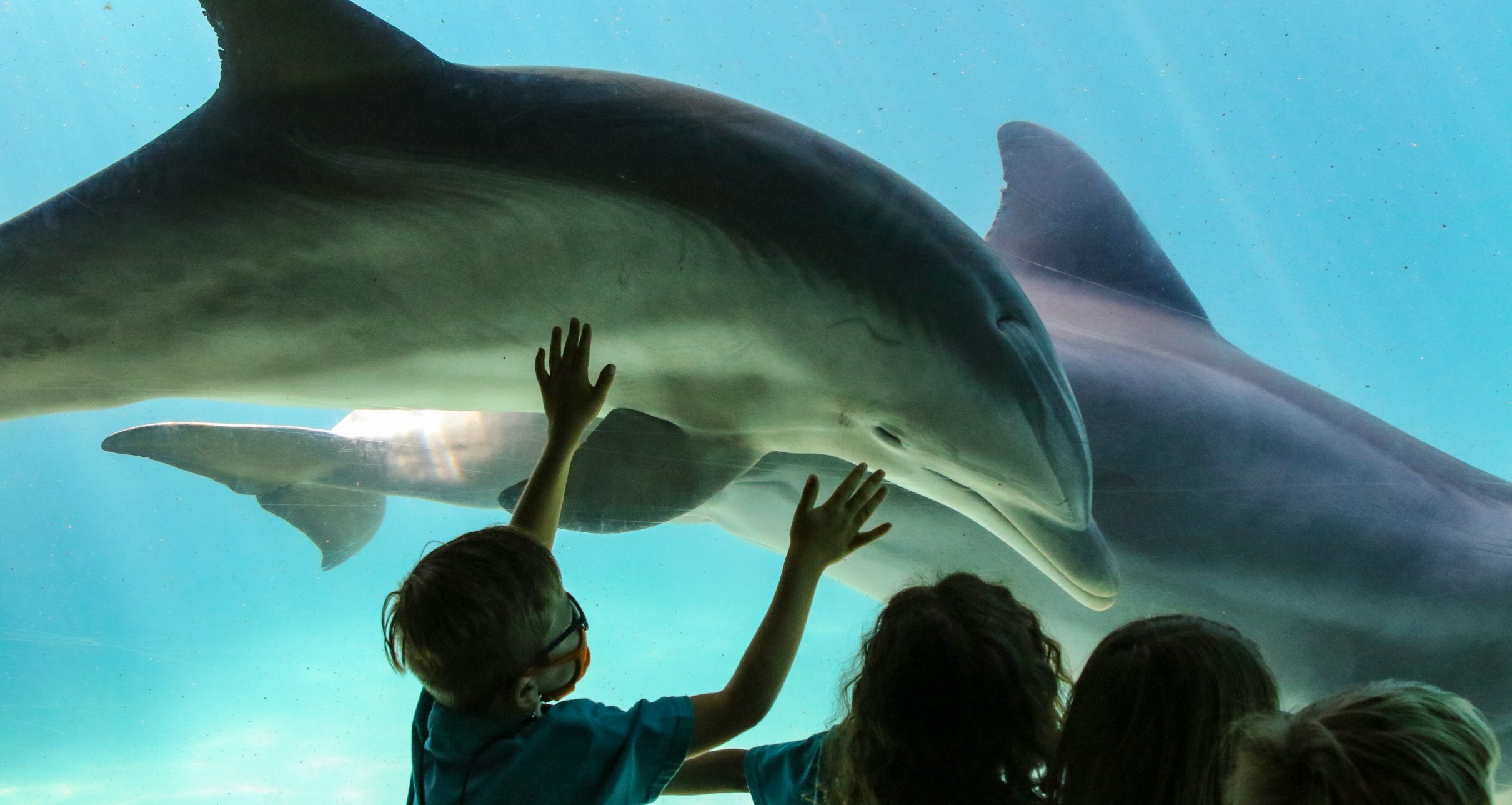
The child sees the breath before he sees the dolphin.
It rises briefly above the surface, a small burst of air and spray that disappears before anyone else turns towards it.
“There,” he says.
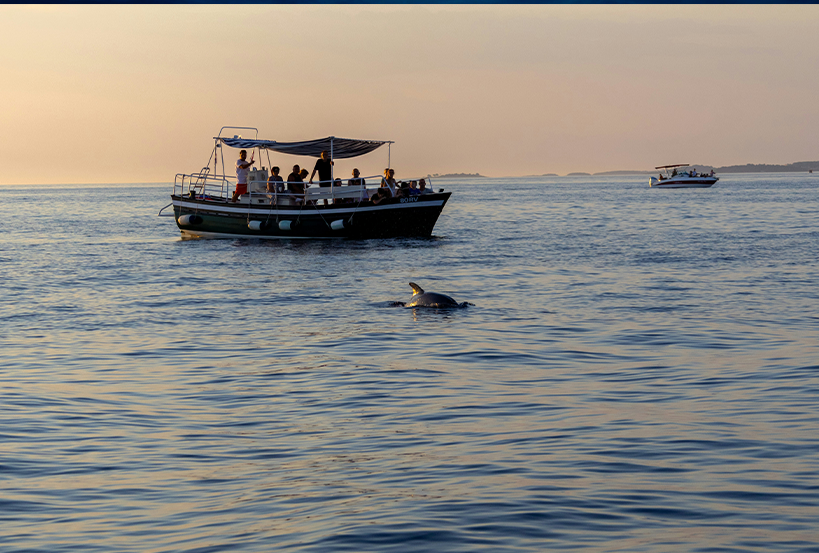
The boat has left the busier waterfront behind. The buildings of Vlora are becoming smaller, Sazan lies ahead in the summer haze, and the long body of Karaburun holds the southern edge of the bay.
For several seconds, nothing happens.
Then a dark back breaks the water.
The dorsal fin follows, travels through the surface and disappears.
Everyone points at once.
A woman reaches for her telephone too late. Two passengers stand and block each other’s view. Someone calls towards the people seated at the back. The child says there were two dolphins, although nobody else is certain.
The older man beside him does not count yet.
He watches the water ahead of the place where the first animal disappeared.
A second fin rises farther from the boat than expected.
Then another.
The captain lowers the engine speed. Conversations stop. People who had been looking at the coast, at the wake or at their screens now face the same direction.
Few animals can reorganise human attention so quickly.
A moment earlier, the water was scenery.
Now it contains an intelligence moving through it.
Yet the dolphins have not entered the Bay of Vlora to create this moment.
They may be travelling, searching for fish, following prey or moving through a route used long before anyone on the boat began watching.
Their appearance is not a performance.
It is the visible edge of a life that continues mostly out of sight.
Every Appearance Begins with a Breath
The dolphin surfaces again.
Its back rises in a smooth curve. The blowhole reaches the air, the dorsal fin follows, and the body returns beneath the surface without a jump or a dramatic splash.
The child had expected something more.
He has seen dolphins in films, almost always leaping beside boats. The animals in front of him seem quieter. They rise, breathe and disappear.
This reveals something simple that human excitement often hides:
Every appearance at the surface begins with the need to breathe.
Dolphins are mammals. They spend their lives in the sea, but they depend entirely on air. They do not breathe automatically in the same way humans do while sleeping. Breathing is part of their conscious rhythm, coordinated with movement and surfacing.
The curve people recognise as graceful is also a precise respiratory act.
The passengers interpret the surfacing as an arrival.
For the dolphin, it is a breath.
In the coastal waters of the Adriatic, the animal most likely to produce this familiar curved back and strong dorsal fin is the common bottlenose dolphin, Tursiops truncatus. Other cetaceans inhabit the wider southern Adriatic and Ionian Sea, particularly in deeper offshore waters, but the bottlenose dolphin is the only cetacean regularly distributed throughout the Adriatic and is particularly capable of using coastal habitats, bays and channels. (Frontiers)
Even then, a distant fin is not enough for certainty.
Light changes the apparent colour of the body. Waves hide its shape. Distance makes size difficult to judge. An observer may see only a small section of the back for less than two seconds.
The child sees a dolphin.
A scientist would want to see the fin again.
A sighting begins with excitement.
Identification begins with restraint.
The Bay the Dolphin Heard First
The people discover the dolphins through sight.
The dolphins have probably discovered the boat through sound.
Before the first fin appeared, the engine was already sending noise and vibration through the water. The propeller, hull and movement of the vessel entered the dolphins’ acoustic environment before anyone on board knew that the animals were nearby.
This reverses the encounter:
People believe the dolphin has entered their view.
From the dolphin’s perspective, the boat may have entered its world first.
Bottlenose dolphins use rapid, high-frequency clicks for echolocation. The sounds travel through the water, strike fish, rocks or other objects, and return as echoes. Dolphins use the information contained in those echoes to investigate their surroundings and locate prey. They also produce whistles and other sounds used in social communication. (Ocean Today)
The passengers look across the surface and see blue water hiding almost everything beneath it.
The dolphin moves through a landscape partly constructed from sound.
A school of fish does not need to be visible in sunlight to be detected. The shape of the seabed, another dolphin and the movement of the boat all contribute to an acoustic world that people above the surface can barely imagine.
For humans, the Bay of Vlora is first a landscape of colour.
For the dolphin, it is also a landscape of echoes.
The older man leans towards the child.
“They knew we were here,” he tells him, “before we knew they were.”
The child looks at the boat differently.
The engine is no longer only the thing carrying them towards Sazan. It is a presence spreading beyond the hull.
Human-generated underwater noise can interrupt communication, affect feeding or movement and cause dolphins to change their behaviour or leave important areas. Unregulated boat traffic can therefore transform an encounter even when nobody intends to harm the animals. (Ocean Noise Strategy)
The captain reduces the engine to its lowest practical level.
For the first time, quietness on the boat feels like part of seeing.