A Meadow That Stores Time
The hidden structure beneath Posidonia does more than stabilise the seabed.
It also stores carbon.
Like plants on land, seagrasses absorb carbon dioxide as they grow. Some of that carbon becomes part of the leaves, roots and rhizomes. Additional organic material settles into the sediment beneath the meadow, where decomposition can be very slow.
This is often described as blue carbon: carbon captured and retained by marine and coastal ecosystems.
The idea becomes easier to understand when connected to a real place.
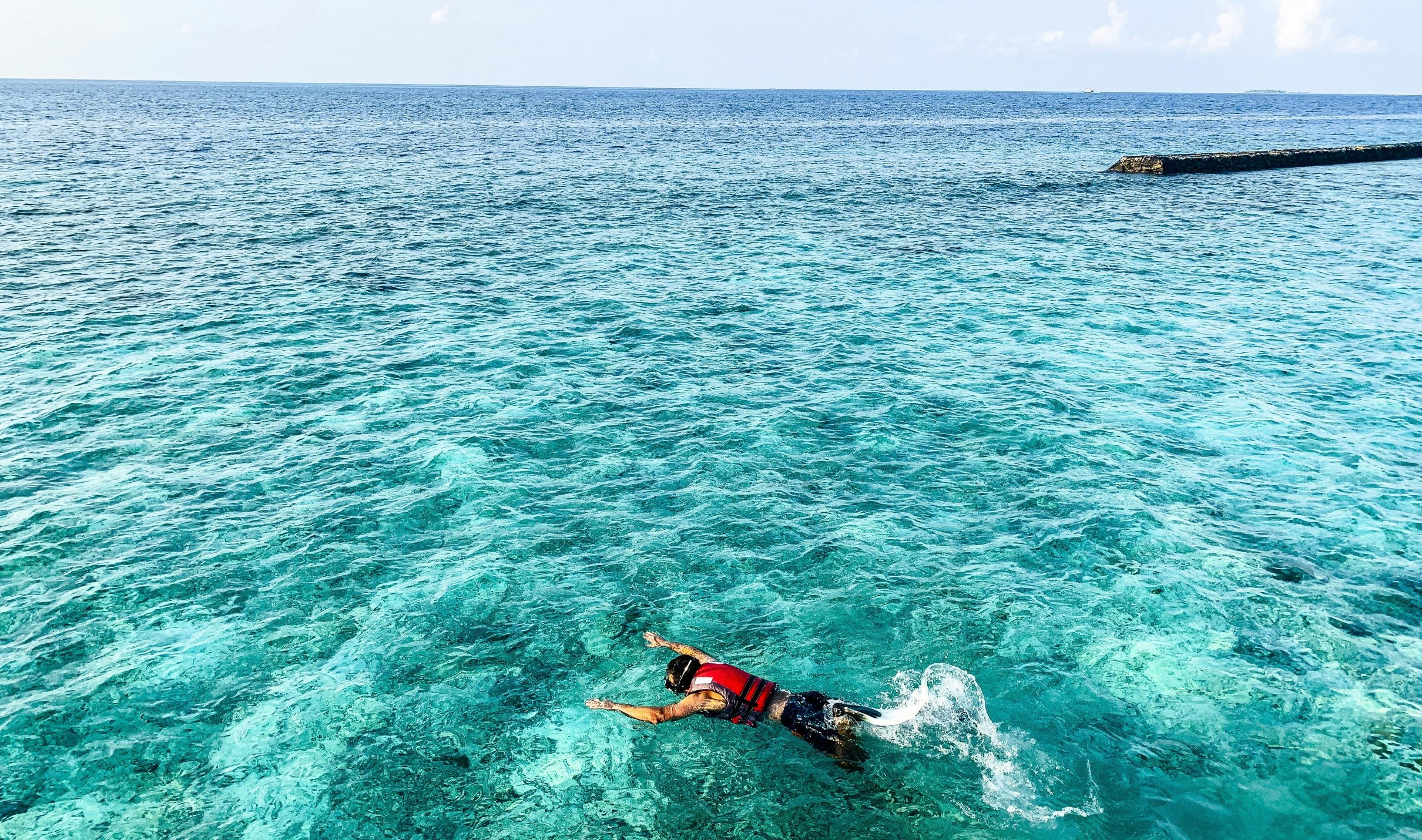
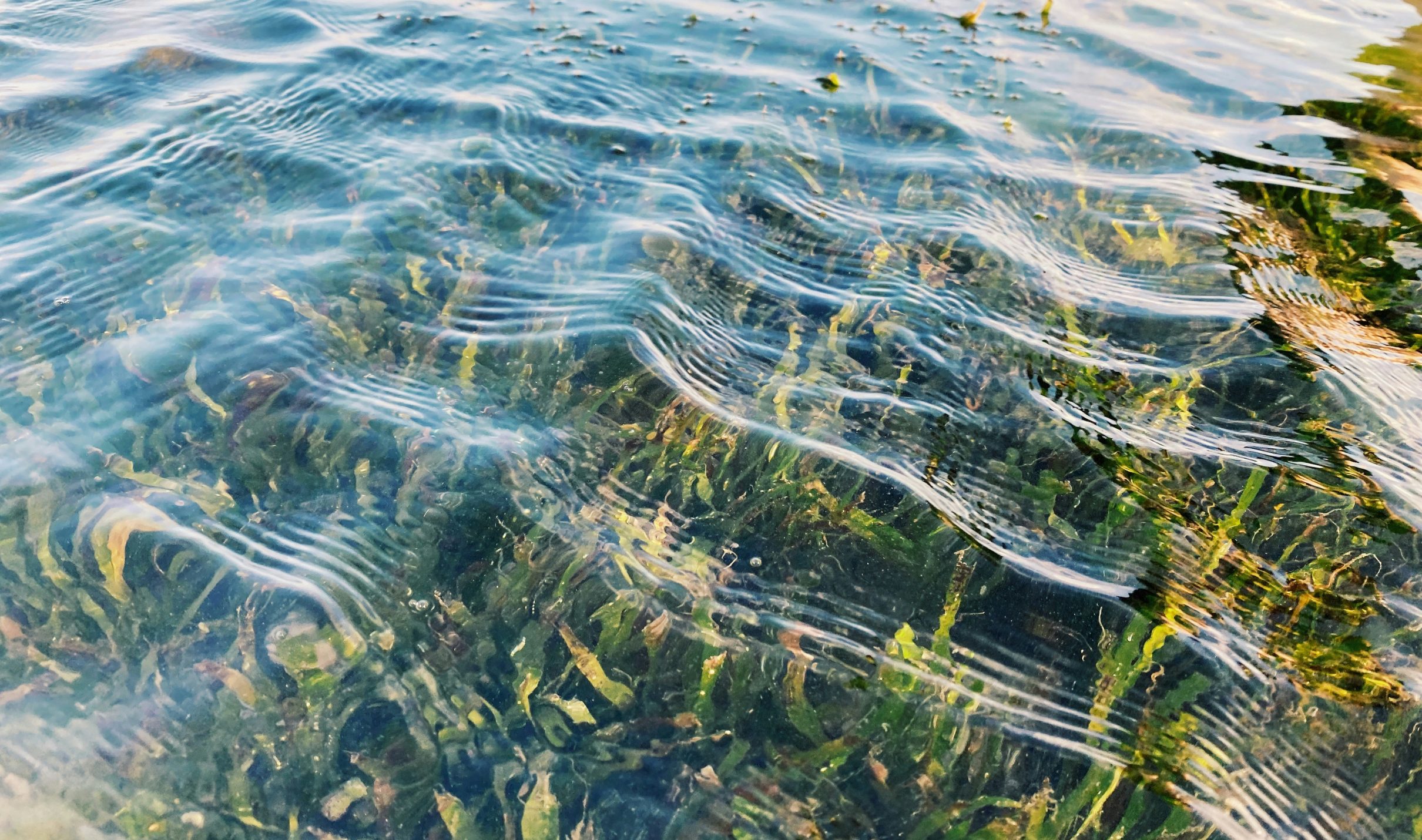
A swimmer floats above a dark meadow near the southern shore of the Bay of Vlora. Beneath the moving leaves, recent plant material has become a layer. Beneath that layer, older material remains buried. The landscape is not only alive in the present; it is holding part of its own past.
The meadow becomes an archive.
Its leaves respond to the water passing through them now. Its roots hold the seabed together over years. Its buried layers preserve material from a much longer history.
Few visitors imagine this when they see a dark shape beneath the surface.
They are looking at a living plant, a coastal defence and a storehouse of time in the same place.
The Moment the Meadow Becomes Personal
The most memorable encounter may happen in water shallow enough to stand in.
A child following a fish reaches the edge of the vegetation and stops. The fish disappears between the leaves. For several seconds, there is only movement from the current. Then it reappears farther away, joined by two smaller fish that had remained completely hidden.
The child lifts their face from the water and points excitedly towards a place that, from above, still looks like nothing more than a dark patch.
This is how understanding often begins.
Not with a scientific definition, but with the discovery that something apparently empty was alive.
Adults experience a quieter version of the same moment. Once the meadow is recognised as habitat, it becomes difficult to swim above it carelessly. Fins rise slightly. Movements become more controlled. The urge to stand on the seabed disappears.
Knowledge changes behaviour before anyone asks it to.
People rarely protect what they consider empty. Once the darkness becomes a forest, indifference becomes much harder.
A Forest That Can Disappear Silently
The loss of a terrestrial forest is visible.
Trees fall. Bare ground opens. The change can be seen from a road, a hill or a satellite image.
An underwater meadow can decline almost unnoticed.
The surface remains blue. Boats continue crossing the bay. Swimmers enter the water without realising that vegetation once occupied a larger area beneath them. Unless someone remembers the earlier landscape or studies the seabed closely, disappearance can resemble ordinary emptiness.
That silence makes protection more difficult.
Across the Mediterranean, Posidonia faces pressure from coastal construction, pollution, destructive fishing practices, warming seas, invasive species and repeated anchoring. Not every meadow responds in the same way, and not every decline has a single cause. The central problem is cumulative pressure: several disturbances acting repeatedly on a plant that recovers very slowly.
The meadow does not need to vanish completely before its functions weaken. Fragmentation creates exposed edges. Sediment becomes easier to move. Animals lose continuous shelter, and the habitat becomes less capable of resisting further disturbance.
A living landscape can therefore begin collapsing while much of it still appears present.
How to Enter an Underwater Forest
The most responsible way to experience Posidonia is also the most rewarding.
Do not swim through it as though it were an obstacle. Float above the edge and watch how the vegetation meets sand or rock. Avoid standing on the leaves, particularly in shallow water, and keep fins high enough not to strike the seabed. Do not pull plants or search beneath them with your hands.
The objective is not to enter every hiding place.
It is to allow the meadow to reveal movement on its own.
Morning light often makes the boundary easier to read. Pale sand reflects more light, while the vegetation remains darker, creating a clear line where fish move between shelter and open water. From a respectful distance, the meadow’s rhythm becomes visible: leaves bending together, shadows changing and animals crossing openings that exist only for a few seconds.
The experience requires no specialised knowledge.
Only a change in expectation.
Do not look for constant spectacle. Look for relationships.
Notice how a fish remains close to shelter. Notice how the water appears calmer inside the vegetation. Notice how a detached leaf travels towards the coast, beginning another stage of the same natural process.
The more carefully the meadow is observed, the less ordinary it becomes.
The Beach Seen from Below
Most visitors understand a beach from land.
They notice the colour of the water, the warmth of the stones and the distance to the horizon. Yet the beach also has an underwater foundation, and Posidonia is often part of it.
The meadow slows water close to the seabed. Its underground structure helps bind sediment. Detached leaves gather along the shore. Fish use its edges. Carbon accumulates beneath it. Each function appears separate until the system is seen as a whole.
Then the coastline begins to look less like a line and more like a relationship.
The forest below supports the beach above. The beach receives the forest’s leaves. Water moves constantly between them.
The distinction between land and sea becomes difficult to maintain because each is helping shape the other.
This may be the article’s most important idea:
The Mediterranean coast does not end where the water begins.
Its living systems cross that boundary constantly.
Conclusion
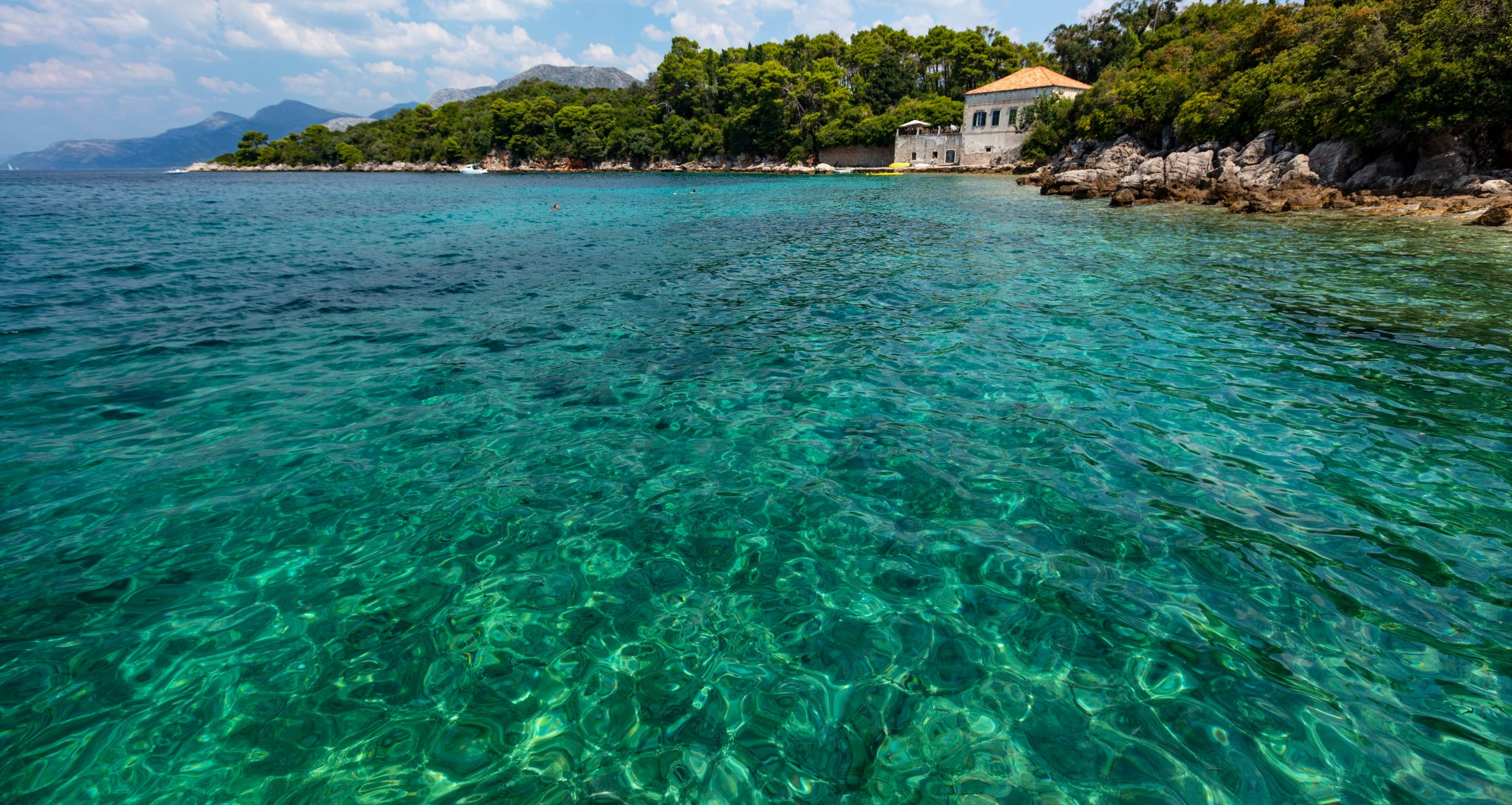
The next time a dark meadow appears beneath the clear waters of the Bay of Vlora, it may no longer seem mysterious or uninviting.
You will know that the leaves belong to a flowering plant found only in the Mediterranean. You will know that beneath them lies an older architecture of roots, rhizomes and trapped sediment. You will understand that fish use the meadow as shelter, that the coastline benefits from its presence and that even the brown leaves resting on the beach may still be protecting the shore.
The darkness will have acquired meaning.
That is what knowledge does to a landscape.
It does not make the place more beautiful by changing it. It makes the beauty harder to overlook.
Visitors often arrive in Vlora searching for transparent water, pale beaches and uninterrupted blue. Yet one of the bay’s greatest natural treasures is the dark shape many swimmers instinctively avoid.
The underwater forest does not ask to be admired.
It works quietly beneath the surface, holding sediment, sheltering life, storing time and protecting a coast that may never realise how much it owes to the meadow below.
Editorial Note
This article is part of the MAREOGRAPH Editorial Project, an independent editorial initiative founded and developed by Valza Boutique Hotel to document the landscapes, history, biodiversity, culture and living systems of Vlora and the Albanian Mediterranean through research-based storytelling.
Experience the Place
The transparent shallows along the southern Bay of Vlora offer opportunities to recognise these underwater meadows and observe their edges responsibly. Valza Boutique Hotel provides a thoughtful base near this coastline, while Eden by Valza overlooks the same bay whose beaches, habitats and changing colours remain connected beneath the surface.
www.valza.al