
Why the Waters of the Bay of Vlora Are So Exceptionally
Clear
You have probably looked through glass thousands of times without thinking about it.
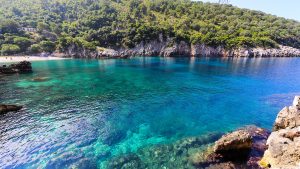
The remarkable thing about the Bay of Vlora is that, on the clearest summer mornings, the sea
begins behaving in almost exactly the same way.
It almost disappears.
A small boat lies anchored a short distance from the shore. Every rock beneath it is perfectly
visible. Its shadow rests sharply on the seabed, while the hull appears suspended in mid-air rather
than floating on water. Instinctively, your brain tells you the bottom must be only a metre or two
below the surface. Then you dive in and discover it is far deeper than you imagined.
Nothing is wrong with your eyes.
You are witnessing one of the Mediterranean’s most remarkable combinations of natural clarity,
sunlight and optical physics.
Most visitors simply describe the water as crystal clear.
Scientists could spend hours explaining suspended particles, wavelengths of light, marine
ecology and underwater optics.
Both descriptions are correct.
Neither tells the whole story.
The extraordinary transparency of the Bay of Vlora is not created by a single phenomenon. It is
the result of an entire landscape working together. Light, geology, marine biology, coastal
currents and healthy underwater ecosystems combine so precisely that the sea itself almost
vanishes, revealing everything beneath it.
Perhaps that is why people remember these waters so vividly.
They do not remember the water.
They remember what the water allowed them to see.
The First Surprise Happens Before You Even Swim
Ask almost anyone who has snorkelled in the Bay of Vlora for the first time what surprised them
most.
Very few will mention fish.
Most will say exactly the same thing.
“I couldn’t believe how far away the bottom actually was.”
Crystal-clear water quietly confuses the human brain.
Normally, tiny suspended particles soften outlines and gradually hide the seabed as depth
increases. Our eyes naturally use that fading image to estimate distance.
Here, those familiar visual clues almost disappear.
The rocks remain perfectly sharp.
Shadows stay dark.
The seabed seems close enough to touch.
Only when you dive do you realise it is still several metres below.
Scientists describe this as the combined effect of exceptional underwater visibility and light
refraction. As light passes from air into water it bends, making objects appear roughly twenty-
five percent closer than they really are.
For visitors, however, the explanation usually comes later.
The first reaction is always the same.
Wonder.
It feels less like swimming through water.
More like floating through transparent air.
Nature’s Underwater Garden
The remarkable clarity of the Bay of Vlora is not simply the absence of suspended particles.
It is also the presence of life.
Beneath the surface grow extensive meadows of Posidonia oceanica, one of the Mediterranean’s
most important marine plants. Although many visitors mistake it for seaweed, Posidonia is
actually a flowering plant that has evolved to live entirely underwater. Some of its meadows are
thought to be thousands of years old, making them among the oldest living ecosystems on Earth.
Their importance is difficult to overstate.
The long leaves gently slow underwater currents, allowing fine particles to settle onto the seabed
instead of remaining suspended in the water. Their roots anchor marine sediments in place,
reducing the amount of material that waves can lift back into the sea. They also produce oxygen,
absorb carbon and provide shelter for hundreds of species that spend part or all of their lives
within these underwater forests.
The clearer the water becomes, the healthier these meadows remain.
The healthier the meadows remain, the clearer the water becomes.
It is a remarkable natural partnership that has been quietly maintaining itself for centuries.
A Snorkel Changes Everything
Many of the world’s famous marine destinations require diving equipment before visitors can
truly appreciate what lies beneath the surface.
The Bay of Vlora asks for something much simpler.
A mask.
A snorkel.
And a little curiosity.
On calm mornings, when the sea becomes almost perfectly still, even inexperienced swimmers
can explore an underwater landscape that feels surprisingly close. Shafts of sunlight move slowly
across pale limestone while schools of seabream glide beneath them like flashes of polished
silver. Colourful wrasse weave effortlessly between submerged rocks, sea anemones sway gently
with invisible currents and tiny transparent shrimp suddenly appear where, only seconds before,
you thought there was nothing at all.
The slower you move, the more the sea begins rewarding your patience.
Many visitors finish their holiday wishing they had packed a snorkel.
Few places reveal so much with so little effort.
The Fisherman Reads a Different Sea
Ask an experienced fisherman when the water will be at its clearest and he is unlikely to open a
weather application.
Instead, he watches the wind.
Several calm days usually allow the sea to settle. Fine particles slowly sink back to the seabed,
colours become brighter and visibility improves dramatically. Before underwater cameras or
marine science explained these processes, local fishermen already understood them through
observation alone.
“The sea will be like glass tomorrow.”
It is a prediction you still hear along the coast.
Not because someone measured it with instruments.
Because someone has watched the sea for decades.
Interestingly, exceptionally clear water also changes the behaviour of fish. Visibility improves
for everything beneath the surface, not only for people. Fish become more cautious because they
can detect danger from greater distances, forcing fishermen to adapt their techniques accordingly.
The same clarity admired by visitors becomes valuable information for those who make their
living from the sea.
One person sees beauty.
The other sees knowledge.
Both are looking at exactly the same water.
The Visitors That Tell the Real Story
Every now and then, someone standing on the beach points towards the open sea.
“Dolphins”
The word spreads quickly.
People stop swimming, children run to the shoreline and dozens of eyes begin searching the
horizon.
Their appearance usually lasts only a few minutes.
Then they disappear again.
Many people think dolphins choose these waters because they are beautiful.
Nature has a different explanation.
Dolphins follow food, not scenery.
Where healthy currents bring oxygen and nutrients, fish gather. Where fish gather, dolphins
eventually arrive. Their brief appearance is one of the clearest signs that the marine ecosystem
beneath the surface continues functioning exactly as it should.
Sometimes the most beautiful thing about clear water is not what you can see.
It is what clear water makes possible.
Even an octopus hiding among the limestone depends on the same healthy environment. Most
swimmers pass directly above one without ever noticing. But on exceptionally calm mornings,
when the light enters the sea at just the right angle, a patient snorkeller may spot two curious
eyes watching quietly from a rocky crevice.
The sea does not reveal all of its secrets immediately.
It rewards those willing to slow down.
The Sea Changes Every Hour
Spend an entire day beside the Bay of Vlora and one thing quickly becomes clear.
The sea is never exactly the same twice.
Early in the morning, before the afternoon breeze begins to ripple the surface, the water often
resembles polished glass. Light enters almost vertically, illuminating the seabed with astonishing
precision. Every stone casts a sharp shadow. Every movement of a fish becomes visible from the
shore.
By midday, the colours intensify. Shallow limestone shelves glow turquoise, deeper channels
become sapphire blue and underwater meadows soften the landscape with shades of emerald.
Towards sunset, warm Mediterranean light transforms everything once again, replacing bright
blues with gold, violet and deep cobalt.
Photographers know this well.
They are not simply chasing sunrise or sunset.
They are chasing transparency.
Some mornings, after several calm nights, visibility becomes so extraordinary that even
experienced photographers return to locations they have photographed dozens of times. The
landscape has not changed.
The sea has simply decided to reveal more of it.
Small Wonders Hidden Beneath the Surface
Children are often the first to discover just how unusual these waters really are.
Many instinctively throw a small white pebble into the sea and compete to see who can follow it
with their eyes for the longest time before it finally disappears into the blue. Adults usually smile
at the game.
Then they quietly try it themselves.
Look carefully beneath the surface and you begin noticing details that many swimmers pass
without ever seeing.
A beautifully patterned spiral shell resting undisturbed between two rocks.
An orange Mediterranean sea star slowly crossing pale limestone, so perfectly shaped that it
almost appears artificial until it begins to move.
A tiny hermit crab carrying a borrowed shell several times larger than itself.
Even the sunlight becomes part of the landscape. As gentle waves pass overhead, ribbons of light
dance across the seabed, constantly changing shape like reflections inside an ancient cathedral.
These are not rare events.
They happen every day.
The only difference is whether someone pauses long enough to notice them.
The Sea Is Telling You a Story
Perhaps the greatest mistake we make is believing that clear water is simply beautiful.
In reality, it is informative.
Transparency tells us that marine ecosystems remain healthy. It tells us that underwater meadows
continue stabilising the seabed, that currents are renewing the Adriatic through the Strait of
Otranto and that countless natural processes are working together with extraordinary precision.
The sea is constantly communicating.
Most of us simply do not know its language.
Once you begin understanding these signs, every swim becomes different. The changing colours
are no longer just colours. They become clues. The movement of fish becomes evidence. Even
the appearance of dolphins offshore becomes part of a much larger story unfolding beneath the
surface.
The coastline has not changed.
Your understanding has.
Conclusion
The next time you stand beside the Bay of Vlora and wonder why the water seems almost
invisible, remember that you are not looking at a single natural wonder.
You are looking at sunlight travelling through one of the Mediterranean’s healthiest coastal
ecosystems. You are looking at underwater forests quietly holding the seabed in place, marine
currents renewing an entire sea and millions of years of natural history working together so
perfectly that the water itself almost disappears.
Perhaps that is the greatest illusion of all.
Visitors arrive believing they have come to admire the sea.
They leave remembering everything the sea allowed them to see.
The water was never trying to attract attention.
It was quietly revealing a world beneath it.
And perhaps that is exactly how nature intended it.
Editorial Note
This article is part of the MAREOGRAPH Editorial Project, an independent editorial initiative
founded and developed by Valza Boutique Hotel to document the landscapes, history, geology,
biodiversity and living systems of the Albanian Mediterranean through research-based
storytelling.
Experience the Place
The clearest way to understand the Bay of Vlora is to step into it. Spend an early morning
snorkelling along the rocky shores of Uji i Ftohtë or Radhimë, watch the changing colours from
the beaches of the bay and discover how much the sea reveals when conditions are calm. From
Valza Boutique Hotel, these crystal-clear waters are only minutes away, while Eden by Valza
offers a front-row view of the same coastline as sunlight transforms the sea from turquoise to
sapphire and finally to gold before sunset.


