The Temperature Inside the Sand
The child asks whether the turtle is male or female.
Nobody on the boat can answer.
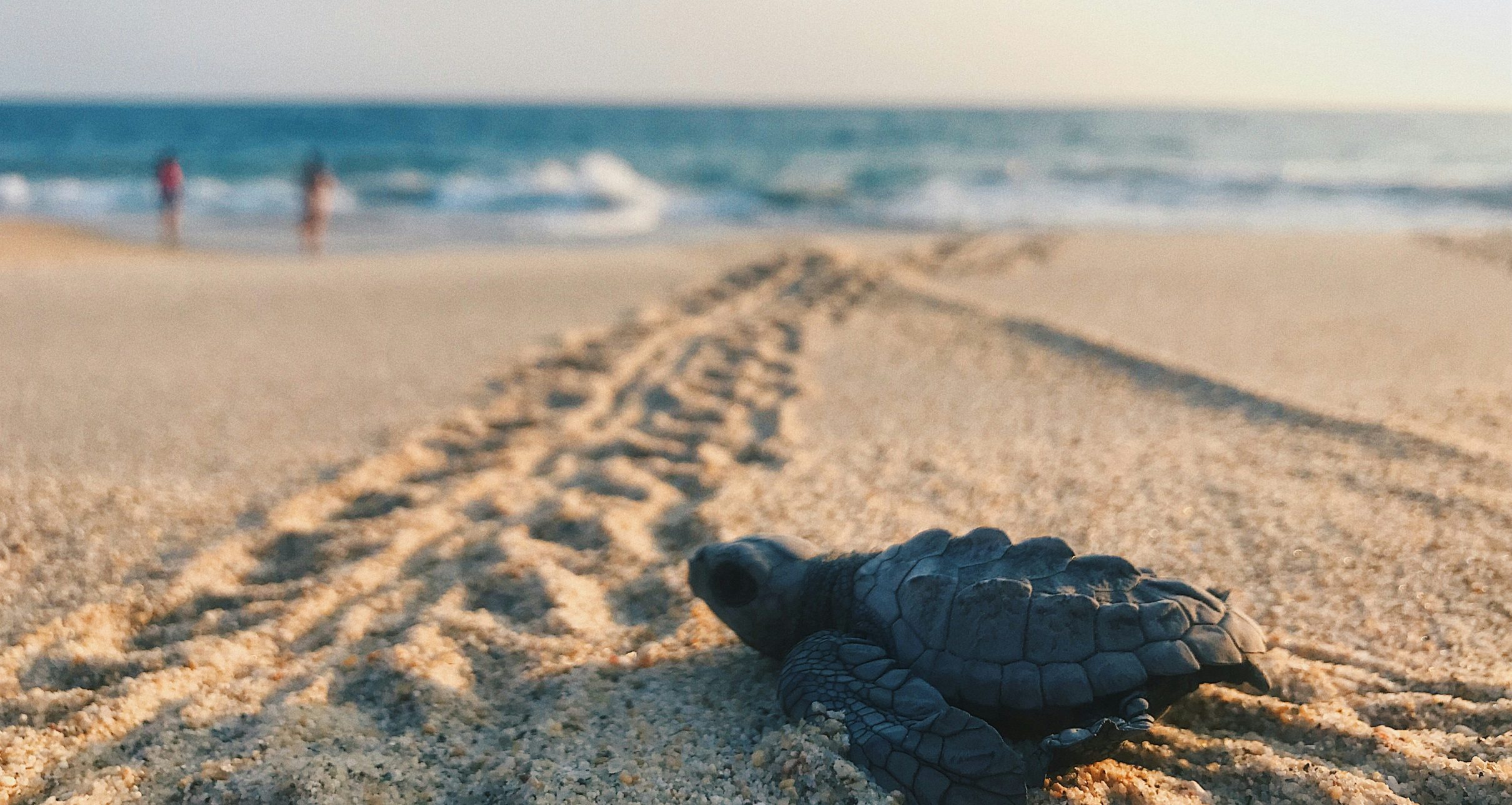
In young loggerheads, sex cannot usually be identified from appearance. But the decision was made long before the turtle became large enough to cross the Bay of Vlora.
It was made inside the nest.
Sea turtles have temperature-dependent sex determination. The temperature surrounding the eggs during a critical stage of development influences whether hatchlings become male or female.
Warmer nests generally produce more females.
Cooler nests generally produce more males.
The sand is therefore not merely protecting the eggs.
It is participating in the future shape of the population.
Shade, rainfall, nest depth, sand colour and local weather can all influence temperature. A small difference between one section of beach and another can alter the balance of hatchlings emerging from it.
Climate change adds pressure to this already delicate system.
Rising temperatures can produce increasingly female-biased nests. Extreme heat can reduce successful development. Sea-level rise and stronger erosion can remove nesting areas or allow seawater to reach the eggs.
The turtle beside the boat appears almost timeless.
Its future may depend on changes measured across only a few summers.
This is one of the central paradoxes of sea-turtle conservation:
An animal whose life unfolds over many decades must adapt to coastlines changing within a single generation.
What Brought It into the Bay
The turtle surfaces near a quieter section of water.
The passengers imagine that it is resting.
It may be.
It may also be searching for food.
Loggerheads are flexible predators. Their large heads and powerful jaws allow them to eat crabs, molluscs and other animals living on or near the seabed.
The turtle may therefore be following a landscape hidden beneath the boat.
Rocky areas provide one kind of prey.
Sandy and muddy bottoms provide another.
Seagrass meadows support dense communities of small marine animals, even when the turtle is not feeding directly on the plants.
A travelling animal does not move through empty space.
It moves from opportunity to opportunity.
The appearance of the turtle does not prove that the entire bay is healthy. It proves only that the animal found a reason to use that place at that moment.
Understanding the reason requires patterns.
Do turtles pass through the same areas each year?
Do they remain to feed?
Are most of them juveniles or adults?
Do their routes change during the busiest months of boat traffic?
A single sighting creates wonder.
Repeated observation creates knowledge.
The older man tells the child that fishermen often see turtles when tourists do not.
They spend more seasons on the water.
They know where currents collect floating objects, where fish gather and where animals are likely to surface.
That knowledge can become part of conservation.
Fishers can report sightings, help release live turtles and identify areas where accidental capture occurs repeatedly.
But fishing also creates one of the greatest dangers turtles face.
The Net Meant for Another Animal
A fishing net is almost never placed in the sea to catch a turtle.
That does not prevent the turtle from entering it.
Bycatch occurs when an animal is caught unintentionally by equipment intended for another species. Trawl nets, static nets and hooks can all interact with marine turtles.
The Adriatic is an important feeding area for loggerheads.
It is also an area of intense fishing activity.
The same conditions attract both.
Fish gather where the sea provides food.
Turtles follow the fish and bottom-dwelling prey.
Fishing vessels follow them too.
The conflict begins with shared geography.
For a turtle, entanglement is especially dangerous because it must reach the surface to breathe. An animal held underwater may drown. A turtle returned to the sea alive may still carry internal damage, exhaustion or injuries that are not immediately visible.
The solution cannot be reduced to blaming people whose livelihoods depend on the same waters.
Effective conservation requires cooperation.
Fishers need practical guidance on safely handling and releasing turtles. Researchers need accurate reports. Fishing methods can sometimes be adapted to reduce risk. Areas and seasons with repeated interactions need closer monitoring.
The fishermen are not outside the turtle’s story.
They are among the people most capable of changing its outcome.
When the Sea Imitates Food
A pale object floats behind the boat.
The child turns quickly, expecting another turtle.
It is a plastic bag.
For the passengers, the difference is obvious.
For an animal moving through filtered light, currents and disturbed water, it may be less clear.
Marine plastic harms turtles through ingestion and entanglement. Bags, sheets and fragments can resemble natural prey. Fishing line can tighten around flippers or the neck. Hooks and rope may remain attached long after the original equipment has been lost.
The danger lies partly in how ordinary the objects appear.
An oil spill announces itself.
A plastic bag enters the sea quietly.
It travels, folds, collects algae and becomes part of the moving texture of the water. By the time a turtle encounters it, it may no longer resemble the object that left a road, beach or boat.
The animal’s instincts evolved around jellyfish, drifting organisms and natural debris.
Plastic entered that world almost instantly in evolutionary time.
The turtle has not forgotten how to survive.
The environment has learned how to mislead it.
The older man reaches over the side with a boat hook and lifts the bag from the water.
It is a small action.
For the turtle, the sea is built from the accumulation of actions this small.
The Corridor Through Vlora
The turtle begins moving more steadily towards the opening of the bay.
The captain does not follow.
Beyond the boat, Sazan and Karaburun frame the passage towards deeper water. This is one of the features that makes Vlora more than a scenic coastal enclosure.
It is a point of connection.
Marine turtles travelling between the Adriatic and Ionian seas may use these waters as part of a wider migratory corridor. Some may stop to feed. Others may pass through without remaining long enough to be noticed.
A corridor is valuable only while movement remains possible.
Repeated disturbance from vessels, concentrated fishing pressure, pollution or habitat degradation can turn a route into a sequence of obstacles.
Responsible observation therefore begins with distance.
The captain keeps the boat slow and parallel to the turtle’s direction. He does not move across its path. Nobody reaches into the water, throws food or asks him to approach more closely.
The most meaningful encounter is not the nearest one.
It is the one that leaves the animal unchanged.
The child watches the shell become smaller.
He no longer asks the captain to follow.
The turtle has already given the passengers everything a wild animal owes an observer:
proof of its presence.
Nothing more is required.
The Point Where the Traveller Disappears
The turtle surfaces one final time.
Its head reaches the air. A section of shell catches the sunlight, then tilts forward.
The water closes above it.
Unlike the dolphins, it leaves no sequence of fins to follow across the bay.
It simply becomes invisible.
The passengers continue looking.
The child asks where it will go next.
The older man turns towards the channel between Sazan and Karaburun.
He does not guess.
The turtle may remain in the bay.
It may travel north through the Adriatic.
It may move south into the Ionian.
It may follow a route used before the child was born and continue using it when he is an adult.
This is the scale on which turtle lives must be understood.
A loggerhead can live for many decades. It may not reproduce until long after the beaches, ports and tourism economies around it have changed.
Its survival depends on continuity.
A turtle protected in one country can be caught in another.
A hatchling guided safely to the water can encounter plastic months later.
An adult surviving thousands of kilometres can return to find its nesting beach illuminated, narrowed or built over.
The journey connects actions that people usually consider separately.
What happens on land enters the sea.
What happens in the bay affects a distant beach.
What happens today may determine whether an animal returns decades later.
Conclusion
A sea turtle appears to move slowly.
Its life does not.
Behind the quiet shell lies a journey between beaches, feeding grounds, currents, coastlines and national waters.
The turtle passing through the Bay of Vlora may have hatched far from Albania. It may have crossed the Ionian, grown in the Adriatic and followed routes written not on maps, but in magnetic fields, waves and inherited behaviour.
It depends on air while spending almost its entire life beneath the surface.
Its shell is not a house, but part of its skeleton.
Its sex was influenced by the temperature of sand before it entered the sea.
Its future may depend on a fishing net intended for another animal, a light placed beside a beach or a piece of plastic discarded far from the place where they meet.
At first, the child believed he had seen a stone breathe.
By the time the turtle disappears, he understands that the shell was carrying something much larger than an animal.
It was carrying a route.
The turtle does not belong only to the beach where it began, the bay where it feeds or the country whose waters it crosses.
It belongs to the connections between them.
That is why protecting sea turtles cannot mean protecting a single moment or a single place.
It means keeping the journey possible.
Editorial Note
This article is part of the MAREOGRAPH Editorial Project, an independent editorial initiative founded and developed by Valza Boutique Hotel to document the landscapes, history, biodiversity, culture and living systems of Vlora and the Albanian Mediterranean through research-based storytelling.
Experience the Place
Marine turtles may occasionally be observed in the Bay of Vlora and along the waters connecting the Albanian Adriatic with the Ionian Sea. Every sighting should remain calm and respectful. Boats should reduce speed, avoid obstructing the animal’s route and allow it to surface, breathe and continue without being pursued.
Valza Boutique Hotel overlooks the wider marine corridor leading towards Sazan and Karaburun, while Eden by Valza offers a perspective across waters used not only by boats and swimmers, but also by travellers whose journeys began long before the modern coastline took its present form.
www.valza.al