
Why the Bay Is Far More Alive Than It Appears
There is a moment that almost every visitor to the Bay of Vlora experiences.
It may happen while standing above the rocky coastline of Uji i Ftohtë, leaning over the side of a
boat near Karaburun or swimming above the pale stones of a small beach.
The seabed appears so close that reaching it seems effortless. Yet when someone dives towards
it, the distance is often much greater than expected. The water has removed the usual visual
barrier between the human eye and the landscape beneath it.
Boats appear to float above their own shadows. Fish seem suspended between the surface and the
stones. Sunlight reveals details that would remain hidden in cloudier coastal waters.
The experience can feel almost magical.
Science begins with a simpler question: why is the water in Vlora so clear, and why can its
colour change so dramatically within the same bay?
The Colour Everyone Remembers
Water does not possess one permanent colour.
What visitors see depends on depth, sunlight, weather, the material covering the seabed and the
particles suspended in the water.
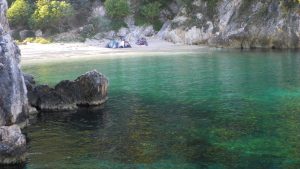
In shallow and transparent areas, sunlight reaches pale stones or sand and reflects upwards. This
produces the brilliant turquoise shades associated with Karaburun, Sazan and much of the
Albanian Riviera.
As the seabed becomes deeper, less light returns from below and the colour gradually changes
into a darker Mediterranean blue.
The first secret of Vlora’s famous water is therefore surprisingly simple.
Much of the turquoise admired from above is not created by the water alone.
It is the seabed shining back through it.
The bay can change colour several times during a single day. Early in the morning, when
sunlight reaches the surface at a low angle, the water may appear silver or pale blue. By midday,
shallow areas begin to glow turquoise, while deeper sections become an intense sapphire.
Near sunset, the same sea reflects gold, red and violet from the sky, temporarily hiding the
underwater landscape that had remained visible only hours earlier.
Wind changes the view as well.
After a calm night, suspended particles gradually settle and underwater visibility may improve.
Stronger waves can lift fine material from the seabed and make the same beach appear less
transparent the following morning.
The clarity admired by visitors is not a permanent filter placed over the Bay of Vlora.
It is a living condition shaped by light, weather and the character of each section of coastline.
The bay does not have one blue.
It has a language of blues, and every shade reveals something about depth, seabed and exposure
to the open sea.
Clear Water Is Not Empty Water
People often look into exceptionally transparent water and assume that almost nothing lives
inside it.
The stones are visible. The space between them appears empty. Only an occasional fish
interrupts the stillness.
Yet this impression is one of the greatest illusions created by the sea.
Scientific research in the Bay of Vlora has recorded hundreds of types of phytoplankton and
microzooplankton. These organisms are so small that a swimmer can pass through an entire
living community without noticing a single member of it.
Some capture sunlight and help form the beginning of marine food webs. Others transfer that
energy towards larger organisms.
The apparently empty space between a swimmer and the seabed is therefore filled with
biological activity.
This creates one of the central lessons of the bay.
Clear water does not mean that the sea lacks life.
It means that much of its busiest life is too small, too quiet or too well hidden to interrupt the
passage of light.
A snorkeller begins to understand this within minutes.
What appeared from the shore as an empty blue surface becomes a landscape of small fish
moving between rocks, molluscs attached to stone, algae following the movement of the water
and shadows disappearing into narrow openings.
Pale stones gradually become sand. Sand gives way to vegetation. The vegetation finally opens
towards deeper blue.
Clarity, however, should not automatically be treated as proof of perfect water quality. Some
chemical or microbiological conditions cannot be judged by sight alone.
Transparency describes how easily light passes through the water. Environmental quality
requires scientific monitoring.
The human eye can admire clarity.
It cannot perform the work of a laboratory.
The Dark Patches Beneath the Blue
Visitors sometimes become concerned when they notice large dark patches beneath otherwise
turquoise water.
From a distance, these areas can resemble deep holes, rocks or shadows from passing clouds.
In many places, however, they reveal something far more valuable: underwater habitats formed
by Mediterranean seagrass and other marine vegetation.
A snorkeller passing from pale stones into one of these darker areas immediately feels that the
landscape has changed.
Small fish find shelter between the leaves. Fragments of sunlight move across the vegetation.
The open seabed becomes a layered habitat.
What appeared from the boat as a simple change in colour is actually the boundary between two
different underwater worlds.
Seagrass meadows influence the environment around them as well.
Their leaves slow water movement close to the bottom, while their roots and rhizomes help hold
sediment in place. This makes it more difficult for every small wave to lift loose particles back
into the water.
The relationship is remarkably elegant.
Seagrass needs sunlight to survive, so it benefits from transparent water. Once established, the
meadow helps stabilise sediment and can contribute to the conditions that allow light to continue
reaching it.
Clear water supports the meadow.
The meadow helps the water remain clear.
The dark shapes beneath Vlora’s famous blue are therefore not imperfections in the view.
They are part of the living system helping to create it.
A Bay with an Open Door
From the city, the Bay of Vlora appears almost enclosed.
The Karaburun Peninsula forms its western wall. The coastline curves around its eastern and
southern sides. Sazan Island stands near the entrance like a natural guardian.
This geography creates the impression of a protected marine room separated from the greater
Mediterranean beyond it.
In reality, the door is always open.
The bay lies beside the Strait of Otranto, the passage connecting the Adriatic and Ionian Seas.
Water, heat, salt, oxygen and biological material move through this gateway as part of a much
larger regional circulation.
The sea touching the coastline of Vlora is therefore not confined to the bay. It belongs to an
interconnected system extending through the southern Adriatic, the Ionian and the wider
Mediterranean.
Different masses of water can move in different directions and at different depths. Ionian water
generally travels northwards along the eastern side of the strait, while Adriatic water returns
southwards through other sections and deeper layers.
What appears on a map as a narrow line between two seas is actually a multilayered marine
junction.
This does not mean that all the water inside the Bay of Vlora is replaced immediately or that one
invisible current continuously washes every beach.
Local circulation is also influenced by wind, waves, depth, temperature and the shape of the
coastline.
The more accurate and more interesting truth is that the bay is protected without being isolated.
The horizon may look like the end of the bay.
For the water, it is only another passage.
A Calm Surface Can Hide a Moving Sea
On a quiet summer morning, the Bay of Vlora can resemble an enormous mirror.
The surface appears almost motionless, reflecting Karaburun, Sazan and the surrounding
coastline with barely a disturbance.
Beneath it, however, water continues to move under the influence of wind, temperature, density
and the shape of the seabed.
Some of this movement is regional and connected to the exchange through the Strait of Otranto.
Other circulation is local, created by winds crossing the bay and by the natural shelter of the
peninsula.
Different sections can therefore behave differently on the same day.
A beach near the city may remain calm while another part of the coastline experiences stronger
waves or reduced visibility.
People familiar with the bay rarely judge the entire sea by looking at one beach.
They understand that Uji i Ftohtë, Radhimë, Orikum, Sazan and Karaburun do not always
experience the same conditions.
The direction of the wind may leave one cove protected while exposing another. A change that
appears sudden from shore may have begun hours earlier over the open sea.
Much of the beauty of the Bay of Vlora is created by movement rather than stillness.
Summer Above, Spring Below
One of the most surprising sensations for a swimmer occurs during the warmer months.
The surface feels almost like a bath, but a few strokes downward suddenly reveal a colder layer.
The change can be sharp enough to feel as though the swimmer has crossed an invisible
boundary.
That boundary is real.
During spring and summer, sunlight warms the surface more rapidly than the deeper water. The
warmer layer becomes lighter and remains above colder, denser water.
This seasonal separation is known as thermal stratification.
The sea can therefore contain different seasons at the same time.
At the surface, summer has already arrived.
Several metres below, the water can still carry the cool memory of spring.
This separation influences more than the comfort of swimmers. It affects the distribution of
oxygen, nutrients and microscopic organisms through the water.
Later in the year, cooler temperatures and stronger winds weaken the difference between the
layers. The water mixes more deeply and the internal structure of the bay changes again.
Visitors notice the seasons through air temperature and sunlight.
Marine life experiences them as a reorganisation of the entire water column.
One Bay, Several Underwater Worlds
Seen from the hills above Vlora, the bay appears to be one coherent marine space.
Scientific research reveals important differences between its inner, intermediate and outer areas.
The inner section is more strongly influenced by the city, ports, lagoons and material arriving
from land.
The outer bay is more directly connected with open marine conditions near Karaburun, Sazan
and the entrance towards the Strait of Otranto.
Between them lies a changing transition zone where the characteristics of both environments
meet.
A boat can pass between these ecological worlds without crossing any visible line.
A swimmer cannot feel the exact moment one area becomes another, yet microscopic organisms
respond to differences in temperature, circulation and available nutrients.
The biological map of the bay is not drawn with roads or borders.
It is continuously redrawn by water itself.
This helps explain why a sheltered city beach, a rocky swimming place near Uji i Ftohtë and an
exposed cove around Karaburun can feel so different despite belonging to the same bay.
Each represents a different meeting between sea, land, light and life.
When the Sea Reorganises Itself
A summer storm can temporarily erase the transparency visitors associate with Vlora.
Waves strike the coastline, sediment rises from the seabed and the water near exposed beaches
becomes cloudy.
At first glance, this seems like a simple loss of clarity.
In reality, the sea is being physically reorganised.
Wave energy moves sediment, breaks down the warm surface layer and mixes water that had
remained separated during calm periods.
Material resting on the seabed may return to circulation, while nutrients can be moved into parts
of the water where microscopic organisms can use them.
After the storm passes, heavier particles begin to settle and sheltered areas calm more quickly.
Underwater visibility gradually returns, but the bay does not simply return to its previous
condition.
It reaches another temporary balance.
This is why the sea can look different every morning.
One day it appears almost transparent. Another brings deeper colour, cooler water or reduced
visibility.
These changes do not mean the bay is unstable.
They mean it is alive.
A calm sea is not a sea doing nothing.
It is a sea whose work has become invisible.
When the Hidden Coastline Reveals Itself
The clarity of the Bay of Vlora matters because it changes the relationship between people and
the sea.
In cloudy water, the surface becomes a visual boundary.
In transparent water, that boundary weakens.
A swimmer can follow the movement of fish, observe stones several metres below and recognise
the point where pale seabed gives way to a darker meadow.
Snorkelling near Uji i Ftohtë, Karaburun or Sazan reveals landscapes that remain almost
completely hidden from someone travelling only by road.
A small cove is no longer simply a beach surrounded by cliffs.
It continues underwater through rocky ledges, vegetation, patches of sand and narrow spaces
used by marine life.
The experience is often intimate rather than spectacular.
It may be a small octopus withdrawing between rocks, a school of fish changing direction
together or sunlight moving across the leaves of seagrass.
These moments create an emotional connection because the underwater landscape stops being an
abstract ecosystem and becomes part of a personal memory.
The visitor is no longer looking only at the colour of the sea.
The visitor has entered the system creating it.
The Most Beautiful Seabed Is Not Always the Richest
Pale sand and white stones produce the brightest turquoise water, making them particularly
attractive in photographs.
Yet the darkest parts of the seabed are often the most complex biologically.
A seagrass meadow can provide shelter, nursery habitat and feeding space for organisms that
would find little protection over bare sediment.
The most visually perfect patch of turquoise is therefore not necessarily the most valuable part of
the sea.
The dark meadow may support more life than the bright seabed beside it.
Its importance is not measured by how attractive it looks from a boat, but by the relationships it
sustains below the surface.
The sea does not organise its richest habitats according to human ideas of visual perfection.
Understanding this changes the experience of snorkelling.
A dark patch stops looking like something to avoid and becomes an invitation to observe from a
respectful distance.
The change in colour signals that the underwater landscape has become more complex.
What Can Disappear Before We Notice
The greatest danger facing underwater habitats is that their decline may remain almost invisible
from land.
A road, hotel or restaurant can continue overlooking the same blue horizon even after the
ecosystem below has begun to change.
The surface can still appear beautiful while vegetation has been damaged or the seabed has
become increasingly disturbed.
Research in the Bay of Vlora has documented historical losses of seagrass and other habitat-
forming vegetation associated with rapid and poorly planned coastal development.
This creates one of the most sobering lessons of the bay.
A coastline can remain beautiful in photographs while losing some of the living structures that
helped create that beauty.
Seagrass grows slowly compared with the speed at which construction, pollution, repeated
anchoring or seabed disturbance can damage it.
Once a meadow becomes fragmented, the sediment it held in place becomes more exposed and
the habitat loses continuity.
The consequences may begin with scars too small to notice from a boat, but repeated disturbance
can gradually transform an entire underwater landscape.
Protecting Vlora’s crystal waters therefore means protecting more than the appearance of the
surface.
It requires care for the habitats below, the quality of water entering the bay and the way tourism,
infrastructure and boating interact with the marine environment.
What cannot be seen from shore can still determine what the shore will look like in the future.
Protection Beneath the View
The Karaburun-Sazan National Marine Park protects the most dramatic marine landscape
connected with the Bay of Vlora.
Around the peninsula and Sazan Island, rocky coastlines, caves, underwater habitats and open-
sea conditions meet near the boundary between the Adriatic and Ionian Seas.
The purpose of a marine protected area is not to turn the coastline into a museum that people can
only observe from a distance.
Its deeper purpose is to allow nature, local communities and responsible tourism to continue
existing together without destroying the system on which they all depend.
Protection benefits more than rare species.
It safeguards swimming water, living seabeds, fishing traditions and boat journeys that define the
experience of visiting Vlora.
Environmental conservation is not separate from tourism.
It is the work that allows tourism to continue without consuming the landscape that created it.
Every image of a boat floating above transparent water depends upon decisions that remain
invisible inside the photograph.
Small Choices Above the Surface
The future of the Bay of Vlora will not be determined by one action alone.
It will be shaped by thousands of decisions made by institutions, businesses, residents and
visitors.
Some concern major infrastructure and water management.
Others appear much smaller, such as where a boat drops its anchor or whether rubbish is left
behind in an isolated cove.
Anchoring directly over a seagrass meadow can break leaves and damage the underground
structures holding the plant and sediment together.
Repeated anchoring creates scars, particularly in popular coves where many vessels stop in the
same places.
Visitors can also help by observing marine animals without removing them.
A shell, starfish or small creature may look like a souvenir, but it belongs to a living system.
Responsible tourism does not make the experience less enjoyable.
It makes the experience more meaningful.
The goal is not to leave no memory of the bay.
It is to leave no damage inside it.
Seeing Vlora Differently
After understanding what lies behind Vlora’s crystal waters, the familiar view begins to change.
Turquoise near a shallow beach becomes sunlight returning from the seabed.
A dark patch beneath a boat becomes habitat rather than shadow.
A sudden cold layer felt while swimming reveals that summer may exist only at the surface,
while deeper water follows another rhythm.
Even the horizon acquires a different meaning.
What appears to be the edge of the bay is the entrance to a circulation connecting the Adriatic
and Ionian Seas.
The calm surface hides water moving at different depths, while the apparently empty space
below contains communities helping sustain the life of the bay.
Knowledge should not replace beauty with explanation.
It should make beauty deeper.
A visitor does not need to remember the scientific name of every plant or understand every
current.
It is enough to leave with a more accurate sense of what has been experienced.
The Bay of Vlora is not simply a blue background behind beaches, boats and sunsets.
It is a living environment whose colour, clarity and biodiversity depend upon relationships that
continue every hour of the day.
The secret behind Vlora’s crystal waters is not one hidden spring, one current or one untouched
beach.
It is the balance created when sunlight, geology, open-sea exchange, local circulation,
underwater vegetation and microscopic life continue working together.
The bay appears peaceful because most of that work is invisible.
It appears empty because much of its life is microscopic or hidden.
It appears permanent because environmental change often begins beneath the surface, long
before it becomes obvious from shore.
The greatest secret of Vlora’s crystal waters is therefore not their colour.
It is everything that colour allows us to discover.
Experience the Bay of Vlora
The Bay of Vlora is best experienced, not simply visited.
Valza Boutique Hotel offers travellers a natural starting point from which to discover the
beaches, marine heritage and hidden corners explored throughout the MAREOGRAPH series.
Above the hotel, Eden by Valza continues the experience through Mediterranean cuisine inspired
by the same coastline and sea.
About MAREOGRAPH
MAREOGRAPH is an independent editorial project created by Valza Boutique Hotel to
document and explain the natural, historical and cultural heritage of the Bay of Vlora and the
Albanian Mediterranean.
Each Knowledge Unit combines scientific research, local knowledge and human storytelling to
build a long-term digital library about the landscapes, ecosystems, traditions and experiences that
define this coastline.
MAREOGRAPH does not seek to replace the experience of visiting the sea.
Its purpose is to make that experience richer by helping readers understand what they are seeing,
why it matters and how it can be protected for the generations that follow.


