
How Geography Explains the Albanian Mediterranean
A landscape can be admired in a few seconds.
Understanding it can take a lifetime.
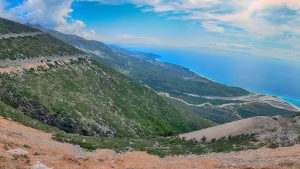
Stand anywhere along the Albanian Mediterranean and the view appears almost effortless.
Mountains rise directly from the sea. The coastline bends gently towards hidden coves. The
water shifts from deep blue to bright turquoise as clouds pass overhead, while the horizon
stretches uninterrupted towards the wider Mediterranean.
It feels timeless.
Almost inevitable.
Yet nothing you are looking at happened by accident.
Every cliff, every beach, every quiet bay and every change in the colour of the sea is the visible
result of processes that have been unfolding for millions of years. The landscape is not simply a
collection of beautiful places. It is a system where geology, water, climate and life constantly
influence one another.
Perhaps that is why some people leave the Albanian Mediterranean remembering only beautiful
photographs, while others leave feeling that they have understood something much deeper.
The difference is not what they saw.
It is what they learned to notice.
Once you begin reading the landscape instead of simply looking at it, the coastline quietly starts
revealing its secrets.
The Language Written in Stone
The first chapter of this story is written in limestone.
Millions of years ago, these mountains did not overlook the Mediterranean.
They rested beneath it.
The cliffs that today rise above the sea were once part of an ancient seabed where countless
shells, corals and microscopic marine organisms slowly accumulated over millions of years. As the African and Eurasian tectonic plates continued colliding, these sediments were compressed,
folded and gradually lifted high above sea level, creating the mountain ranges that define
southern Albania today.
The next time you stand on a panoramic viewpoint overlooking the Albanian Mediterranean,
pause for a moment.
Everything beneath your feet once lay beneath a prehistoric sea.
Suddenly the landscape no longer feels static.
It feels alive.
Limestone gives the region much more than spectacular scenery. Unlike harder volcanic rocks, it
fractures easily and slowly dissolves under the influence of rainwater. Over immense periods of
time, this creates sharp ridges, dramatic cliffs, hidden caves, irregular valleys and landscapes that
seem almost sculpted rather than built.
Even today, the process continues.
Drop by drop.
Winter after winter.
Century after century.
The mountains surrounding the Albanian Mediterranean are still changing, although far too
slowly for the human eye to notice.
Water That Travels Underground
One of the most fascinating characteristics of this coastline is something visitors rarely see.
The rivers that are not there.
Across much of Europe, rivers dominate the landscape. They carve valleys, transport enormous
quantities of sediment and leave unmistakable traces before reaching the sea.
Here, water often chooses another path.
Instead of remaining on the surface, rainwater seeps into fractured limestone and begins
travelling underground through a hidden network of cracks, tunnels and natural reservoirs. Some
of these underground journeys continue for kilometres before the water finally reappears as
coastal springs or freshwater sources close to the sea.
This invisible circulation quietly transforms the coastline.
Because fewer large rivers carry mud and sediment into the Mediterranean, the sea remains
remarkably transparent. Sunlight penetrates deeper beneath the surface, allowing marine plants
and underwater ecosystems to flourish in conditions that would be impossible in cloudier water.
That extraordinary clarity is therefore much more than beauty.
It is evidence.
The next time you find yourself looking through several metres of crystal-clear water towards the
seabed, remember that what you are really seeing is geology at work.
The landscape cleaned the water long before it reached the sea.
The Coastline Never Repeats Itself
One of the greatest surprises waiting along the Albanian Mediterranean is how quickly the
coastline changes.
Drive only a few kilometres and everything feels different.
A wide beach suddenly gives way to towering limestone cliffs. Smooth pebbles replace soft
sand. Hidden coves appear where the coastline seemed completely inaccessible only moments
earlier.
None of these changes is random.
Where limestone resists the constant force of waves, cliffs survive.
Where weaker sections gradually erode, small bays begin to form.
Where currents slow down enough to deposit sand or pebbles, beaches quietly appear.
Every section of coastline represents a different balance between construction and destruction.
The sea is always building.
The sea is always removing.
The landscape visible today exists only because these two processes have remained in balance
for thousands of years.
Perhaps this explains why exploring the Albanian Mediterranean never becomes repetitive.
The coastline constantly changes its personality.
Sometimes within the distance of a short walk.
The Sea Is Always Moving
From the shore, the Mediterranean often appears calm.
Look at it for a few minutes and it seems almost motionless.
In reality, it never stops moving.
Beneath the surface, invisible currents constantly transport water between the Adriatic, the
Ionian and the wider Mediterranean. Differences in temperature, salinity, wind and depth create a
slow but continuous circulation that renews coastal waters every single day.
Although impossible to see with the naked eye, these movements influence almost everything.
They affect water clarity.
They distribute nutrients.
They determine where fish gather.
They even shape the beaches themselves.
This is why two beaches separated by only a few kilometres can feel surprisingly different. One
may be sheltered and almost perfectly calm while another receives stronger waves from the open
sea. One develops fine sand beneath your feet while the next is covered with smooth pebbles
polished over centuries.
The sea is constantly responding to the landscape.
The landscape is constantly responding to the sea.
Neither exists independently.
Perhaps the most beautiful demonstration of this relationship appears during exceptionally calm
mornings.
The surface becomes almost perfectly still, reflecting mountains and clouds like polished glass. It
feels as though nothing is happening.
Yet beneath that mirror, billions of litres of water continue their silent journey through the
Mediterranean.
Stillness, it turns out, is often an illusion.
Life Follows the Landscape
Nature rarely wastes energy.
Plants grow where conditions allow them to survive.
Animals settle where food is reliable.
The Albanian Mediterranean follows exactly the same principle.
Walk across a dry hillside in midsummer and you will notice olive trees, aromatic herbs,
evergreen shrubs and resilient Mediterranean plants thriving where many other species could not
survive. Their small leaves, deep roots and slow growth are not accidents. They are solutions
developed over thousands of years in response to intense sunlight, thin soils and long dry
summers.
Even the air tells part of the story.
Brush past wild thyme or oregano on a warm afternoon and their fragrance suddenly fills the
breeze. Pine forests release resin warmed by the sun while sea salt carried inland mixes with the
scent of herbs growing among the rocks.
The landscape is experienced not only through sight.
It is heard.
It is smelled.
It is felt beneath your feet.
The same pattern continues beneath the water.
Clear conditions allow sunlight to reach remarkable depths, supporting underwater meadows of
seagrass that provide shelter for countless marine species. Small fish gather there because they
find food and protection. Larger fish follow the smaller ones. Dolphins occasionally appear
because healthy ecosystems naturally concentrate the prey they depend upon.
Nothing happens by coincidence.
Life follows structure.
Once you understand that principle, even wildlife encounters begin making more sense.
A dolphin appearing offshore is no longer simply a lucky surprise.
It becomes evidence that the entire marine system beneath the surface is functioning as it should.
People Learned to Read the Landscape Long Before Science
Did
Long before geology became a science, people living along the Albanian Mediterranean had
already learned to read many of the same signs.
Fishermen understood which winds announced rough weather.
Farmers recognised which slopes retained enough moisture for olive trees.
Builders chose stone that had already proven capable of resisting centuries of Mediterranean
winters.
Even villages appeared where the landscape quietly offered shelter, freshwater and access to the
sea.
They may not have used scientific language.
But they understood the landscape remarkably well.
Knowledge accumulated through observation.
Generation after generation.
One family noticed where fish returned every season.
Another remembered which springs continued flowing after dry summers.
Children learned where storms reached the shore and where calm water usually remained
protected.
Over time, this practical understanding became something deeper.
A relationship.
The landscape was not something people tried to control.
It was something they learned to cooperate with.
Modern science has explained many of these patterns in remarkable detail.
Yet in many ways it has simply confirmed what careful observation had already revealed
centuries earlier.
The coast rewards those who pay attention.
Exactly as it always has.
Seeing What Most People Walk Past
The greatest transformation does not happen in the landscape.
It happens in the observer.
The first time most visitors arrive, they notice colours.
The second time, they begin noticing shapes.
Eventually, they start recognising patterns.
A calm bay is no longer simply a pleasant place to swim. It becomes evidence that the
surrounding land is protecting the water from the energy of the open sea.
A steep limestone cliff is no longer just dramatic scenery. It tells the story of rock that has
resisted thousands of years of relentless wave action while softer material disappeared long ago.
An isolated beach hidden between rocky headlands is no longer a lucky discovery. It exists
because erosion exploited tiny weaknesses in the rock until the sea slowly carved out a protected
cove.
Even the extraordinary clarity of the water begins to mean something different. Instead of
admiring only its beauty, you realise you are looking at a coastline where geology, underground
water systems and marine circulation work together to create exceptional conditions for life.
The landscape quietly begins explaining itself.
Once you recognise these connections, something unexpected happens.
The coast stops being a collection of beautiful places.
It becomes a conversation.
Every cliff answers a question.
Every bay explains a process.
Every change in colour reveals another layer of the story.
This is why geologists, marine biologists, photographers and sailors often admire exactly the
same landscape for completely different reasons. Each person is reading a different chapter of the
same book.
A Landscape That Rewards Curiosity
One of the greatest pleasures of travelling is discovering things that cannot be captured in a
single photograph.
The Albanian Mediterranean offers countless moments like these.
Pause beside a limestone wall after heavy rain and you may notice tiny droplets emerging
directly from the rock itself, continuing an underground journey that may have begun kilometres
away.
Walk along the shoreline after winter storms and the beach has changed completely. New pebbles
appear, shells have been rearranged and pieces of smooth sea glass, polished by years beneath
the waves, sometimes wait among the stones like small treasures left behind by the sea.
Swim above a rocky seabed on a calm morning and sunlight creates moving patterns that dance
across the limestone below. Every passing wave bends the light differently, turning the seabed
into a constantly changing mosaic.
Climb a coastal viewpoint before sunset and watch how the mountains gradually change colour.
Grey becomes silver. Silver becomes gold. Gold fades into soft orange before the entire
landscape slowly dissolves into deep blue as evening arrives.
Nothing in these moments is accidental.
They are all consequences of the same natural system working exactly as it has for thousands of
years.
The landscape rewards those who stop long enough to notice.
Why Reading the Landscape Matters
Understanding the Albanian Mediterranean does not reduce its beauty.
It multiplies it.
A beach becomes more interesting when you know why it exists.
A mountain becomes more impressive when you realise it was once part of the seabed.
Clear water becomes more meaningful when you understand the geological journey that allowed
it to remain so transparent.
Knowledge does not replace wonder.
It deepens it.
Perhaps that is the greatest lesson this coastline offers.
The most beautiful landscapes are rarely beautiful by chance.
They are beautiful because countless natural processes have worked together, patiently and
continuously, over immense periods of time.
Once those connections become visible, the Albanian Mediterranean is no longer simply a
destination.
It becomes something that can be read.
And once you learn its language, every visit reveals another sentence.
Editorial Note
This article is part of the MAREOGRAPH Editorial Project, an independent editorial initiative
founded and developed by Valza Boutique Hotel to document the landscapes, history, culture,
gastronomy and living systems of the Albanian Mediterranean through research-based
storytelling.
Experience the Place
If this perspective changes the way you see the coast, Valza Boutique Hotel offers a peaceful
base from which to explore it slowly. From Eden by Valza, overlooking the Bay of Vlora, the
relationship between mountain, sea and light becomes visible in a single frame, reminding
visitors that the most rewarding journeys begin not with seeing more, but with understanding
more.


