
The Narrow Passage That Connects Two Seas
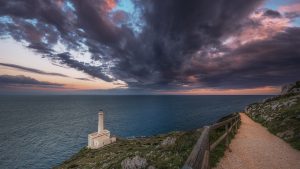
Stand on the cliffs of the Karaburun Peninsula on an exceptionally clear winter morning and look
west.
Beyond the horizon, only about seventy kilometres away, lies Italy.
Between the two stretches one of the Mediterranean’s most important maritime gateways.
At first glance, it seems almost ordinary. A narrow opening between two coastlines, linking the
Adriatic Sea with the Ionian. There are no dramatic islands dividing the passage, no monumental
cliffs announcing its importance and no obvious landmark suggesting that this is one of the great
crossroads of European maritime history.
Yet for thousands of years, almost everything entering or leaving the Adriatic has passed through
this narrow corridor.
Roman merchants.
Greek sailors.
Venetian traders.
Ottoman fleets.
Fishing boats.
Modern ferries.
Container ships.
Migrating birds.
Marine currents.
Even whales and dolphins moving between the deeper waters of the Mediterranean and the
northern Adriatic follow routes shaped by this geography.
The Strait of Otranto is remarkable because it is not defined by what exists within it.
It is defined by everything that moves through it.
Some places become famous because people choose to visit them.
Others become important because the world has no choice but to pass through them.
The Strait of Otranto has always belonged to the second kind.
Where One Sea Becomes Another
Maps often create the illusion that seas begin and end with invisible lines.
Nature works differently.
The Strait of Otranto marks the point where the Adriatic gradually opens into the Ionian Sea, but
standing on a boat crossing these waters, there is no moment when one sea suddenly becomes
another.
Instead, the transition happens quietly.
To the north stretches the Adriatic, a long and relatively enclosed basin bordered by Italy on one
side and the Balkan Peninsula on the other. Its waters are generally shallower, its circulation
more contained and its history closely connected with the ports and cities of Central Europe.
South of the strait, everything begins to change.
The Ionian becomes deeper, wider and more directly connected to the greater Mediterranean.
Winds behave differently. Currents strengthen. The scale of the sea itself expands.
For sailors throughout history, crossing the Strait of Otranto did not simply mean changing
location.
It meant entering a different maritime world.
Seventy Kilometres That Changed History
On paper, seventy kilometres does not sound particularly impressive.
By modern ferry or speedboat, it is a relatively short crossing.
For sailors navigating wooden vessels powered only by wind, it was something entirely different.
Imagine standing on the deck of a merchant ship two thousand years ago.
Behind you lies the vast Mediterranean.
Ahead stretches the long corridor of the Adriatic leading towards present-day Croatia, Slovenia
and northern Italy.
There are no engines.
No weather forecasts.
No satellite navigation.
Only the sky, the sea and experience.
Reaching the Strait of Otranto meant reaching one of the journey's most important decisions.
Continue north.
Wait for better conditions.
Or turn back.
This narrow opening became the natural gateway between two maritime systems.
Every successful crossing depended upon reading the winds correctly.
Every mistake became magnified by open water.
The geography imposed the decision.
Human beings merely responded to it.
The Sea Breathes Through Otranto
One of the Strait’s most remarkable roles cannot be seen from the surface.
Imagine the Adriatic as a giant living lung.
Every day it inhales.
Every day it exhales.
Surface currents generally carry warmer, saltier Ionian water northwards into the Adriatic. Deep
below, colder and denser water slowly travels south, returning towards the wider Mediterranean.
This continuous exchange renews the entire basin.
Without it, oxygen levels would decline, temperatures would gradually change and marine
ecosystems throughout the Adriatic would function very differently.
The Strait does not simply connect two seas.
It allows one of them to breathe.
The astonishing thing is that this immense natural process continues silently every second of
every day.
Most people crossing these waters never realise that beneath their boat an invisible river is
flowing in two opposite directions at the same time.
It is one of the Mediterranean’s greatest hidden movements.
A Living Corridor Between Two Seas
The movement of water through the Strait of Otranto shapes far more than currents.
It shapes life.
As the Adriatic and Ionian continually exchange water, they also exchange nutrients,
microscopic organisms and marine species. Fish do not recognise political borders or imaginary
lines on maps. Many species simply follow the conditions that favour them, moving through the
Strait as naturally as birds cross a valley.
The passage has become one of the Mediterranean’s great biological corridors.
Where currents converge, life gathers.
Schools of anchovies and sardines move through these waters following seasonal cycles that
have remained remarkably consistent for generations. Larger predators soon arrive behind them.
Tuna, swordfish and other pelagic species depend upon these migrations, while dolphins
frequently patrol the same routes, searching for concentrated shoals of fish driven together by the
movement of the sea.
On calm mornings, local fishermen occasionally notice dolphins surfacing only a short distance
from their boats.
They are not following people.
They are following the rhythm of the Mediterranean itself.
Where water brings nutrients, smaller fish gather.
Where smaller fish gather, larger animals inevitably appear.
The Strait is therefore not empty water separating two countries.
It is a living bridge connecting entire ecosystems.
Winds That Commanded Respect
Long before satellites could predict the weather, sailors learned to respect one simple truth.
The Strait of Otranto could change its mood very quickly.
The Bora, descending from the northeast, could transform calm conditions into rough seas within
hours. The warm Sirocco, arriving from the south, often brought humidity, haze and changing
wave patterns across the passage.
For ancient mariners, these were not simply weather events.
They determined whether a journey continued safely or not.
Imagine a small merchant vessel approaching the Strait after several days at sea.
The destination is close.
The crew is exhausted.
Yet the captain continues watching the sky instead of the horizon.
Clouds.
Wind direction.
The behaviour of the waves.
Every sign matters.
Sometimes the safest decision was not to continue.
It was to wait.
For centuries, experience mattered more than courage.
Those who respected the Strait usually crossed it.
Those who underestimated it often paid a much higher price.
The Gateway to the Adriatic
For thousands of years, the Strait of Otranto has functioned as the front door of the Adriatic.
Every vessel entering the northern basin passed through here.
So did ideas.
Trade.
Cultures.
Religions.
Technologies.
This narrow passage quietly connected the eastern and western Mediterranean with Central
Europe.
Roman grain shipments, Venetian merchant convoys, Byzantine envoys and Ottoman fleets all
depended, in one way or another, upon this same geographical gateway.
History repeatedly changed the flags carried by ships.
The route itself never changed.
The Strait decided where movement would concentrate.
Civilizations simply adapted to that reality.
Few places demonstrate more clearly that geography often shapes history long before politics
does.
A Passage of Hope and Loss
The Strait of Otranto is also part of a much more recent chapter in Albanian history.
One that remains within living memory.
Following the collapse of Albania’s communist regime in the early 1990s, thousands of
Albanians looked across these same seventy kilometres with a mixture of hope, uncertainty and
desperation.
For many, Italy represented opportunity, freedom and the possibility of building a different
future.
Small fishing boats, overcrowded vessels and improvised craft began crossing the Strait, often
carrying entire families willing to risk everything for a chance at a better life.
Some arrived safely.
Others never did.
Storms, overcrowded boats and dangerous sea conditions turned this narrow passage into the
final journey for many men, women and children whose names are remembered today by their
families but largely unknown to history.
The waters that had connected civilizations for thousands of years also became silent witnesses
to human courage, sacrifice and loss.
Standing today on the Albanian coast, it is impossible not to think differently about the horizon.
For countless people, it was never simply the line where the sea met the sky.
It was the direction where hope lived.
The Strait therefore carries more than geographical significance.
It also carries memory.
Its waves tell stories not only of merchants and sailors, but of ordinary people searching for
dignity, security and a future beyond the horizon.
Understanding the Strait of Otranto means recognising all of these stories together.
It is a natural corridor.
A biological corridor.
A maritime corridor.
And, for one generation of Albanians, it became a profoundly human corridor as well.
The Bay of Vlora and the Strait
The relationship between the Strait of Otranto and the Bay of Vlora is impossible to separate.
The bay lies just inside the entrance to the Adriatic, protected by the Karaburun Peninsula while
remaining only a short distance from the Strait itself. For sailors arriving from the Ionian Sea, it
offered something invaluable after crossing open water.
Shelter.
After hours or even days exposed to changing winds and unpredictable seas, the Bay of Vlora
appeared exactly when it was needed most. Its naturally protected waters allowed ships to anchor
safely, repair damage, replenish freshwater supplies and wait patiently for favourable weather
before continuing north.
Even today, arriving by sea explains immediately why generations of mariners valued this
coastline so highly.
The geography speaks for itself.
Karaburun breaks much of the force of the open sea.
The bay absorbs the remaining energy.
The result is one of the finest natural anchorages in the eastern Adriatic.
It is no coincidence that the Bay of Vlora appears repeatedly throughout Mediterranean history.
Its importance begins with the Strait.
Watching the Strait Today
Modern technology has changed almost everything about navigation.
Ships now rely on radar, satellite positioning, electronic charts and weather forecasts accurate
days in advance.
Yet the Strait continues performing exactly the same role it always has.
Cargo vessels cross between continents.
Passenger ferries connect Albania and Italy.
Fishing boats leave before sunrise.
Research vessels monitor marine ecosystems.
Migrating birds follow ancient aerial routes stretching between Europe and Africa.
Meanwhile, beneath the surface, invisible currents continue renewing the Adriatic exactly as they
did long before the first harbour was ever built.
Some landscapes change because people reshape them.
The Strait of Otranto reminds us that other landscapes continue shaping us.
Why the Strait Matters
At first glance, the Strait of Otranto appears surprisingly modest.
It is neither the widest nor the deepest maritime passage in the Mediterranean.
Its importance comes from something much simpler.
Everything passes through it.
Water entering the Adriatic.
Water leaving it.
Marine life migrating between two seas.
Ships connecting southern Europe with the wider Mediterranean.
For centuries, even ideas, cultures and economies have travelled through this same narrow
opening.
It is geography reduced to its purest form.
A single corridor concentrating movement across an entire region.
That is why the Strait cannot be understood simply as a gap between Albania and Italy.
It is the hinge connecting two seas.
Remove it, and the Adriatic would become a completely different place.
Conclusion
Most travellers crossing the Strait of Otranto never stop to think about it.
The ferry continues towards Italy.
Cargo ships continue north.
Fishing boats return home before sunset.
Dolphins follow shoals of fish.
Currents continue their endless exchange between the Adriatic and the Ionian.
Life simply keeps moving.
Yet every one of these journeys depends upon the same narrow passage.
Some landscapes become famous because people choose to visit them.
Others become important because history, nature and humanity repeatedly have no choice but to
pass through them.
The Strait of Otranto has belonged to that second category for thousands of years.
It has connected seas.
It has connected civilizations.
It has connected families separated by migration and united by hope.
It has witnessed commerce, exploration, conflict and some of the most emotional chapters in
modern Albanian history.
Today, standing on the coast of Karaburun or looking west from the Bay of Vlora, the horizon
appears calm.
It is easy to believe that nothing extraordinary is happening.
But beyond that quiet line, one of the Mediterranean’s oldest journeys continues every single day.
The Strait of Otranto is far more than the entrance to the Adriatic.
It is one of the places where geography reminds us that even the narrowest passages can change
the course of history.
Editorial Note
This article is part of the MAREOGRAPH Editorial Project, an independent editorial initiative
founded and developed by Valza Boutique Hotel to document the landscapes, history, geography
and living systems of the Albanian Mediterranean through research-based storytelling.
Experience the Place
Few places allow you to appreciate the Strait of Otranto better than the Bay of Vlora. From
Valza Boutique Hotel, overlooking the entrance to the Adriatic, the relationship between
Karaburun, Sazan Island and the open Mediterranean becomes immediately visible. As the sun
sets beyond the horizon, it is easy to imagine the countless sailors, merchants, fishermen and
families who have looked towards this same passage for thousands of years, each carrying their
own destination, their own story and their own hope.


