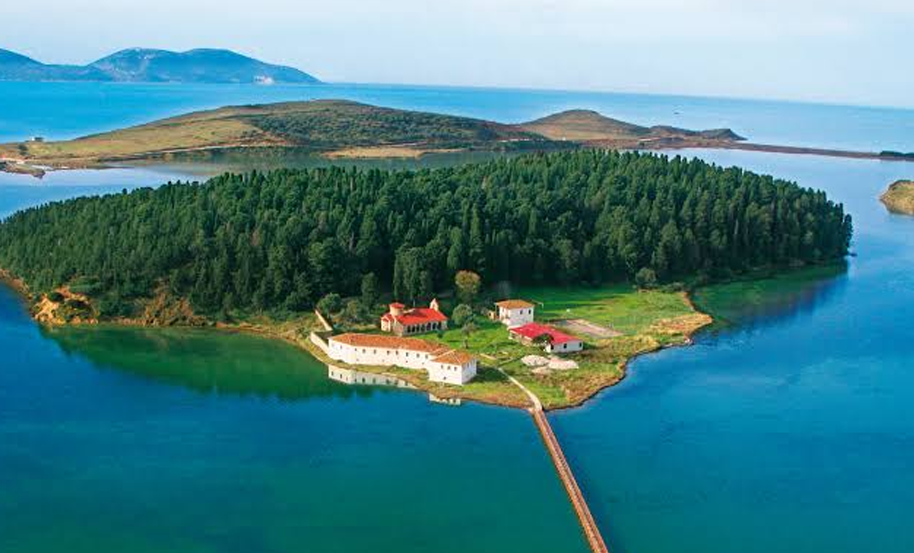
Most visitors arrive at Zvërnec looking towards the wooden bridge. It crosses the shallow lagoon towards an island of dark trees, disappearing beneath the forest before reaching the monastery. In the late afternoon, the water can become so still that bridge, sky and shore seem to exist twice—once above the surface and once inside it.
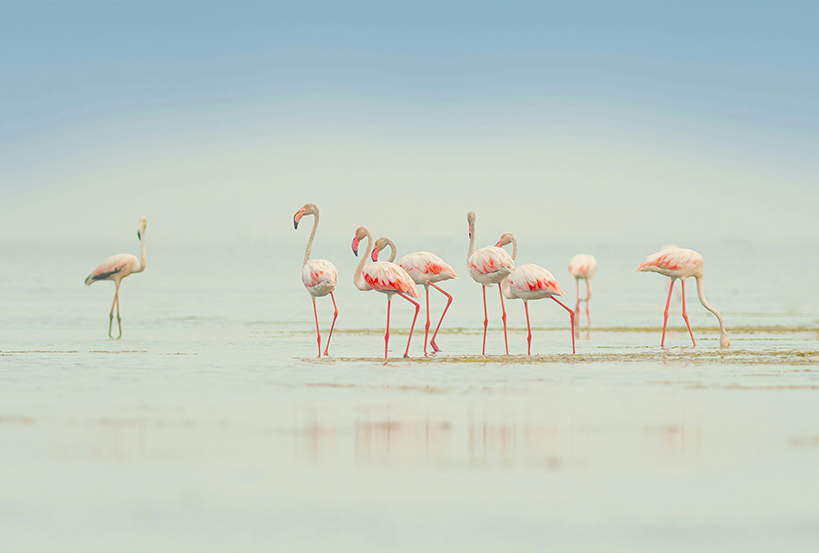
A child walking ahead stops when the flamingos begin to move. At first, only a few birds lift their heads. Then part of the flock runs across the water, long legs touching the surface while broad wings reveal flashes of black beneath the pink. More birds rise behind them until the quiet lagoon appears to loosen from the earth and enter the sky.
The child watches until the flock settles farther away, then asks a question that seems to belong to another landscape.
“Are the turtles here too?”
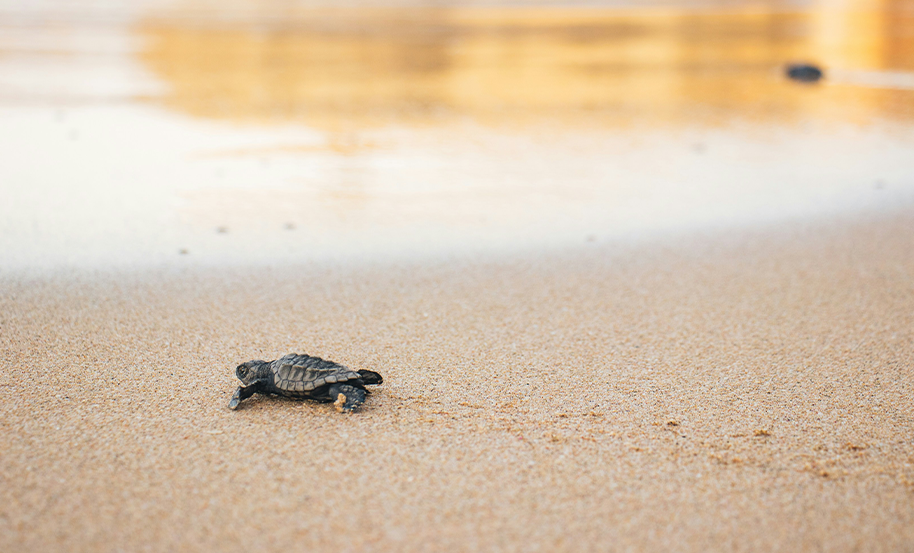
The answer requires a larger map. Sea turtles do not nest beside the bridge or inside the lagoon. Their story belongs to the outer sandy coast of the wider Vjosa–Narta landscape, where dunes separate wetlands from the open Adriatic. Loggerhead nesting has been documented on beaches north and south of the Vjosa River mouth. A turtle seen swimming through coastal water may later depend on dry sand that visitors at the monastery cannot see. (CMS Convention)
That is the first revelation of Narta–Zvërnec. It is not one attraction surrounded by scenery. It is a connected system of lagoon, salt pan, forest, dune, beach and sea. A flamingo arrives from the sky. A turtle emerges from the water. Both approach land only when they are prepared to trust it with the next generation.
One Landscape, Two Nurseries
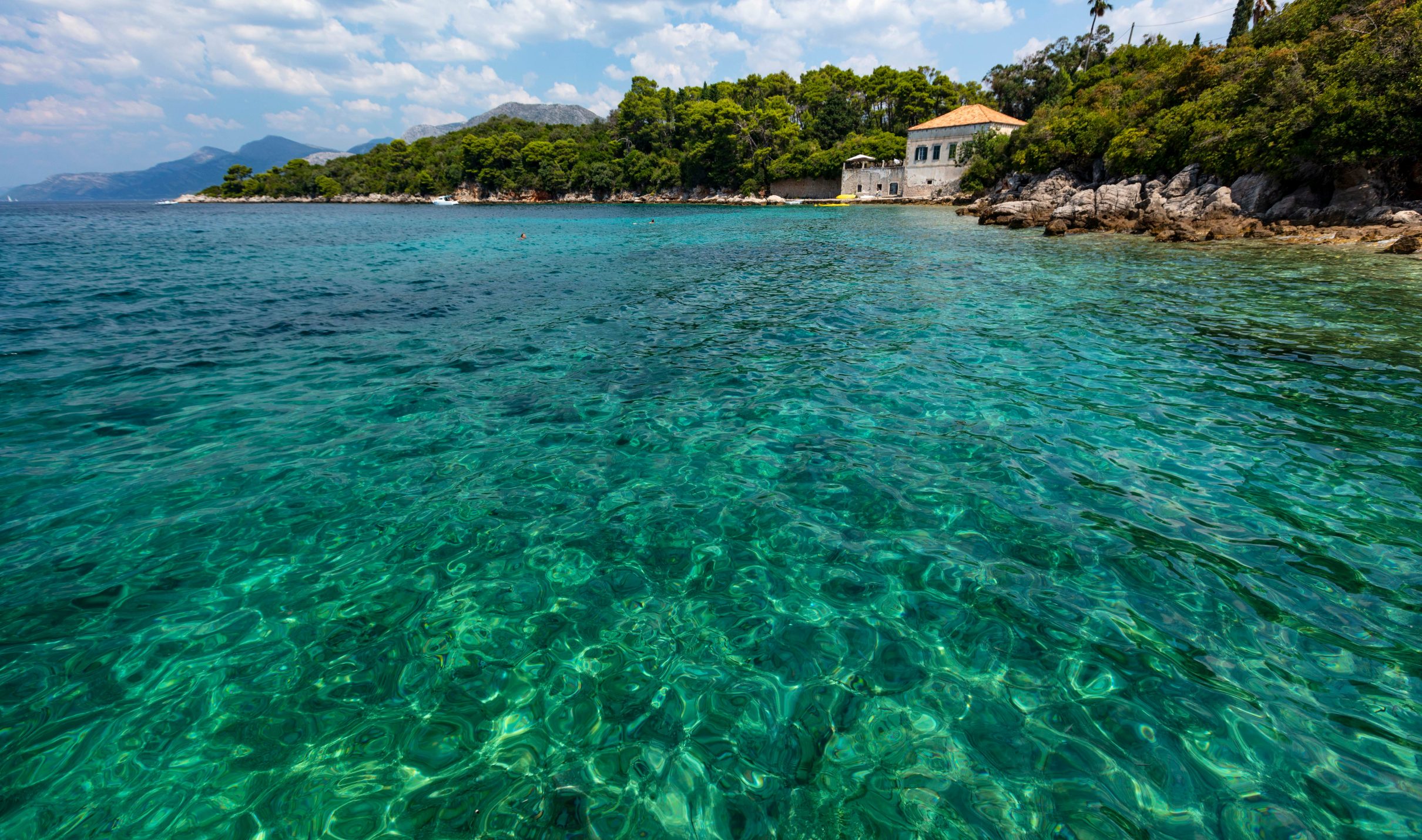
From the bridge, the lagoon appears naturally separated from the Adriatic. The forest creates one horizon, the dunes another. Yet these habitats are connected by water, wind, sand and the movement of animals. A bird may feed in the lagoon, rest on a salt-pan embankment and shelter among trees during the same day. A sea turtle may spend almost its entire life in marine water, then require an undisturbed beach for the few hours in which she lays her eggs.
Humans divide the coast into categories: wetland, forest, beach and sea. Wildlife experiences a sequence of places needed at different moments. This is the central idea of Narta–Zvërnec:
A protected landscape succeeds not by preserving one beautiful view, but by keeping the routes between habitats alive.
The wider landscape lies on the Adriatic Flyway and supports more than 200 recorded bird species, including breeding, wintering and migratory populations. Its value comes from the continuity of lagoon, shallow water, salt pans, dunes, forest and coastline. (BirdLife International)
The bridge leads towards the monastery. Ecologically, it also leads towards a larger idea: no place here can be fully understood alone.
The Night Journey from Sea to Sand
In water, a loggerhead turtle appears completely adapted to movement. Broad front flippers pull a streamlined body through the Mediterranean. On land, that grace becomes effort.
A nesting female must leave the support of the water and drag her heavy body across loose sand. She searches above the reach of ordinary waves, turns carefully and excavates a chamber with her rear flippers. The journey may cover only part of a beach, yet it is one of the most demanding passages of her life.
After laying the eggs, she covers the chamber and returns towards the water. By sunrise, the animal may be gone. What remains is a broad track running inland from the surf and another leading back towards the sea.
A marine animal has written its most important message on dry land.
The most vulnerable journey of a sea turtle may happen outside the sea.
Protecting the turtle therefore means more than keeping marine water clean. It means maintaining a beach wide enough to nest, dunes able to store and replace sand, darkness that preserves natural orientation and a route unobstructed by vehicles, buildings or crowds. The beach may be valued by visitors for swimming. The turtle values it because, for one night, the sea is not enough.