A few painted lanes behind Flag Square are all that is left of the Vlorë of 1912, and they are worth the walk.
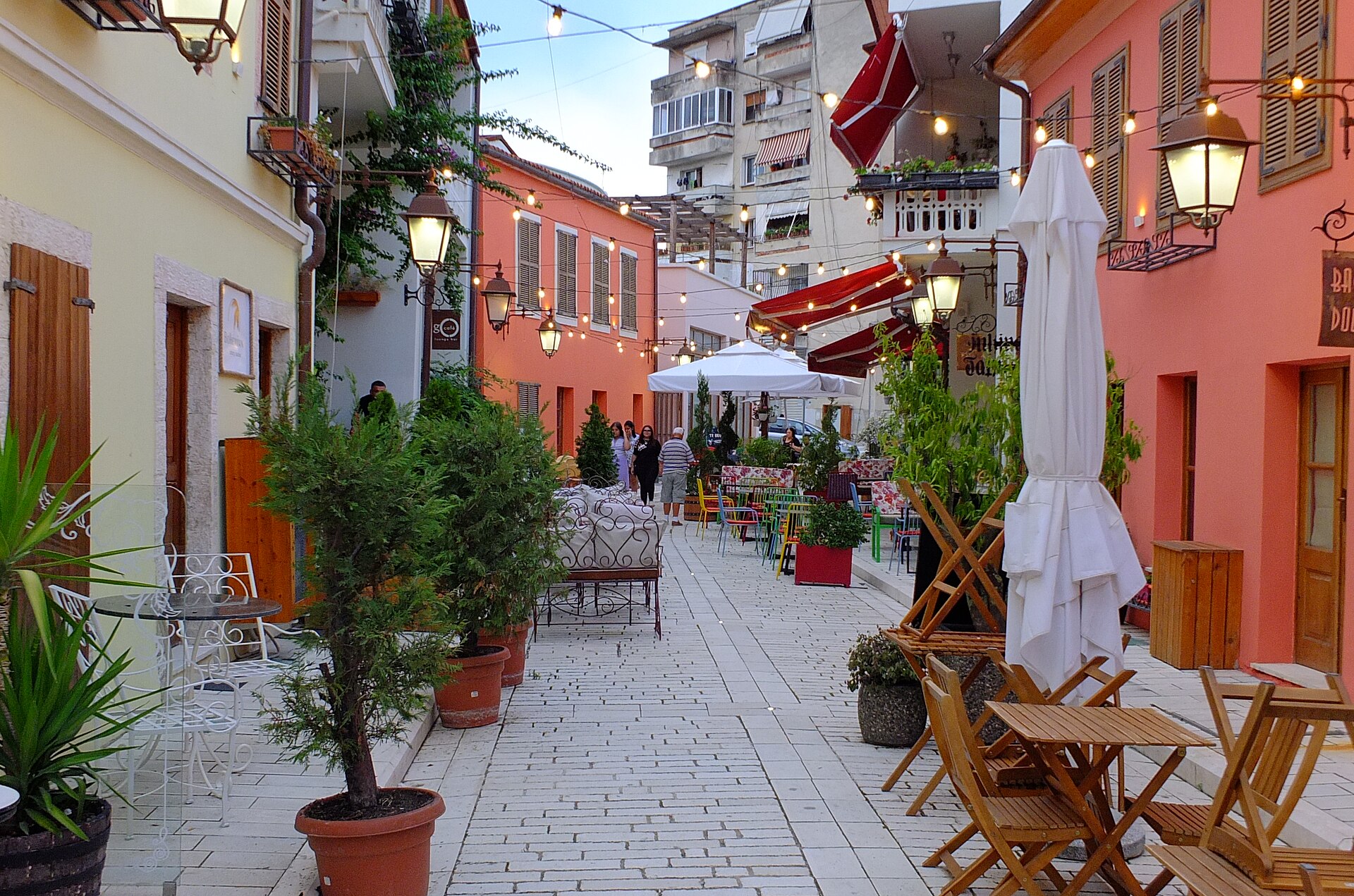
The Old Town of Vlorë is a small quarter behind Flag Square and the Muradie Mosque, where the town’s 19th- and early 20th-century houses, two or three storeys high with neoclassical façades, were restored in 2019 and repainted in soft colours. It was the heart of the city when Albania declared independence in 1912. Allow 45 to 60 minutes, in the late afternoon, and end with a coffee in the lane.
The street of Vlorë’s Rilindja
Most of old Vlorë did not survive the 20th century, which is why the small quarter behind Flag Square feels so precious. Its main lane was the principal street of the town in the years of the National Awakening, the Rilindja, lined with the houses of merchants, craftsmen and the families who led the town’s public life. A few steps away stands the Muradie Mosque, finished in 1542, the oldest building in the centre.
This was a town where Muslim, Orthodox and Jewish families lived side by side, a few streets from the square where independence would be declared in 1912. The quarter is protected as a Cultural Monument, and in 2019 about 68 of its buildings were restored, keeping the original style of their façades. The lanes are almost free of cars, and the pace drops the moment you step in.
Look up at the street sign on the main lane: Rruga Justin Godart, named after a French politician (1871–1956) recognised by Yad Vashem in 2004 as Righteous Among the Nations. The name remembers the Jewish community that lived in these streets for centuries: an Ottoman count of 1520 recorded 525 Jews in a town of about 4,000 people, and a plaque on Rruga Perlat Rexhepi still recalls them.
Come in the late afternoon, when the light warms the façades, and let the quarter end the way it should: with a coffee at a small table in the lane.
What you’ll see
-
The painted lanes
Restored houses in soft colours, and lanes almost free of cars.
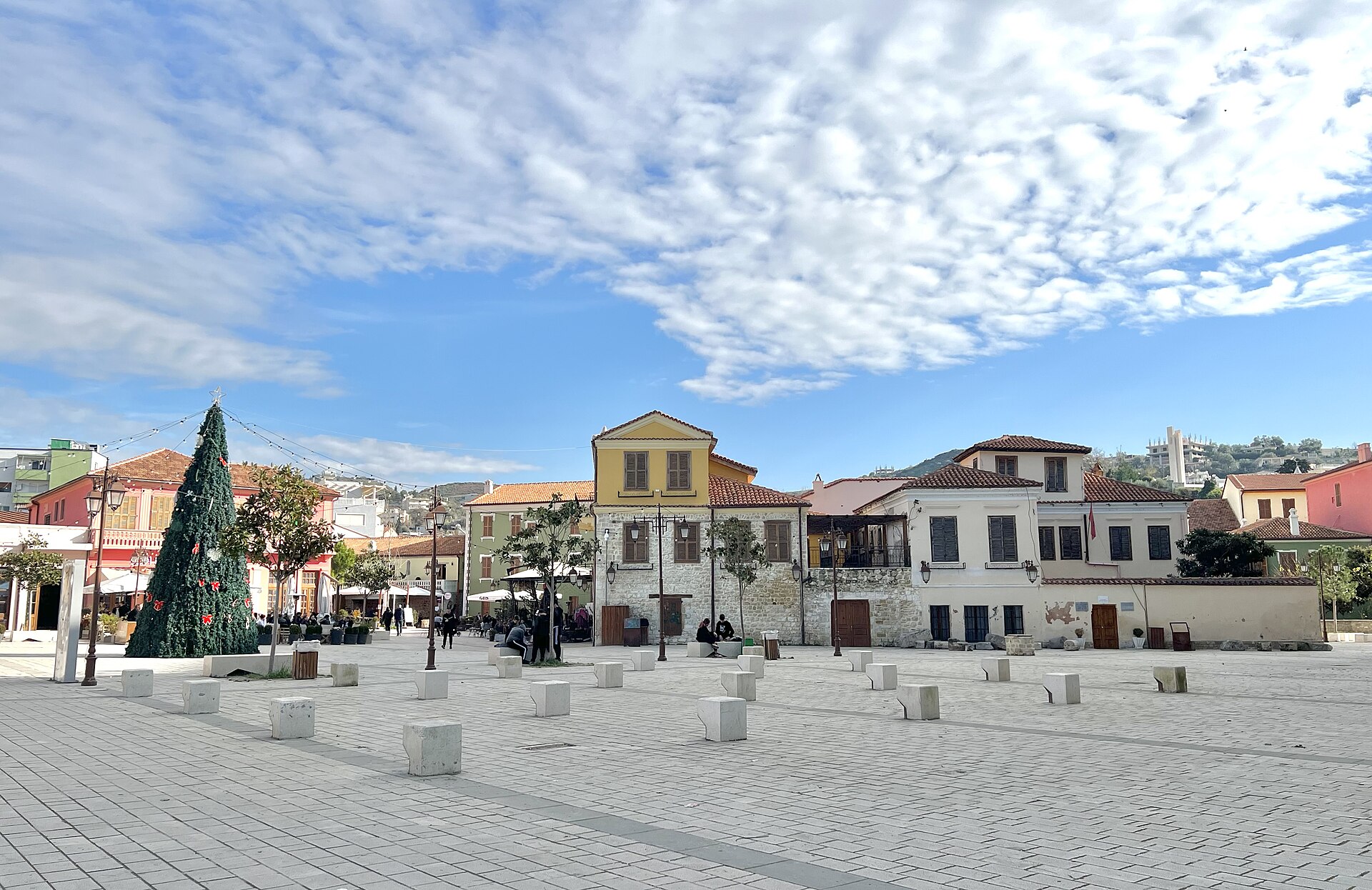
The square
The open square of the old town, among the restored houses.
-
Rruga Justin Godart
The street sign on the main lane honours a French politician, recognised by Israel in 2004 as Righteous Among the Nations.
-
The plaque
On Rruga Perlat Rexhepi, it still remembers Vlorë’s Jewish community.
The quarter in four moments
- 1520
An Ottoman count records about 4,000 people in Vlorë, 525 of them Jews.
- 1542
The Muradie Mosque is finished, a few steps from the quarter.
- 1912
Albania declares independence on the square in front of the old town.
- 2019
About 68 buildings of the historic centre are restored, keeping their original style.
The old town in numbers
-
68 buildings
Restored in 2019, keeping their original style
-
2–3 storeys
The height of its neoclassical houses
-
1542
The Muradie Mosque, a few steps away
-
45–60 minutes
Enough to walk the lanes and stop for a coffee
Where it is
In the city centre, in the small quarter behind Flag Square.
What to bring
- Comfortable shoes: for wandering the lanes on foot
- Camera: restored houses in soft colours
- Cash in lek: for a coffee at a small table in the lane
- Phone map: to find the plaque on Rruga Perlat Rexhepi
- Light layer: for lingering as the evening cools
- Water: for the walk from the seafront
Is it worth it?
Yes, if…
you want slow, car-free lanes, restored houses and a coffee at a small table in the late afternoon, or you want to see what the town looked like in 1912.
Maybe not, if…
you are looking for big sights: this is a small quarter, because most of old Vlorë did not survive the 20th century.
Free to explore. Come in the late afternoon, when the light warms the façades.
Combine it with
Continue exploring
More places and ideas for your days around Vlorë:
- The Museum of Independence and Ismail Qemali’s rooms
- All attractions around Vlorë
- Vlorë: the city, its history and where it is
- Archaeological sites in Vlorë: Amantia, Orikum, Kanina and ancient Aulona
- Where to stay in Vlorë: our complete guide