
Understanding Albania’s Most Important Coastal
Landscape
Every country has at least one landscape that quietly explains much of its history. It is rarely the
highest mountain, the longest river or even its largest city. More often, it is a place where nature
created such extraordinary conditions that people kept returning for thousands of years, often
without fully understanding why. These landscapes become crossroads without planning to,
centres of exchange without being designed for it and symbols of national identity long before
anyone gives them a name. In Albania, no coastal landscape tells that story more convincingly
than the Bay of Vlora.
Most visitors fall in love with the bay long before they understand it. They remember the
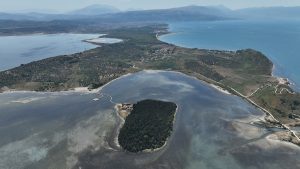
brilliant blue water stretching towards Karaburun, the silhouette of Sazan Island on the horizon
or sunsets that seem to linger a little longer than expected. These memories are genuine, yet they
explain only why the bay is beautiful. They do not explain why it has mattered continuously for
thousands of years.
The true importance of the Bay of Vlora lies beneath its surface. This is one of the very few
places along the eastern Mediterranean where geology, climate, biodiversity, navigation and
human history have continuously reinforced one another. Mountains shaped the winds. The
winds shaped the sea. The sea determined where ships could anchor safely. Safe anchorages
encouraged settlement, settlement encouraged trade and trade transformed a quiet bay into one of
Albania’s defining landscapes.
Once you begin seeing these connections, the coastline changes completely.
The beaches are no longer simply beaches.
The mountains become part of the sea.
The sea becomes part of history.
Even the city itself starts to make more sense.
Perhaps that is the greatest reason this landscape deserves attention. It reminds us that geography
is never merely scenery. Sometimes it quietly becomes the architect of everything that follows.
A Landscape Older Than Human Memory
The story of the Bay of Vlora began long before there was a bay.
Millions of years ago, the mountains surrounding today’s coastline did not overlook the sea.
They were the sea.
What now appears as towering limestone cliffs once formed part of the floor of an ancient
tropical ocean where countless marine organisms lived, died and slowly accumulated layer upon
layer beneath the water. Over immense periods of time, the continuing collision between the
African and Eurasian tectonic plates compressed these sediments until they folded, fractured and
gradually rose high above sea level. Every cliff overlooking the bay is therefore the remains of a
prehistoric seabed lifted into the sky by geological forces that continue shaping the
Mediterranean even today.
The next time you stand on a viewpoint above the Bay of Vlora, pause for a moment and look
beneath your feet.
You are standing on the floor of an ocean that disappeared millions of years before the first
humans ever reached this coastline.
It is one of those rare thoughts that changes the way an entire landscape is perceived.
The coastline itself is surprisingly young. During the last Ice Age, when vast quantities of the
Earth’s water remained trapped inside glaciers, global sea levels were more than one hundred
metres lower than today. Instead of a broad bay, rivers crossed an open valley extending far
beyond the present shoreline. As the climate warmed and the glaciers melted, the Adriatic
gradually advanced inland, flooding that ancient landscape and transforming it into the sheltered
marine basin visible today.
In other words, if someone had stood here twelve thousand years ago, they would not have seen
the Bay of Vlora at all.
They would have looked across dry land.
Understanding this completely changes the idea that coastlines are permanent. They are not.
They are living landscapes constantly rewritten by geology, climate and the sea. The Bay of
Vlora simply happens to be one of the Mediterranean's most beautiful chapters.
Yet geology alone does not explain why this place became so important.
For that, we must look at what happened after nature finished building the landscape.
Geography Creates Opportunity
History often appears to be written by kings, armies and political decisions. Geography rarely
receives the same attention, yet it quietly decides which opportunities exist long before people
recognise them. The Bay of Vlora is one of the clearest examples of this principle anywhere in
the Mediterranean.
Imagine approaching this coastline in a wooden sailing vessel two thousand years ago.
There are no engines.
No weather forecasts.
No GPS.
Everything depends on the wind, the waves and the ability to find shelter before conditions
change.
Suddenly, the coastline begins to open. Ahead lies a broad natural bay protected by the long
limestone ridge of the Karaburun Peninsula. The water becomes calmer. The waves lose much of
their strength. Freshwater can be found nearby, fertile valleys lie only a short distance inland and
the open gateway of the Strait of Otranto remains within easy reach.
Without realising it, you have just entered one of the safest natural harbours on the eastern
Adriatic.
For ancient sailors, this was far more than convenience.
It was security.
It was survival.
It was the difference between continuing a journey and losing an entire ship.
This simple geographical advantage shaped everything that followed. Ships stopped because they
could. Traders exchanged goods because ships stopped. Settlements expanded because trade
created opportunity. Roads connected the coast with the interior because communities needed
reliable access to the sea.
Nothing about this process was planned.
The landscape quietly encouraged the same decisions generation after generation.
Perhaps this explains why such different civilizations reached remarkably similar conclusions.
Illyrians, Greeks, Romans, Byzantines, Venetians, Ottomans and modern Albanians all inherited
the same coastline. They spoke different languages, worshipped different gods and built different
societies, yet they all recognised the same natural advantages. Political power changed
repeatedly. Geography remained astonishingly constant.
There is another way to understand this.
The Bay of Vlora did not become important because history happened here.
History happened here because the landscape kept making it possible.
The Sea That Never Stands Still
Visitors often hear that the Bay of Vlora lies where the Adriatic and Ionian Seas meet.
Most imagine an invisible line separating one sea from the other.
Reality is far more fascinating.
The two seas are constantly exchanging water through the Strait of Otranto, carrying different
temperatures, salinity levels, nutrients and marine life between them. Although invisible from the
shore, this slow but continuous movement has been shaping the bay every day for thousands of
years.
Healthy seas depend upon movement.
Without circulation, oxygen levels fall, nutrients become unevenly distributed and marine
ecosystems gradually weaken. The Bay of Vlora avoids this problem because it is continuously
refreshed by natural water exchange. Every wave arriving at the shoreline is therefore part of a
much larger Mediterranean system extending hundreds of kilometres beyond the horizon.
This constant renewal explains why the water often appears exceptionally clear.
Many visitors assume the colour of the sea is fixed.
It is not.
Look carefully while travelling from the Old Beach towards Uji i Ftohtë and then further to
Radhimë.
The sea changes almost continuously.
At first it reflects soft shades of blue above sandy seabeds. Further south it suddenly becomes
turquoise where pale limestone and deeper water combine beneath the surface. By late afternoon
the same coastline begins reflecting darker sapphire tones as the angle of sunlight changes.
It almost feels as though someone has quietly changed the sea while you were driving.
In reality, the water has not changed at all.
The landscape beneath it has.
The Mediterranean constantly paints using light.
A Living World Hidden Beneath the Surface
Most people spend the day looking across the Bay of Vlora.
Few remember to look into it.
Bring nothing more than a simple snorkel mask and another landscape begins to appear.
Schools of silver fish move effortlessly above underwater rocks. Purple sea urchins anchor
themselves inside limestone crevices while colourful wrasse weave between patches of seagrass.
Every few metres the underwater scenery changes again, revealing a remarkable diversity that
remains completely invisible from the shore.
One of the Mediterranean’s most important ecosystems also lives here.
Beneath the surface grow meadows of Posidonia oceanica, a flowering marine plant found
nowhere else on Earth except the Mediterranean Sea. These underwater forests stabilise the
seabed, produce oxygen, shelter hundreds of marine species and quietly capture enormous
quantities of carbon.
Yet perhaps their most astonishing quality is something else entirely.
Some Posidonia meadows have existed continuously for thousands of years.
While people built cities, fought wars and changed civilizations above the surface, these
underwater landscapes simply continued growing leaf by leaf.
There is something deeply humbling about that thought.
Perhaps the oldest living archive of the Bay of Vlora has never been carved into stone.
It has always grown beneath the sea.
The rocky coastline around Uji i Ftohtë hides another surprise.
If you swim slowly between the limestone outcrops, occasionally you may notice a small pile of
broken shells gathered beside a narrow crack in the rocks. It looks almost deliberate.
It usually is.
Experienced divers recognise this as one of nature’s quiet clues.
An octopus may be living inside.
These remarkably intelligent animals often leave the remains of shellfish and crabs outside their
underwater shelters after feeding. Spotting the shells does not guarantee you will see the octopus
itself. But wait patiently, remain still and sometimes a curious eye appears first, followed by
slowly unfolding arms as the animal cautiously investigates the unexpected visitor.
Moments like these rarely appear in holiday brochures.
Yet they often become the memories people talk about long after the holiday ends.
Perhaps because they cannot be scheduled.
They simply happen when curiosity replaces hurry.
A Landscape That Creates Its Own Climate
Some landscapes simply experience the weather.
The Bay of Vlora quietly creates its own.
That becomes obvious the first time you spend an entire day travelling from the city towards
Radhimë. Without noticing exactly where it happens, the air begins to change. The heat softens.
A gentle breeze arrives from the sea. Even on the warmest summer afternoons, the coastline
often feels fresher than the streets only a few kilometres inland.
This is not coincidence.
The surrounding mountains, the open bay and the vast surface of the Adriatic work together
every day, creating a natural rhythm that has influenced life here for centuries. During summer,
the land heats much faster than the sea, drawing cooler marine air inland. By evening, as the sun
sinks behind the Karaburun Peninsula, the entire coastline seems to breathe more slowly.
Local fishermen have trusted these winds for generations.
Long before weather apps existed, they already knew when the afternoon breeze would arrive,
when the sea would become calmer again and which mornings would offer the clearest
conditions for heading offshore.
The landscape itself was the forecast.
There is another consequence that many visitors notice without understanding why.
The extraordinary quality of light.
Photographers often describe the Bay of Vlora as one of the easiest places in Albania to
photograph, yet the explanation is surprisingly scientific. Marine air usually contains fewer dust
particles than inland air, allowing sunlight to travel with exceptional clarity. Combined with pale limestone, open water and the changing position of the sun, the result is a coastline whose
colours never remain exactly the same for long.
Return to the same viewpoint in the morning, at midday and again at sunset.
It almost feels like visiting three different places.
The Bay That Still Shapes Everyday Life
The easiest mistake is to believe that the Bay of Vlora mattered only in the past.
Ancient sailors certainly depended on it.
Roman merchants certainly used it.
Empires certainly fought to control it.
But geography never stopped working simply because history moved on.
Today, the bay continues shaping everyday life in ways that are often so familiar that residents
hardly notice them anymore.
Fishing boats still leave before sunrise because calmer morning waters make both navigation and
fishing easier. Restaurants continue serving seafood that arrived only hours earlier because
productive marine ecosystems remain close to shore. Olive groves still climb the surrounding
hills for exactly the same reason they have done for centuries: this landscape provides one of the
Mediterranean’s most favourable combinations of sunlight, drainage and climate.
Even tourism follows geography.
Families naturally gravitate towards the broad sandy beaches of the north.
Snorkellers head south towards rocky shores where underwater visibility is greatest.
Sailors choose Orikum.
Hikers climb Karaburun.
Photographers wait patiently for sunset above the bay.
Without realising it, modern visitors continue making many of the same geographical choices
that generations before them made for entirely different reasons.
Only the purpose has changed.
The landscape has not.
Looking at the Bay Differently
Perhaps the greatest gift the Bay of Vlora offers is not a spectacular photograph or an
unforgettable swim.
It is perspective.
The next time you stand above the coastline, try looking at it differently.
Those mountains were once hidden beneath a prehistoric sea.
The water below is constantly renewed by one of the Mediterranean’s great marine circulation
systems.
The transparent shallows conceal underwater forests older than many civilizations.
The calm harbour that today welcomes pleasure boats once offered safety to ancient sailors
crossing the Adriatic.
The octopus hidden beneath a nearby rock, the shell resting at your feet and the afternoon breeze
cooling the coastline all belong to the same story.
Nothing here exists in isolation.
Everything is connected.
That may be the greatest lesson this landscape has to teach.
Conclusion
Every generation has discovered the Bay of Vlora in its own way.
Ancient sailors found shelter.
Merchants found opportunity.
Scientists found one of Albania’s most remarkable natural laboratories.
Travellers found beauty.
Yet all of them, knowingly or not, were responding to exactly the same thing.
An extraordinary landscape whose greatest strength has always been the relationships it creates.
Perhaps that is why the Bay of Vlora feels so different from many beautiful places around the
Mediterranean.
It is not defined by one famous beach, one historic monument or one spectacular viewpoint.
Its identity emerges from the way mountains, sea, climate, wildlife and people have quietly
shaped one another for thousands of years.
Few landscapes explain so much simply by existing.
Perhaps that is the greatest lesson the Bay of Vlora offers.
The landscapes that shape civilizations are not always the largest, the highest or the most
dramatic. They are the ones that quietly create possibilities, generation after generation, until
people begin to mistake those possibilities for destiny.
For millions of years, geology prepared this coastline.
For thousands of years, people learned to live with it rather than against it.
Together they created a landscape where mountains explain the sea, the sea explains history and
history explains the identity of an entire region.
Long after monuments fade, political borders shift and memories disappear, the landscape
remains.
It continues doing what it has always done.
Connecting worlds.
Sustaining life.
Rewarding curiosity.
That is why the Bay of Vlora is not simply one of Albania's most beautiful places.
It is the landscape that explains why the Albanian Mediterranean exists as we know it today.
Editorial Note
This article is part of the MAREOGRAPH Editorial Project, an independent editorial initiative
founded and developed by Valza Boutique Hotel to document the history, geography, culture,
gastronomy and thoughtful hospitality of the Albanian Mediterranean through research-based
storytelling.
Experience the Place
The best way to understand the Bay of Vlora is not from a single viewpoint, but by experiencing
its many faces. Watch sunrise over the calm northern beaches, snorkel among the limestone
rocks of Uji i Ftohtë, explore the hidden coves of Karaburun, and end the day watching the sun
disappear beyond the Strait of Otranto. From Valza Boutique Hotel, these experiences are all
within easy reach, while Eden by Valza brings the flavours of the Albanian Mediterranean to the
table, overlooking the very landscape whose story you have just discovered.


