Zvërnec Island and the Narta Lagoon: a complete visitor’s guide

Aerial view of Zvërnec island at sunset, its monastery and curving wooden footbridge across the lagoon

Zvërnec and the Narta Lagoon lie about 16 km north of Valza Boutique Hotel, around 30 minutes by car. A 270-metre wooden bridge crosses the lagoon to a pine-covered island and its medieval monastery, flamingos feed in the shallows, and Dalani Bay opens to the south. Allow two to three hours; come early or late in the day.

Just north of Vlorë lies one of the most distinctive coastal landscapes in Albania. Zvërnec and Narta Lagoon bring together history, biodiversity and a quiet natural setting that feels largely untouched: a slower, more rewarding day trip shaped by nature and local culture.

Zvërnec at a glance

What it is
A pine-covered island with a medieval monastery, reached by a 270-metre wooden bridge across the Narta Lagoon.
Where
About 16 km north of Valza Boutique Hotel, in the Narta Lagoon just north of Vlorë.
Time needed
Two to three hours for the salt pans, the bridge and the island; half a day with Dalani Bay.
Best time
Early morning or late afternoon; winter, spring and autumn for flamingos.
Cost
Walking the bridge and watching the birds from the road costs nothing; check opening times at the monastery before you go.
Good for
Nature lovers, photographers and slow travellers.

How to get to Zvërnec from Vlorë

The road leaves Vlorë heading north, past salt flats and reed beds, and follows the lagoon towards Nartë. From Valza in Uji i Ftohtë it is about 16 km, and the drive is already part of the trip: the salt pans beside the road often have flamingos feeding in them, and ahead the low line of pines marks the island.

There is no direct public transport to the bridge, so most visitors come by car or taxi; our reception can arrange a taxi or a guided excursion. You park near the start of the bridge and continue on foot.

The pine-covered island and the monastery of Zvërnec

At the centre of the lagoon stands the Zvërnec Monastery, on a small island surrounded by calm waters and dense pine trees. The wooden bridge leading to it is one of the most recognisable images of southern Albania, and the walk, with still water and soft light, is part of the experience.

The bridge is about 270 metres long, a walk of a few minutes over water that is rarely deeper than a metre. On the other side, a short path through the pines leads to St Mary’s Monastery. Its church, dedicated to the Dormition of the Virgin, is usually dated to the 13th or 14th century. The island itself is only about 430 metres long, and you can walk around it in a quiet quarter of an hour.

The monastery is still a place of worship, so cover your shoulders and keep your voice low inside the church. On 15 August, the feast of the Dormition, pilgrims gather on the island and the bridge becomes busy; outside that day, and especially outside July and August, the island is usually quiet.

The story of the lagoon

Three stories shape how locals see the lagoon: a floating icon, mysterious lights and a closed military coast.

The icon that arrived by water

According to local tradition, an icon of Saint Mary was found floating in the lagoon, carried by the currents. The discovery was interpreted as a sign, and the island became the chosen place for the monastery. The story reflects a deep connection between the local community and the lagoon, where natural elements have long influenced cultural and spiritual life.

The lights of the lagoon

For generations, local residents have described small moving lights appearing above the water in the distance on calm summer nights. Today this is explained through natural causes such as gas emissions and light reflection in shallow waters. In earlier times, it added a layer of mystery to the landscape.

A coastline shaped by isolation

During the communist period, this area was a restricted military zone, and limited access meant that development remained minimal. Remains of that time can still be found: underground military tunnels, concrete bunkers and observation points, and traces of old service roads. This isolation played an important role in preserving the ecosystem, making it one of the least altered coastal environments near Vlorë.

A half-day route

A simple way to see it all, in order:

  1. Early morning

    Start at the salt pans. Watch the flamingos while the birds are active and the light is soft.

  2. Late morning

    Cross the bridge. Walk to the monastery while the light is still soft.

  3. Lunch

    Grilled eel by the lagoon. Choose one of the restaurants near the lagoon, among those with the best recent reviews.

  4. Afternoon

    Walk the dunes at Dalani Bay. Continue south for a quieter coastal setting.

A natural system from Zvërnec to Dalani Bay

Moving south towards Dalani Bay, Gjiri i Dalanit in Albanian, the landscape becomes more open and dynamic. Dalani, beside the Narta wetlands, is one of the beaches of the Bay of Vlora, with a seabed that stays shallow for a considerable distance. Here you can observe sand dunes shaped by coastal winds, sediment layers that reveal shoreline evolution, and the ongoing interaction between land and sea.

Flamingos and birdlife in Narta Lagoon

Narta Lagoon is one of the most important bird habitats in Albania, and its best-known residents are the greater flamingos (Phoenicopterus roseus). In the 2025 winter count, the Albanian Ornithological Society recorded 3,796 flamingos in the Vjosa–Narta wetlands, a clear increase on previous years.
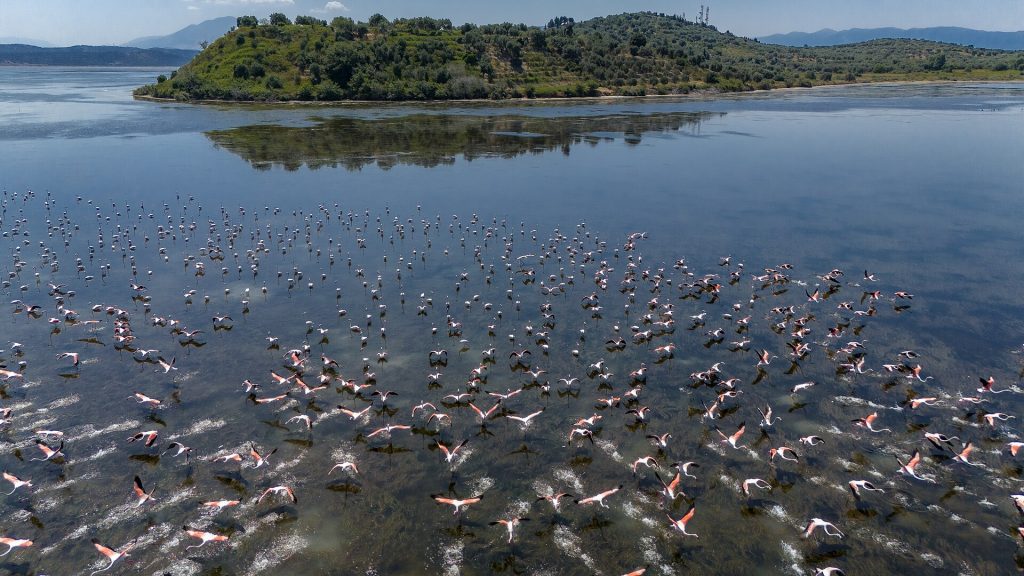
Aerial view of hundreds of flamingos taking off over the shallow Narta Lagoon, with a pine-covered island and its reflection behind

Flamingos over the Narta Lagoon. Photo: Arbenllapashtica, CC BY 4.0, via Wikimedia Commons

Flamingos are present for much of the year, but numbers are highest in winter, and spring (March to May) and autumn (September to November) bring migrating birds as well. The best place to look is the salt pans beside the lagoon, where seawater evaporates in shallow basins and the flamingos wade in to feed. Come early in the morning or at dusk, bring binoculars, and be patient: the birds often stand far out on the water.

In recent years flamingos have also been reported nesting here. In June 2025, monitoring teams reported 281 active nests, presented as the first confirmed flamingo breeding colony in Albania. Whether it becomes a regular colony will depend on how undisturbed the lagoon remains. The lagoon also supports Dalmatian pelicans and many other migratory and protected species. Watch from the road or the paths and keep your distance: flamingos take flight easily, and every disturbance costs them energy.

Traces of early human activity

In the shallow waters of the lagoon, linear stone formations have been identified and discussed in archaeological observations. They are generally interpreted as traditional fish-trapping structures, systems used to manage water flow and salinity, and early adaptations to lagoon life: signs of human activity that historically worked in balance with the natural environment.

A protected ecosystem of national importance

The area is part of the Vjosa–Narta Protected Landscape, one of the most important protected landscapes in the country. It includes salt-adapted vegetation, sensitive lagoon habitats and key breeding and feeding areas for wildlife. Preserving this balance depends on responsible and well-managed tourism.

Local cuisine: tasting the lagoon

The lagoon is home to the eel (Anguilla anguilla), a species highly valued in local cuisine. In nearby restaurants it is prepared using traditional methods: grilled over charcoal, cooked in light regional sauces, and served with simple, fresh ingredients. It remains one of the most distinctive culinary experiences near Vlorë.

Retreats, outdoor activities and group experiences

The area also suits retreats, team building and staff training in Albania: open space, silence and water create the right setting for wellness and yoga programmes, creative residencies and corporate group retreats, while staying close to Vlorë. Activities can be adapted to each group: cycling along lagoon routes and coastal roads, guided ATV and 4×4 explorations towards Dalani Bay, nature walks, birdwatching and photography sessions, small concerts, sunset gatherings and curated picnics.

Did you know?

  • 270 metres

    Length of the wooden bridge to the monastery island

  • 430 metres

    Length of the island itself, a quiet quarter of an hour on foot

  • 3,796 flamingos

    Counted in the Vjosa–Narta wetlands in the 2025 winter count

  • 281 nests

    Active flamingo nests reported in June 2025

Test yourself: how well do you know Zvërnec?

1. How long is the wooden bridge to the island?

  • About 27 metres
  • About 270 metres
  • About 2.7 km
Show the answer

About 270 metres. It is a walk of a few minutes over water that is rarely deeper than a metre.

2. Which day is the busiest at the monastery?

  • 1 May
  • New Year’s Day
  • 15 August
Show the answer

15 August. It is the feast of the Dormition, when pilgrims gather on the island and the bridge becomes busy.

3. How many active flamingo nests were reported in June 2025?

  • 281
  • 28
  • 2,810
Show the answer

281. Monitoring teams reported them in June 2025, presented as the first confirmed flamingo breeding colony in Albania.

Plan your visit

Everything you need to know before you drive out, in six short notes.

Distance

About 16 km from Valza, roughly 30 minutes by car.

Getting there

No direct public transport to the bridge: come by car or taxi. Our reception can arrange a taxi or a guided excursion.

Time needed

Two to three hours for the salt pans, the bridge and the island; half a day with Dalani Bay.

Best time of day

Early morning or late afternoon, for soft light and active birds.

Best season for flamingos

Winter, spring and autumn.

At the monastery

Shoulders covered and a quiet voice. It is a place of worship.

What to bring

  • Binoculars for the flamingos
  • Water
  • Sun protection
  • Insect repellent for summer evenings
  • Comfortable shoes for the wooden bridge and the path through the pines
  • A camera with a zoom lens for the birds
  • Something to cover your shoulders at the monastery

Is Zvërnec worth visiting?

Yes, if…

you like quiet places, nature and photography, and want to look beyond crowded beaches at a more grounded and authentic side of Vlorë.

Maybe not, if…

you want a busy beach day: Zvërnec is not a place defined by intensity, but by rhythm, and the birds often stand far out on the water.

The fix is simple: come early in the morning or at dusk, and bring binoculars.

Go deeper

Our corner of Vlorë

We are Valza Boutique Hotel, a family-run 4-star hotel in Uji i Ftohtë, the part of Vlorë where locals go for the sea. Zvërnec is an easy day trip from us, and our reception team helps guests choose and book local excursions. Every one of our rooms and suites has a private balcony, so you can come back from the lagoon and watch the evening light from your own seat.

Frequently asked questions about Zvërnec


How do you reach the monastery island at Zvërnec?

The Zvërnec Monastery stands on a small island in the Narta Lagoon, surrounded by calm water and dense pine trees. Visitors reach it on foot across a wooden bridge about 270 metres long, one of the most recognisable images of southern Albania. Park near the start of the bridge and walk; the few minutes over still water are part of the experience.


When is the best time to visit Zvërnec and the Narta Lagoon?

Early morning and late afternoon are the best times to visit Zvërnec and the Narta Lagoon, for soft light and active birds. The area is a short drive from Vlorë, suitable for a day trip, and suits nature lovers, photographers and slow travellers who want to combine the monastery island, birdwatching and Dalani Bay.


Which local speciality comes from the Narta Lagoon?

The Narta Lagoon is home to the eel, Anguilla anguilla, a species highly valued in local cuisine. In nearby restaurants, eel is prepared using traditional methods: grilled over charcoal, cooked in light regional sauces and served with simple, fresh ingredients.


Is Zvërnec worth visiting?

Yes, especially if you like quiet places, nature and photography. In two to three hours you can cross a 270-metre wooden bridge to a medieval monastery, watch flamingos at the salt pans and continue to Dalani Bay, all about 30 minutes by car from Valza Boutique Hotel.


Can you see flamingos at Narta all year?

Flamingos are present for much of the year, but numbers are highest in winter and during the spring and autumn migration. Look for them at the salt pans beside the lagoon, early in the morning or at dusk, and bring binoculars. Keep your distance, because the birds take flight easily.


How long is the bridge to Zvërnec Island?

The wooden bridge is about 270 metres long, a few minutes on foot. The island is about 430 metres long, and a short path through the pines leads to St Mary’s Monastery. You can walk around the whole island in a quiet quarter of an hour.


What is the busiest day at Zvërnec?

The busiest day is 15 August, the feast of the Dormition, when pilgrims gather at the monastery and on the bridge. On other days, especially outside July and August, the island is usually quiet. Remember to cover your shoulders and keep your voice low in the church.


Sources

  1. Wikipedia – Narta Lagoon — the Vjosa–Narta Protected Landscape and the lagoon as a bird area.
  2. Wikipedia – Zvërnec Island — the footbridge of about 270 metres, the island of about 430 metres, the monastery dated to the 13th or 14th century.