
Why No Two Beaches Feel the Same
Ask ten people to recommend the best beach in the Bay of Vlora and you will probably hear ten
different answers. Surprisingly, they may all be right.
Unlike many Mediterranean destinations that revolve around one famous stretch of sand, the Bay
of Vlora offers something much more unusual. Within less than thirty kilometres, the coastline
changes personality again and again. Wide sandy beaches become quiet pebble coves. Bustling
promenades give way to untouched rocky shores. Water that feels warm and shallow in one place
becomes crystal clear and refreshingly cool only a few minutes further south.
That is why searching for the “best beach” here is almost impossible.
The Bay of Vlora does not have one perfect beach.
It has a different perfect beach for every mood.
Some mornings are made for walking barefoot across warm sand. Others invite you to put on a
mask and discover an underwater world hidden only a few metres from the shore. Sometimes
you want music, cafés and a sunset cocktail. On another day, all you hear is the gentle sound of
waves breaking against limestone while an occasional fishing boat disappears toward the
horizon.
This constantly changing coastline is one of the reasons visitors return year after year. They may
stay in the same hotel, eat at the same restaurant and watch the same sunset, yet every morning
the bay offers them a completely different experience.
The journey begins in the north.
Dalani – Where the Sea Meets the Sky
Dalani feels different before you even step onto the beach.
The landscape opens dramatically as the Bay of Vlora meets the wetlands surrounding the Narta
Lagoon. There are no towering cliffs or fashionable beach clubs competing for attention. Instead,
the horizon seems almost endless. The sea, the sky and the lagoon blend into one another,
creating an unusual feeling of space that is difficult to find elsewhere along the Albanian coast.
Because the seabed remains shallow for a considerable distance, the water warms quickly during
summer and stays calm on many days. Families with young children appreciate the gentle entry
into the sea, while photographers often arrive early or remain until sunset when the entire
coastline glows with soft golden light reflected across the shallow water.
Look carefully at the wet sand during the quieter hours of the morning and you may notice
hundreds of tiny sand bubbles scattered across the beach. Wait patiently for a few
…seconds and miniature ghost crabs emerge from their hidden burrows, only to disappear again
the moment they sense movement. Children quickly turn this into a game, trying to spot them
before they vanish beneath the sand once more.
The nearby wetlands also attract one of Albania’s richest bird populations. Depending on the
season, flamingos, herons and dozens of migratory species can often be seen feeding only a short
distance from the shoreline. Few places around the Mediterranean allow visitors to experience
both a beach and an internationally important wetland ecosystem within the same walk.
Dalani is not a beach built around excitement.
It is a beach built around breathing a little more slowly.
Porto Nova – The Secret Between the Crowds
Thousands of cars pass Porto Nova every summer.
Very few stop.
Perhaps that is exactly why it has managed to preserve its quiet character.
Situated between the northern beaches and the city, Porto Nova has never tried to compete with
the better-known destinations further south. Instead, it rewards curiosity. Those who decide to
leave the main road discover a peaceful shoreline where local fishermen still prepare their boats
before sunrise and the pace of life follows the sea rather than the clock.
Early mornings here have a rhythm of their own. Nets are untangled, engines start one by one
and gulls circle patiently overhead waiting for the first fish to be cleaned. Visitors searching for
the "perfect Instagram beach" often drive past without realising that they have missed one of the
most authentic maritime scenes in the entire bay.
After winter storms, Porto Nova reveals another surprise.
Walk slowly along the shoreline and you will notice shells unlike those found only a few
kilometres away. Cream-coloured cockles, delicate spiral sea snails and polished fragments of
larger Mediterranean shells are deposited by changing currents after every strong sea. Local
children rarely leave empty-handed, carefully comparing colours and patterns as though the
beach had opened a small natural museum overnight.
No two mornings look exactly alike.
The sea quietly rearranges its exhibition while everyone sleeps.
The Old Beach – Where Vlora Fell in Love with the Sea
Long before Lungomare became the city’s modern waterfront, this was where summer happened.
Ask older residents of Vlora about their childhood and many conversations eventually return
here. Families arrived carrying umbrellas, homemade lunches and inflatable toys long before
organised tourism transformed the coastline. Swimming lessons began in these waters. First
summer friendships were made on this sand. Entire generations learned what summer meant at
the Old Beach.
Although urban development has changed the area considerably over recent decades, its
importance has never been measured by luxury or exclusivity. It is measured by memory.
The beach itself offers one characteristic that visitors often notice immediately without
understanding why. The seabed is predominantly sandy and slopes gently into the bay, creating
warmer, softer water than the rocky coast further south. Walking barefoot here feels completely
different from stepping into the pebble beaches of Uji i Ftohtë or Radhimë. Instead of carefully
choosing where to place each foot, you simply walk straight into the sea.
This gentle underwater landscape explains why so many local children learned to swim here.
Parents still prefer these calmer conditions because the gradual depth allows young swimmers to
gain confidence naturally.
There is also something uniquely Mediterranean about the atmosphere.
Children build sandcastles while grandparents sit beneath umbrellas telling stories that become
slightly more dramatic every summer. Vendors move slowly along the promenade offering fresh
fruit or cold drinks. Teenagers play beach volleyball while older couples quietly watch the sea
they have known for decades.
The Old Beach reminds visitors that coastlines are more than natural landscapes.
They are places where families build traditions that quietly become part of a city’s identity.
Lungomare – The Mediterranean Meets the City
If the Old Beach tells the story of yesterday, Lungomare represents today’s Vlora.
Nowhere else does the relationship between city and sea feel so effortless. Wide pedestrian
walkways, cafés, restaurants, playgrounds and cycling paths stretch beside the coastline, creating
a waterfront designed as much for living as for swimming. Here, people rarely come for only one
activity. A morning swim becomes breakfast overlooking the sea. An afternoon coffee turns into
an evening walk. A sunset stroll often ends with dinner while the lights of the bay begin
reflecting across the calm water.
Lungomare is one of those rare places where the beach never truly empties.
Before sunrise, runners and cyclists are already moving along the promenade. During the hottest
hours families fill the water while cafés buzz with conversation. After sunset the rhythm changes
once again as musicians, street performers and evening walkers gradually replace swimmers.
Few visitors notice another small transformation taking place.
As the sea becomes calmer in the evening, the surface often turns almost mirror-like. On
particularly still nights, the lights of the promenade stretch across the water in long shimmering
reflections, creating the illusion that the city continues beneath the sea itself. It is one of those
quiet spectacles that photographs rarely capture but that visitors remember long after returning
home.
Lungomare is not simply a beach.
It is where the Bay of Vlora becomes part of everyday life.
Uji i Ftohtë – Where the Bay Reveals Its Hidden World
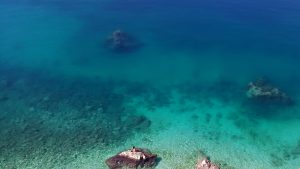
Leave the city behind for only a few minutes and the coastline changes almost without warning.
The long sandy beaches gradually disappear, replaced by smooth white pebbles, limestone rocks
and water so transparent that many first-time visitors instinctively slow down just to look at it.
The colour changes too. Instead of the softer blues found further north, the sea begins shifting
between emerald, turquoise and deep sapphire depending on the sun, the depth and the
movement of the waves.
This is the coastline that many locals quietly recommend when someone asks where the Bay of
Vlora begins to show its true character.
Swimming here feels completely different. The water usually becomes deeper more quickly,
making it ideal for confident swimmers. On calm days, visibility often extends several metres
beneath the surface, transforming even a short swim into an opportunity for exploration.
Bring a simple mask and snorkel.
You do not need expensive equipment or a diving licence to discover another world.
Only a few metres from the shore, shoals of silver seabream move gracefully between the rocks
while colourful wrasse dart through narrow cracks searching for food. Purple sea urchins cling to
the limestone, sea anemones wave gently with the current and tiny transparent shrimp almost
disappear against the pale seabed.
Move slowly.
The slower you swim, the more the sea rewards your patience.
Many people never realise that octopuses are surprisingly common along this rocky coastline.
During the day they remain hidden inside natural holes between the limestone, changing colour
almost perfectly to match their surroundings. Spotting one is difficult until you learn the small
clue that experienced snorkellers always look for.
A neat pile of broken shells.
Octopuses often leave the remains of crabs and shellfish just outside their underwater shelters.
Once you recognise this sign, every rocky crevice suddenly becomes a possible hiding place.
Seeing an octopus emerge cautiously, observe you for a few moments and disappear again in a
cloud of movement is an experience that many visitors remember more vividly than any
photograph they take that day.
There are other treasures too.
Occasionally, resting quietly on the seabed, you may notice an orange or reddish Mediterranean
sea star. Unlike tropical starfish, these blend naturally into the rocky environment and can easily
be overlooked. Finding one feels less like discovering wildlife and more like stumbling across a
carefully placed work of art.
It is remarkable how much life exists only a few steps from the beach.
Most visitors spend the day looking across the horizon.
The real spectacle often lies beneath them.
Radhimë – The Coastline That Teaches You to Slow Down
Continue south and the Bay of Vlora changes personality once again.
The coastline becomes quieter. Olive groves stretch almost to the sea, small family-run hotels
replace busy apartment blocks and the beaches unfold one after another in a series of intimate
coves separated by rocky headlands. Nothing here feels hurried.
Radhimë is not the kind of place that asks you to tick attractions off a list.
It encourages you to stay longer than planned.
The sea is often extraordinarily calm during the morning, making it ideal for paddleboarding and
kayaking. From the water, the coastline reveals details impossible to notice from land. Tiny caves
appear beneath limestone ledges, swallows nest high above the cliffs and the changing colours of
the sea become even more dramatic as the sunlight moves across the bay.
Walking along the shoreline is an experience in itself.
Instead of soft sand, many sections are covered with smooth pebbles polished by countless
winters of wave action. Between them lie shells carried ashore by changing currents. Some are
almost perfectly white, others display delicate shades of cream, pink or violet. Spiral sea snails,
fragments of fan mussels and tiny patterned shells no larger than a fingernail create natural
mosaics that change after every storm.
Children instinctively begin collecting them.
Adults usually end up doing exactly the same.
After strong winter seas, another small surprise sometimes appears among the pebbles.
Pieces of sea glass.
Once ordinary bottles discarded decades ago, years of rolling beneath the waves have
transformed them into smooth, frosted fragments of green, turquoise, amber and occasionally
deep cobalt blue. Collectors around the world search entire coastlines hoping to find pieces like
these, yet here they quietly appear after the sea has done its patient work.
Perhaps the greatest luxury in Radhimë is that nothing demands your attention.
No loud music.
No crowded promenades.
No timetable.
Only the rhythm of the sea.
Many visitors arrive planning to spend an hour.
They often leave wondering where the entire afternoon disappeared.
Every Beach Has Its Own Colour
People often ask why the water changes colour so dramatically along the Bay of Vlora.
The answer has surprisingly little to do with the water itself.
The sea acts almost like a mirror reflecting everything beneath and around it. Sandy seabeds
scatter sunlight differently from dark rocks. White limestone reflects light more intensely than
darker cliffs. Water depth changes the colours our eyes perceive, while the angle of the sun
transforms the same beach from bright turquoise at midday into deep sapphire during the
evening.
That is why photographs taken only a few kilometres apart often appear to show completely
different seas.
They do.
Not because the water changes.
But because the landscape beneath it does.
Perhaps this is the quiet secret of the Bay of Vlora.
It never asks you to admire the same view twice.
Every beach offers its own colours, its own sounds and its own pace.
And every visitor eventually discovers one that feels as though it had been waiting especially for
them.
Orikum – Where Every Adventure Begins
By the time you reach Orikum, the Bay of Vlora feels different once again.
The coastline opens towards the Karaburun Peninsula, boats become part of the landscape and
the horizon no longer marks the end of the journey. Instead, it feels like the beginning of another
one.
This is where many visitors realise that a beach can be much more than a place to swim.
Every morning, the marina slowly comes to life. Skippers prepare their boats, families gather
with bags and towels, kayaks are lowered into the water and small groups wait excitedly to board
speedboats heading towards Haxhi Ali Cave, the hidden beaches of Karaburun or the dramatic
cliffs overlooking the Ionian Sea.
Standing on the waterfront, it is almost impossible not to feel tempted.
Every boat seems to promise a different adventure.
One disappears towards sea caves carved into white limestone. Another heads for secluded coves
where there are no roads, hotels or restaurants, only crystal-clear water meeting untouched
nature. Others continue towards Sazan Island, carrying visitors across one of Albania’s most
fascinating maritime landscapes.
For many travellers, Orikum becomes the place where a beach holiday quietly transforms into an
expedition.
The beach itself reflects this spirit.
Unlike the lively atmosphere of Lungomare or the peaceful rhythm of Radhimë, Orikum carries
a constant sense of movement. Sailboats leave the marina, paddleboarders explore the sheltered
coastline and divers prepare their equipment before disappearing beneath the surface. The sea
here feels alive not because it is crowded, but because it constantly invites exploration.
On exceptionally clear days, if you look carefully across the water, you begin to understand why
this corner of Albania has fascinated sailors for centuries. The sea does not feel like a barrier. It
feels like an invitation.
Which Beach Is Right for You?
One of the greatest strengths of the Bay of Vlora is that it never forces visitors into a single
experience.
Instead, it offers a coastline where every beach answers a different question.
If your perfect holiday means shallow water where children can safely play for hours, Dalani is
difficult to beat.
If you enjoy discovering quiet places before everyone else does, Porto Nova rewards curiosity.
If you want to understand the emotional connection between the city and the sea, spend an
afternoon at the Old Beach.
If your ideal summer day combines swimming, cafés, ice cream and an evening walk,
Lungomare offers the complete Mediterranean city experience.
If your suitcase always includes a snorkel mask, head towards Uji i Ftohtë. The underwater
scenery alone justifies the journey.
If you dream of turquoise water, peaceful afternoons and hidden corners where time seems to
slow down, Radhimë will probably become your favourite.
And if every holiday needs at least one unforgettable adventure, Orikum is where your journey
truly begins.
The beauty of the Bay of Vlora is that none of these choices excludes the others.
During a single holiday, you can experience them all.
Small Things Most Visitors Never Notice
The Bay of Vlora rewards people who slow down.
Instead of rushing from beach to beach, stop for a moment and pay attention to the details.
Look between the rocks before entering the water. Small blennies and gobies often watch
curiously before disappearing into tiny underwater caves.
Pick up a shell and notice how no two patterns are exactly alike. Every colour, ridge and spiral
tells the story of a different marine creature that once lived beneath these waters.
Walk barefoot across smooth pebbles warmed by the afternoon sun before diving into the cool
sea. The contrast lasts only a few seconds, yet it is one of those sensations visitors remember for
years.
Float quietly without speaking.
You begin hearing sounds that disappear on crowded beaches: the gentle clicking of pebbles
rolling with each wave, the distant splash of fish breaking the surface, swallows circling above
the cliffs and the soft echo of water entering hidden cracks beneath the limestone.
Even the scent changes as you travel south.
Near the city, the air carries traces of coffee, restaurants and the promenade.
Further towards Radhimë and Orikum, it gradually fills with wild herbs, pine trees, olive groves,
warm stone and salt carried inland by the afternoon sea breeze.
These are details that almost never appear in guidebooks.
Yet they are often the memories people carry home.
Beyond the Beach
One of the biggest mistakes visitors make is believing that the beach ends where the water
begins.
In the Bay of Vlora, the coastline continues beneath the surface, above the cliffs and beyond the
horizon.
Bring a pair of swimming goggles and discover an underwater world filled with fish, colourful
shells and remarkable marine life.
Walk a little further along the rocks instead of stopping at the first free space. Some of the most
beautiful viewpoints are found only a few minutes away from the main beaches.
Stay until sunset at least once. The changing light transforms every beach into a different place,
while the limestone of Karaburun slowly turns from pale grey to gold, then orange and finally
deep purple before disappearing into the evening.
Wake up early one morning.
Before nine o’clock, the sea often becomes almost perfectly still. It is the best moment for
swimming, snorkelling or simply watching the Bay of Vlora wake up in complete silence.
Sometimes a curious dolphin appears briefly offshore before disappearing just as quickly as it
arrived. There are no guarantees, and perhaps that is exactly what makes such encounters
unforgettable.
The Bay rewards curiosity.
The more patiently you explore it, the more generously it reveals itself.
Conclusion
The greatest surprise waiting along the Bay of Vlora is not that its beaches are beautiful.
Beautiful beaches exist throughout the Mediterranean.
What makes this coastline unforgettable is that it refuses to repeat itself.
Within less than thirty kilometres, you move from quiet lagoons alive with birdlife to beaches
filled with the energy of the city. You swim above sandy seabeds in one place and explore rocky
underwater worlds in another. One morning you collect colourful shells polished by the sea. The
next, you may discover an octopus watching from beneath a limestone ledge or find a secluded
cove that can only be reached by boat.
Every beach offers a different way of experiencing the sea.
Together, they reveal the true personality of the Bay of Vlora.
Perhaps that is why people rarely leave saying they have seen everything.
Instead, they begin planning which beach they will return to first.
Because this coastline never feels completely explored.
There is always another cove around the next headland.
Another shell polished by the waves.
Another sunset that somehow looks different from the last.
The Bay of Vlora does not ask you to choose its best beach.
It simply invites you to keep discovering it.
Editorial Note
This article is part of the MAREOGRAPH Editorial Project, an independent editorial initiative
founded and developed by Valza Boutique Hotel to document the history, geography, culture,
gastronomy and thoughtful hospitality of the Albanian Mediterranean through research-based
storytelling.
Experience the Place
If this story inspires you to discover the beaches of the Bay of Vlora, Valza Boutique Hotel offers
an ideal base between the vibrant Lungomare and the crystal-clear waters of Uji i Ftohtë. From
here, every beach described in this guide lies within easy reach, while Eden by Valza completes
the experience with Mediterranean cuisine overlooking one of the most beautiful sunsets in
Albania.


