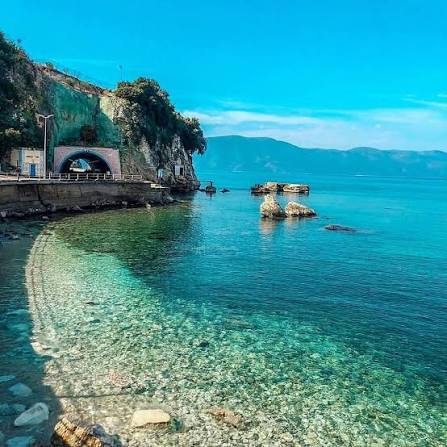
Uji i Ftohtë, literally “Cold Water”, is the coastal neighbourhood on the southern side of Vlorë, about 7.5 km by road from Flag Square, where the promenade reaches an old road tunnel and the shore turns to pebbles and clear water. Its name comes from 32 freshwater springs along 1.7 km of coast that still supply the city’s water.
Uji i Ftohtë at a glance
- What it is
- The coastal neighbourhood of Vlorë named after 32 freshwater springs that rise at sea level along the shore.
- Where
- The southern side of Vlorë, about 7.5 km by road from Flag Square, around 15 minutes by car (Google Maps).
- Time needed
- A morning for the walk and a swim.
- Best time
- Early morning or late afternoon; summer to swim, spring to walk.
- Cost
- Walking is free. Umbrella and two sunbeds: 1,000–2,000 lekë, or two free spots on our beach map.
- Good for
- Swimmers, walkers and the curious.
The neighbourhood that waters a city
Lie on the pebbles of Uji i Ftohtë on an August afternoon and you are within a stone’s throw of the plumbing of an entire city. Hidden in the rock behind the beaches, three horizontal galleries run parallel to the shore, 60–70 metres back from the water and only 0.2–0.5 metres above sea level. They were dug to catch the spring water before it reaches the sea. On average they collect about 2.0 cubic metres a second, some 2,000 litres every second, and around 0.8 cubic metres a second goes into Vlorë’s water supply. The figures come from a 2023 study by the hydrogeologist Romeo Eftimi and colleagues in the journal Hydrology.
What the galleries miss still slips into the bay, and you can feel it. Swim out from the shore and, without warning, the sea around your legs turns cold, then warm again two strokes later. Albania’s National Tourism Agency describes exactly this: natural freshwater springs flowing into the sea, in sharp contrast with the temperature of the water around them. Once you know this, the name on the road signs stops sounding like a slogan. It is a description.
Why the cold stays on top. Fresh water is lighter than salt water, so the spring water spreads over the bay in a thin, cold layer before it mixes, which is why the chill often reaches you first at the surface. And it is truly fresh: the chloride measured in the galleries, 20 to 150 milligrams per litre, is more than a hundred times lower than in seawater (Eftimi and colleagues, 2023).
Where the cold water comes from
The ridge behind Vlorë’s southern coast belongs to the Lungara massif, which rises to 1,863 metres at Qiramanga; one of its summits, Tragjas, reaches 1,281 metres. A major fault line runs along its western flank from Dukat to Uji i Ftohtë, which is why the mountain drops so steeply into the bay. Much of the rain that falls on those slopes never becomes a river. It sinks into the Tragjas karst massif, a body of Triassic dolomite and Jurassic to Eocene limestone, and travels through fractures and cavities until it meets the coast. Our piece on how limestone shapes the Albanian Mediterranean explains the process.
Why does the water come out fresh, right at the edge of the sea? Here the limestone meets younger clay formations, and that contact works as a barrier that keeps seawater out of the aquifer. It is not the rule on this coast: along the 147 km from Vlorë to the Greek border, a 2022 review by Eftimi and colleagues estimates that about two thirds of the karst water is brackish.
How the springs of Uji i Ftohtë work, simplified. Figures from Eftimi and colleagues, Hydrology (2023): three galleries 60–70 metres from the shore and 0.2–0.5 metres above sea level collect about 2.0 cubic metres a second, of which about 0.8 go to the water supply of Vlorë.
The coast, from the tunnel to Lungomare 3
- 1920
After the Vlorë War, when Albanian fighters drove the Italian army out of the city, Qazim Koculi, who had headed the insurgents’ military committee, is given a villa on top of the Uji i Ftohtë hill.
- Communist era
The hill becomes the regime’s spring and summer address: Enver Hoxha has a three-floor villa with a veranda facing the sea, and Mehmet Shehu one almost at the water’s edge.
- 2 April 1976
During one of his stays, Hoxha holds a meeting with party and government cadres of the Vlorë district; the minutes survive in the Central State Archive.
- Early 1990s
The political changes alter Uji i Ftohtë completely: apartment blocks, hotels, restaurants, cafés and beach venues are built in the post-communist decades.
- 2011
Albanian television reports works to widen the old road tunnel, dug during the First World War by military engineers, from one lane to two.
- 2023
Work begins on Lungomare 3, a new seafront designed to run from Uji i Ftohtë to Radhimë and Orikum, with a cycle lane planned from the tunnel to Orikum.
The villas that kept the coast for the few
Good views attract power. Ordinary citizens could not come close to the villas: the grounds were fenced and guarded, and older residents of Vlorë remember the years when the area was closed off. In his final years, a reportage republished by Memorie.al says, the main villa was used more by Hoxha’s children than by Hoxha himself. The villas still stand, and they are still government property, so enjoy them from the sand and the road. The beach beside them took their name: Te Vilat, literally “at the villas”, today a paid beach area with umbrellas and sunbeds.
The regime chose this coast for the reasons people choose it today: height above the water, pines, views across the bay and distance from the crowded centre. Locals now call the modern neighbourhood Lungomare 2, and the pavement carries you from the city into it without a break. The view once reserved for a Politburo now belongs to everyone who comes down to the shore. Our beach map of Uji i Ftohtë shows Te Vilat and the other beaches a few minutes from the hotel.
A walk along the springs coast
The best way to understand Uji i Ftohtë is on foot, with swims along the way. The walking is short and easy; the swims take the rest of the morning. Our own favourite walk goes the other way: early in the morning, before the sun comes up over the mountains, or in the late afternoon, we leave Uji i Ftohtë on foot and follow the sea towards the city. The promenade is quiet, the bay is still, and Vlorë wakes up, or slows down, in front of you.
-
Start at the tunnel. Te Tuneli is the hinge between city and coast: right next to Te Vilat beach, the spring water surfaces beside the road.
-
Pass the old villas. Te Vilat takes its name from the villas behind the beach, built for the communist leadership and still government property today.
-
Swim where the water turns cold. Take a mask: rocks, small fish and a pale seabed start a few metres out, and snorkelling in the Bay of Vlora needs no boat.
-
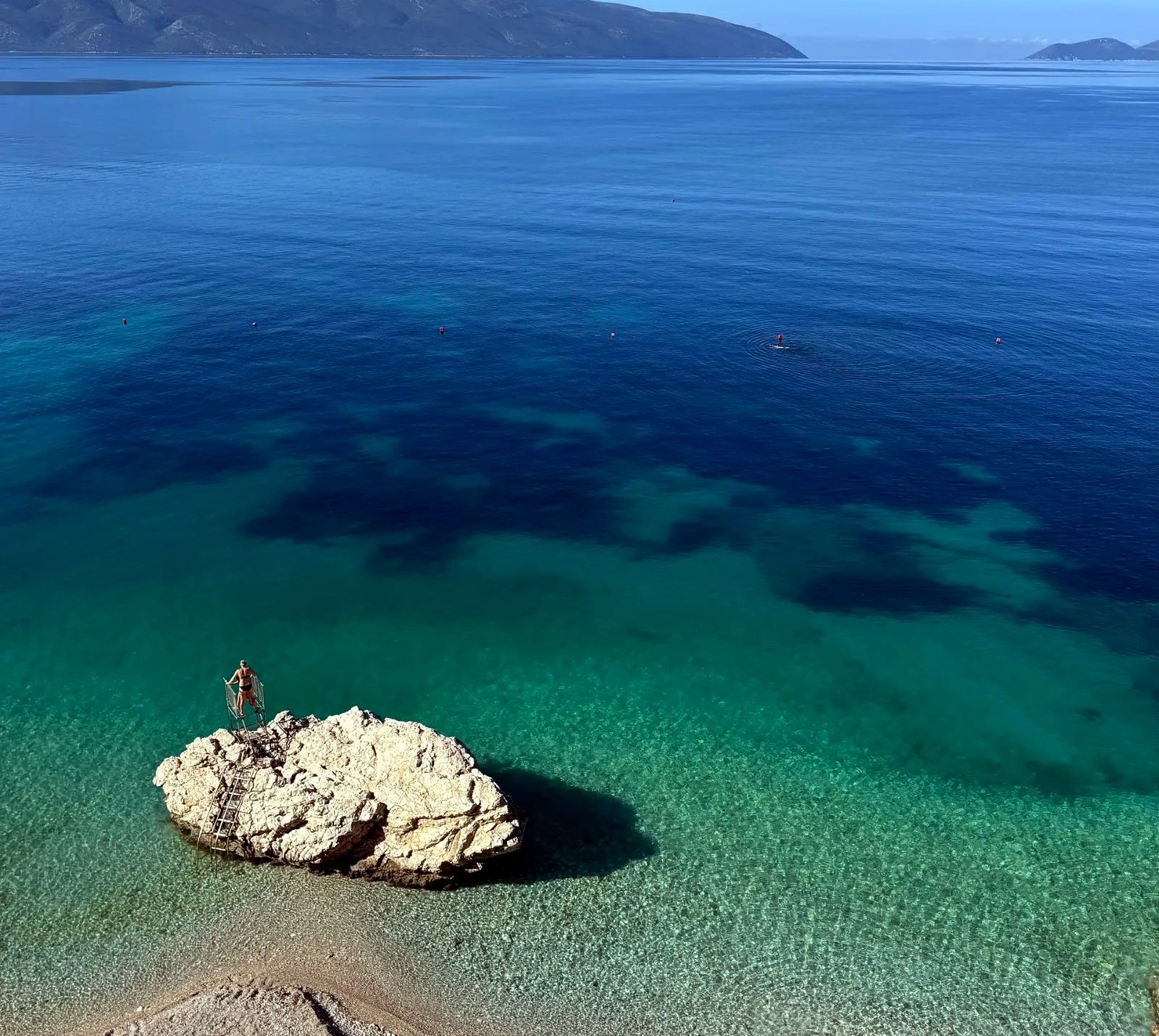
Watch the divers at Kalaja. “Kalaja” is not a castle but a tall rock above the water, and on summer days the young people of Vlorë dive from it.
-
Continue south. Past Kalaja, the beaches of Hotel Kristera and Hotel Nimfa follow one another along the coast, calmer and rockier underfoot, with fewer people.
-
Come back for sunset. Walk back north as the sun goes down behind Sazan Island and Karaburun, then finish the day on the rooftop of Eden by Valza.
Two safety notes. If you jump from the rocks, check the depth first and never jump alone. And get into the water slowly: the cold patches catch first-time swimmers by surprise.
The springs coast on one map. The stretch of Uji i Ftohtë from the pier opposite Hotel Priam to Hotel Nimfa, with Te Vilat, the summer estate and Valza Boutique Hotel in the middle. For prices and free spots, see our beach guide.
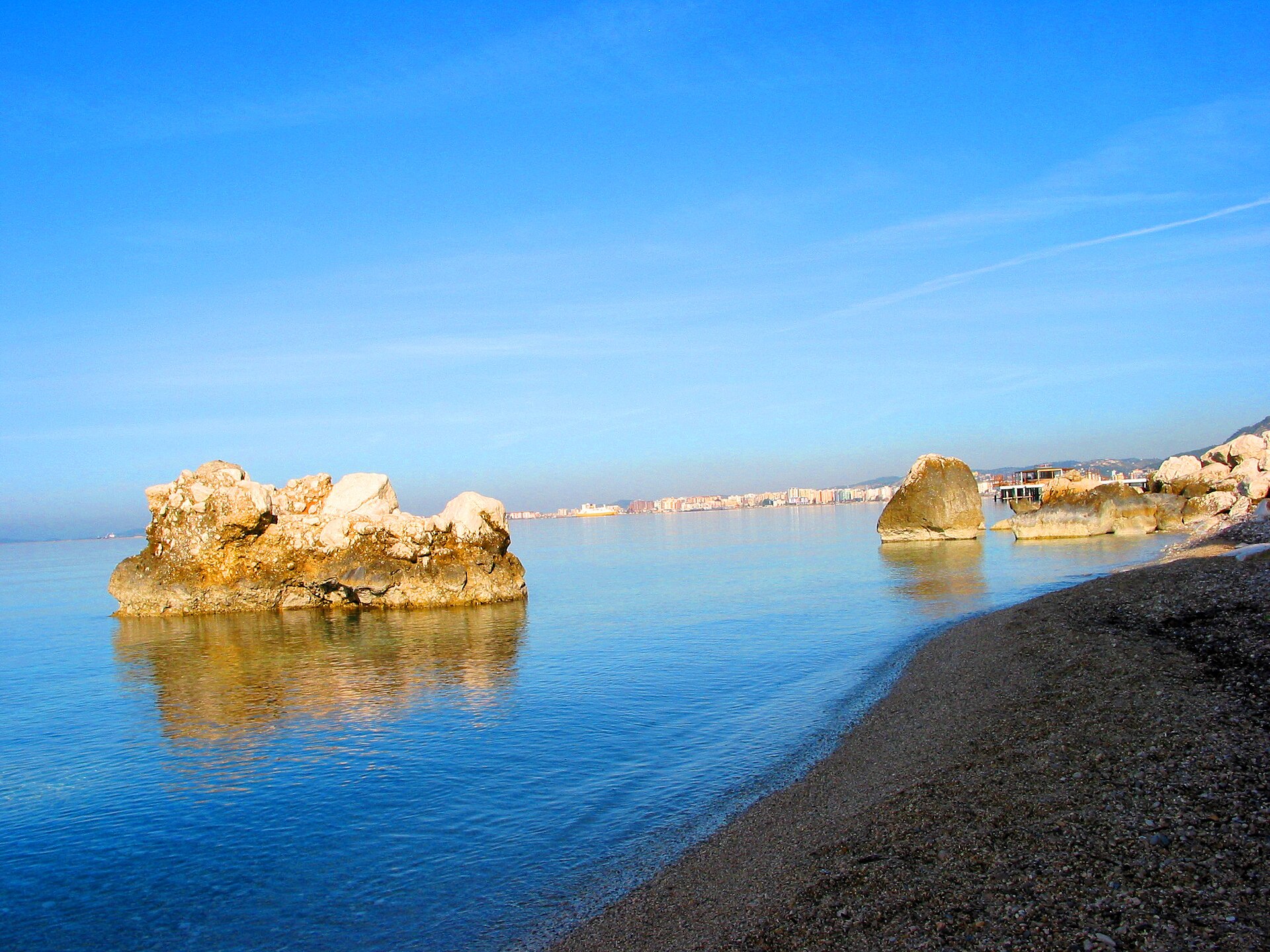
See it from above. Maps tell you where things are; this one-minute film shows what they look like. Filmed by our team, it follows the coast of Uji i Ftohtë from the air: the clear water over the pebbles, the white rocks and the path along the shore that you will walk.
Uji i Ftohtë from the air and from the shore, in one minute.
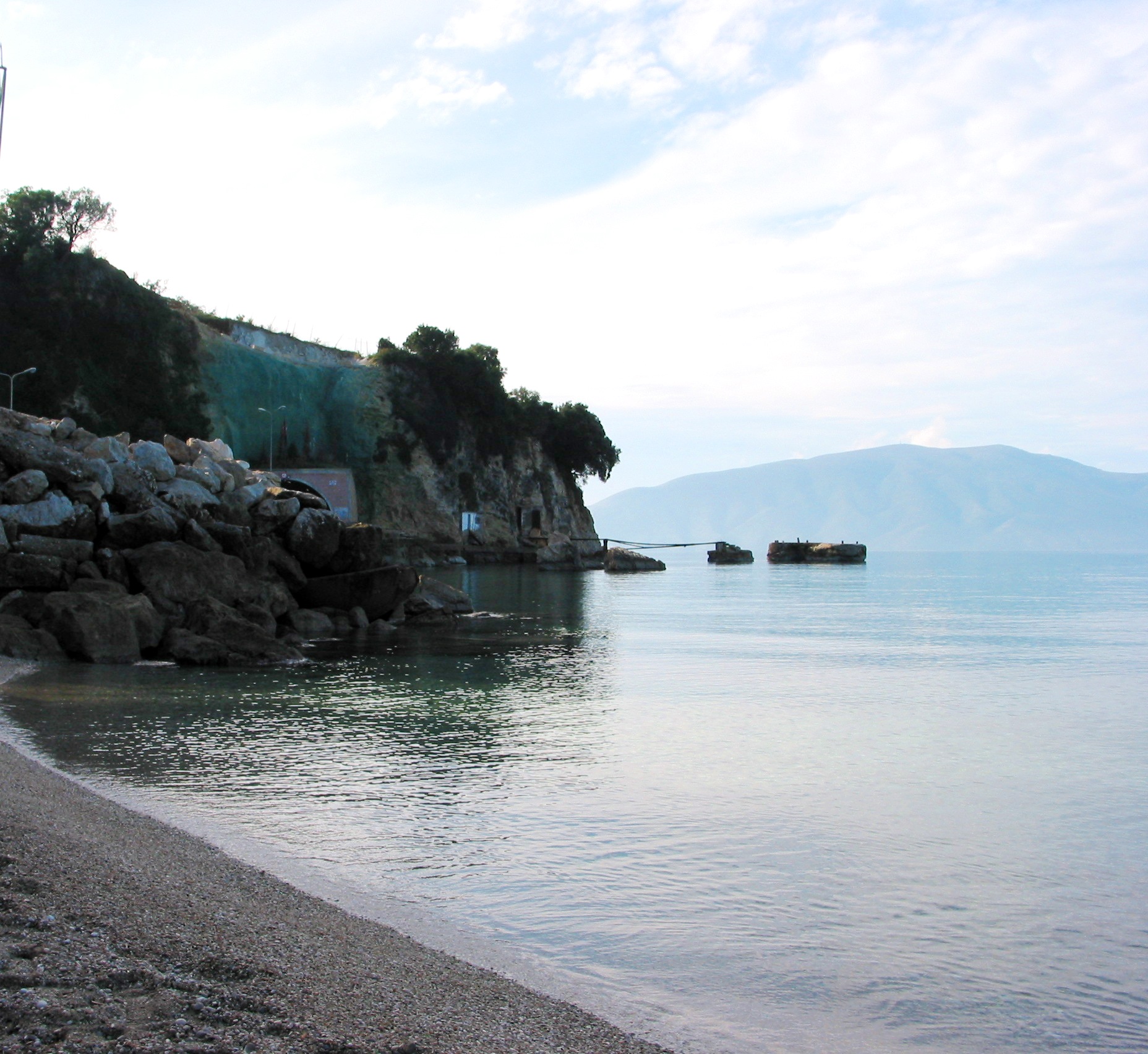
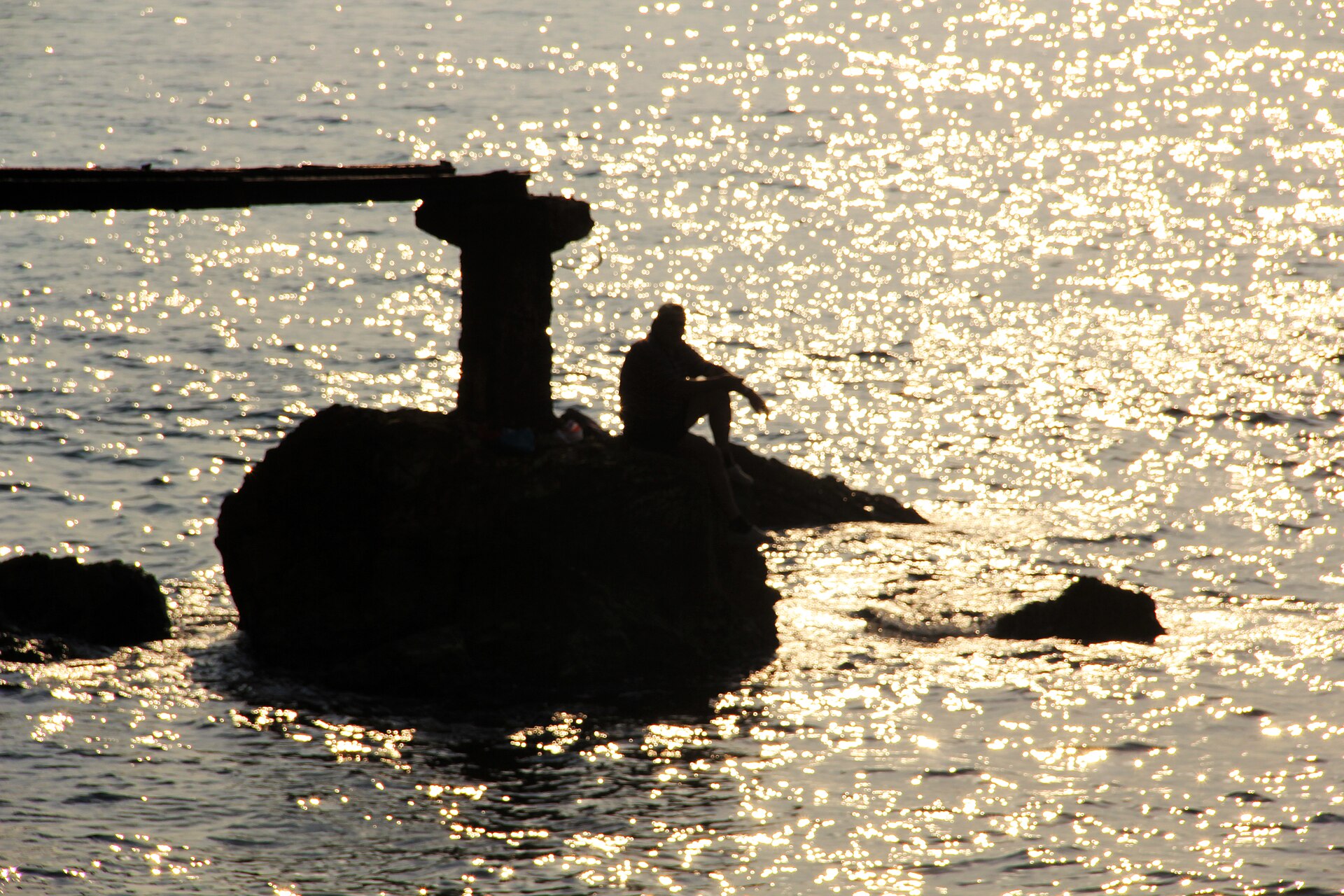
Uji i Ftohtë in pictures
-
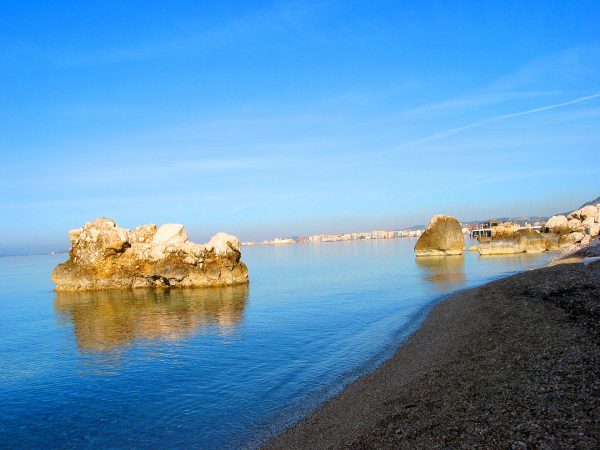
Photo: Thanas Todhe, CC BY 3.0, via Wikimedia Commons -
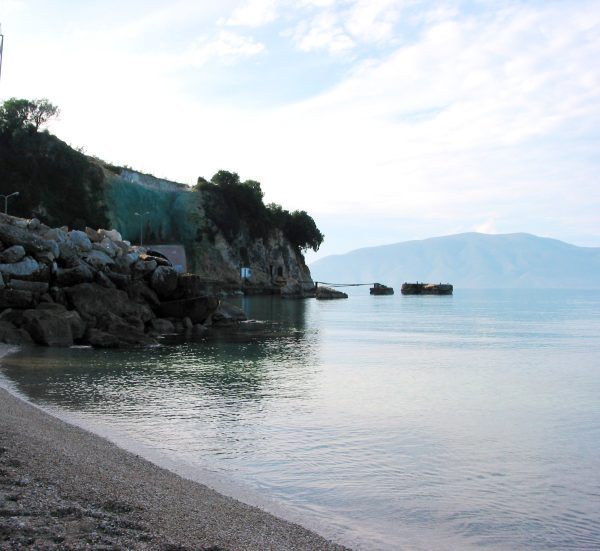
Photo: Thanas Todhe, CC BY 3.0, via Wikimedia Commons -
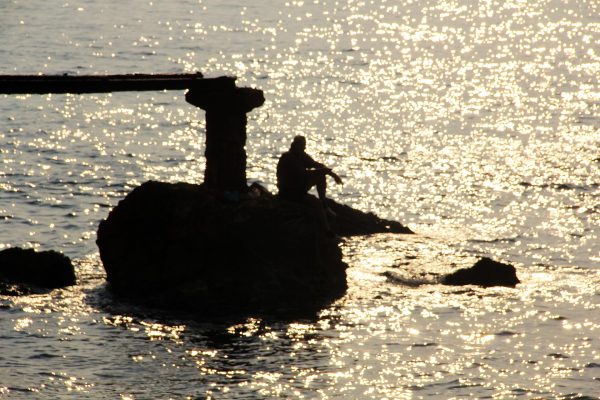
Photo: Anila amataj, CC BY-SA 4.0, via Wikimedia Commons
Myths and legends
Myth“The spring water is pure, so it is fine to drink.”Tap to see the reality
Reality People from Vlorë still come to Te Tuneli with bottles to fill, but our honest advice is not to copy them. Since at least 2009, bacteriological analyses have found the springs heavily polluted: homes without a centralised sewage system have spread over the hillside that feeds them, and the only response so far has been more chlorine in the supply. Enjoy the cold water in the sea, and keep your drinking water for the bottle in your bag.
Myth“Te Kalaja is a castle.”Tap to see the reality
Reality There is no castle at Te Kalaja. “Kalaja” is a tall natural rock above the water, and on summer days the young people of Vlorë gather to dive from it.
Myth“The villas are open to visitors.”Tap to see the reality
Reality The villas still stand, and they are still government property, so enjoy them from the sand and the road. The beach beside them, Te Vilat, is now a paid beach area with umbrellas and sunbeds.
Did you know?
-
32 springs
Emerge at sea level along this shore
-
1.7 km
The stretch of coast where the springs rise
-
2,000 litres
Collected every second on average by three galleries parallel to the shore
-
1,863 m
Height of Qiramanga, the peak of the Lungara massif behind the coast
Test yourself: how well do you know Uji i Ftohtë?
1. What does Uji i Ftohtë mean?
Show the answer
Cold Water. The name describes the freshwater springs that rise along this stretch of coast.
2. How many springs emerge at sea level along the shore?
Show the answer
32. Hydrogeologists count 32 springs along a 1.7 km stretch of coast.
3. What is “Kalaja” at Te Kalaja?
Show the answer
A tall natural rock above the water. There is no castle: young people from Vlorë dive from the rock on summer days.