A village that paid its taxes in salt, ships loaded with white crystals for Europe, and basins that turn pink at the end of every summer.
The Narta salt pans, Kriporja e Nartës, are Albania’s only working saltworks: about 1,470 hectares of shallow basins at the northern end of the Narta Lagoon, near Vlorë, where seawater turns into salt under the summer sun. Salt has been made around Vlorë for more than four centuries, and the modern works date from 1958. From late summer the basins turn pink, and flamingos come to feed. From Valza Boutique Hotel in Uji i Ftohtë it is about 18 km, around 30 minutes by car.
The salt pans of Vlorë at a glance
- What it is
- A working saltworks of shallow evaporation basins, the only one left in Albania, inside a protected landscape.
- Where
- At Skrofotinë, at the northern end of the Narta Lagoon, north of Vlorë along the road towards Fier.
- From Valza
- About 18 km, around 30 minutes by car.
- Best time
- Late summer to early autumn, roughly August to October, for the pink basins; winter for flamingos.
- Time needed
- One to two hours; half a day with the Narta Lagoon and Zvërnec.
- Cost
- Free to look at from the public roads. The basins themselves are a working site, not a visitor attraction.
Why do the salt pans of Narta turn pink?
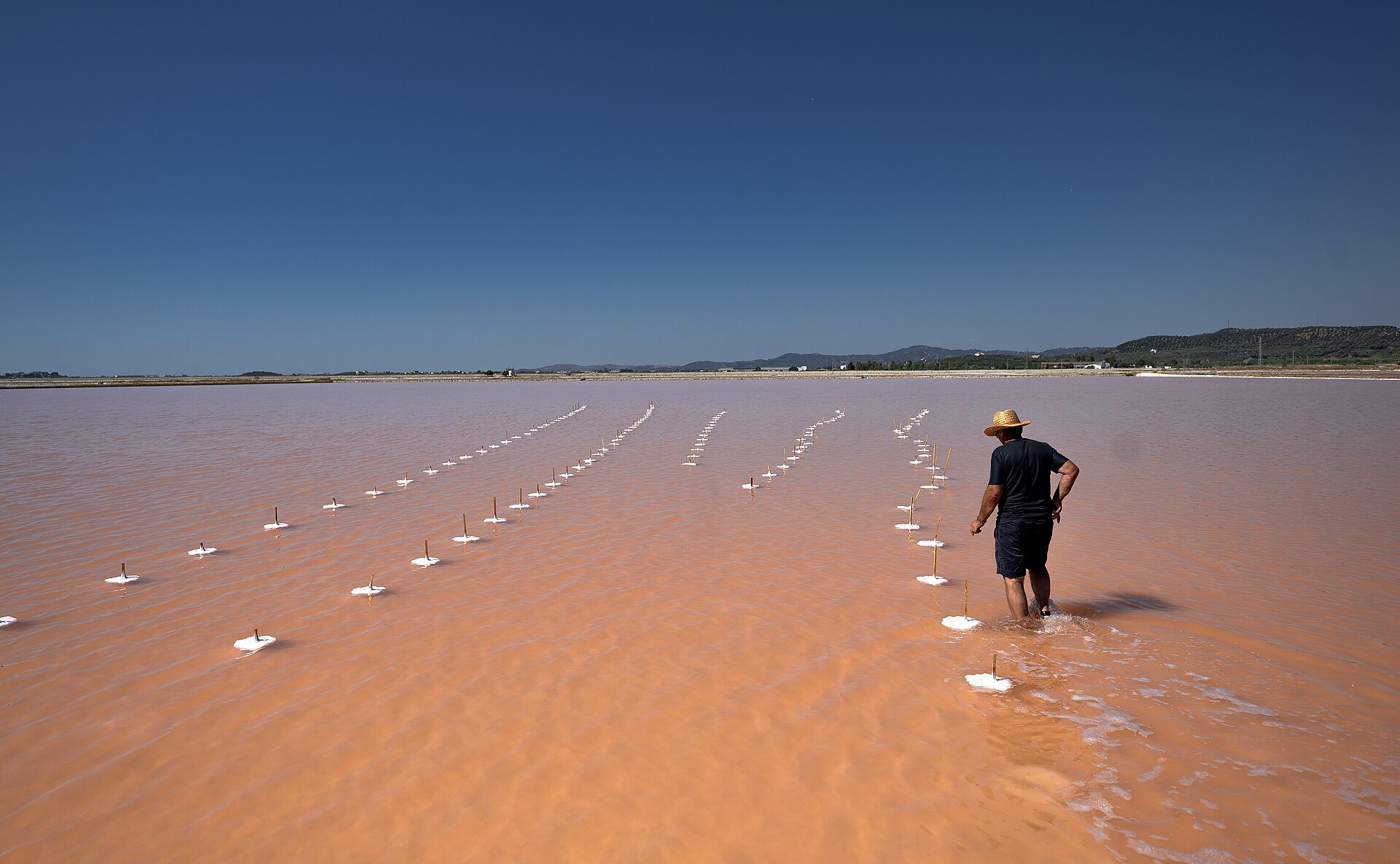
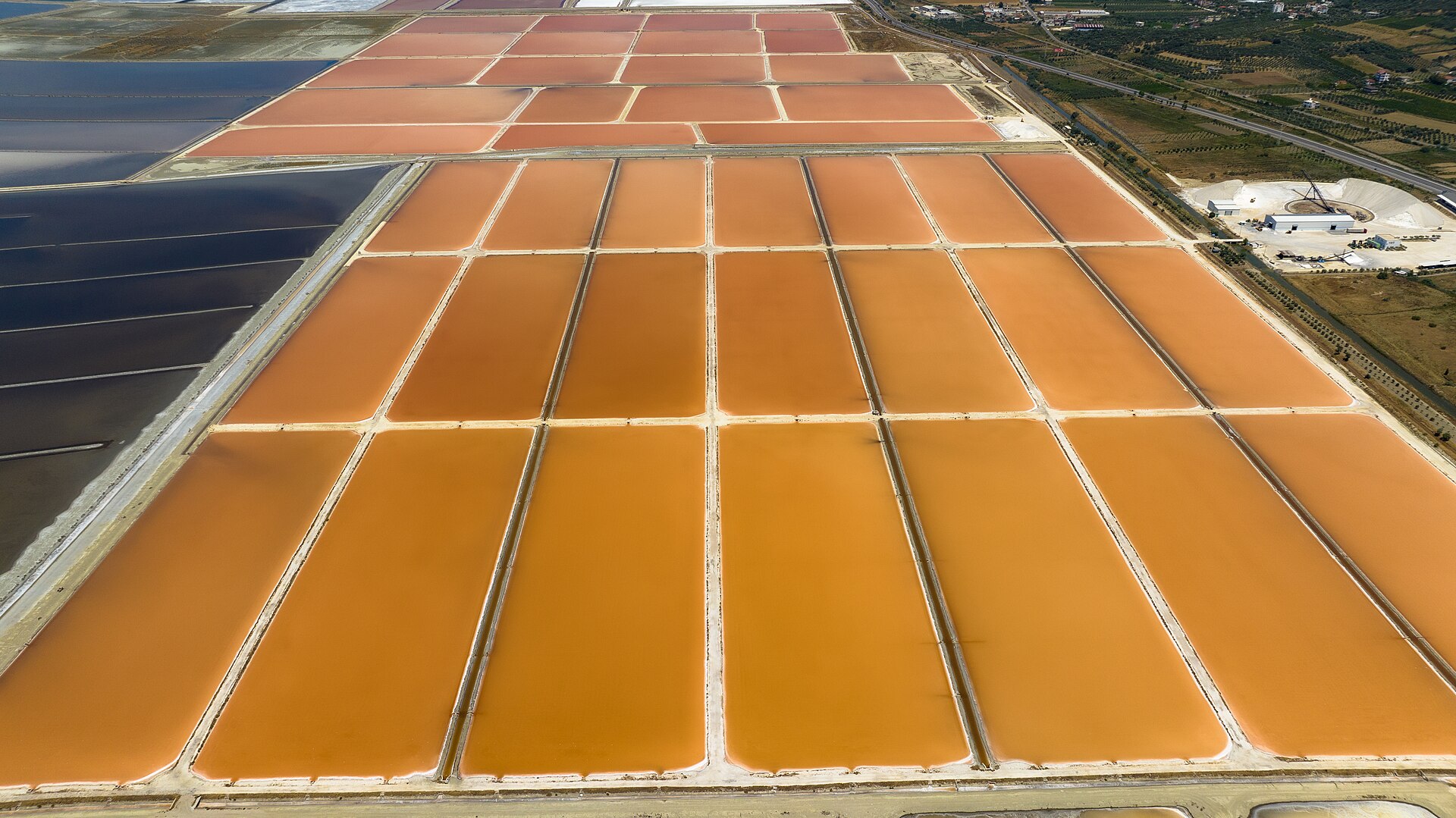
The pink is alive. As seawater moves from basin to basin and the sun evaporates it, the brine becomes many times saltier than the sea. Almost nothing can live in it, except a few organisms that love salt: a microscopic green alga called Dunaliella salina, which protects itself with orange beta-carotene, and above all tiny salt-loving microbes, the haloarchaea, which carry red pigments in their cell walls. The Israeli microbiologist Aharon Oren, who has spent decades studying salt lakes and saltworks, concluded that these red pigments of the haloarchaea are the main reason why saltern ponds turn pink and red.
That is why the colour changes from basin to basin and from month to month. The first basins, still close to the salinity of the sea, look grey or blue. The last ones, where the salt is about to crystallise, can be peach, coral or deep rose. In Vlorë the strongest colours come at the end of the hot season, roughly from August to October, when evaporation is at its peak and the salt is ready to be harvested. On a grey day in April you may see nothing pink at all.
The lagoon itself changes with the seasons. Scientists measuring the Narta Lagoon have found its salinity rising from about 36 grams of salt per litre in winter, close to the open sea, to about 78 grams in summer, more than twice as salty. The salt pans take this further still: every year they draw about 15 per cent of the lagoon’s volume of water into their basins, and only in the last ones, where the brine is far saltier again, does the salt begin to crystallise.
The flamingos are part of the same story. In saltworks around the Mediterranean, greater flamingos feed mainly on brine shrimp, the small crustaceans that live in salty basins, and the colour of a flamingo’s feathers comes from the carotenoid pigments in what it eats. No one has yet published a study of the brine shrimp of Narta, but the birds know where the food is: Narta is the main wintering site for flamingos in Albania, and in June 2026 about 2,000 of them were seen in the Vlorë saltworks preparing to nest.
How old is salt-making in Vlorë?
The modern saltworks opened in 1958, but the salt of Vlorë is much older. Three witnesses, writing centuries apart, describe the same coast and the same work.
Salt also fed another trade. Researchers from the University of Florence, who studied the villages around the lagoon, note that salted fish from the lagoon was once renowned along the whole Adriatic coast. The technique has since been lost, but it explains why salt and fishing appear side by side in every account, from Evliya to the present.
Why did the Italians call it Arta?
On old Italian maps and books the lagoon is not Narta but Arta. Hahn already wrote “Narta or Palaia Arta” in 1854. The Italian encyclopaedia Treccani, in its entry on Valona of 1937, speaks of the laguna di Arta, cut off from the sea by a strip of land, and lists the extraction of salt from that nearby lagoon among the industries of the town. In 1961 the same encyclopaedia could still write that the salt pans of Arta near Valona were in working order.
Be careful with old pictures, though. There is another Arta, a town in north-western Greece, on a gulf with lagoons and salt pans of its own, and Hahn describes those too. A caption that says only “saline di Arta”, without Valona, may show Greece rather than Vlorë.
In the Italian period the salt pans were part of Vlorë’s small industrial landscape. The 1940 Italian guide to Albania mentions the bitumen of Selenicë and the salt pans of Narta as being linked to the port by narrow-gauge railways, and an Italian military map of 1939 shows the historic salt pans next to the railway, near the village of Narta. Those older pans were later abandoned.
1958: the modern saltworks of Skrofotinë
In the early 1950s the northern part of the Narta Lagoon was closed off and turned into salt pans, at a place called Skrofotinë. Production began in 1958. In the first years the works produced 25,000 to 30,000 tonnes of salt a year and employed about 250 people from Vlorë and the villages around it. From 1975 they also produced iodised salt, about 5,000 tonnes a year. At the peak, between 1975 and 1985, output reached about 140,000 tonnes a year, and the works employed about 1,250 people.
Not all of that labour was free. From 1967 to 1972 a unit of political prisoners, Unit 309, was based at Skrofotinë. In 1969 there were 340 of them. They dug the deep canals of the saltworks and built an embankment eight kilometres long that separates the salt pans from the marsh. When you drive along the straight dykes today, you are driving on part of their work.
After 1990 production fell to about 20,000 to 25,000 tonnes a year. In 2009 the state granted a 35-year concession to private companies, and the works are run today by ALB-SALE-VLORA. They remain the only salt production area in the whole of Albania.
-
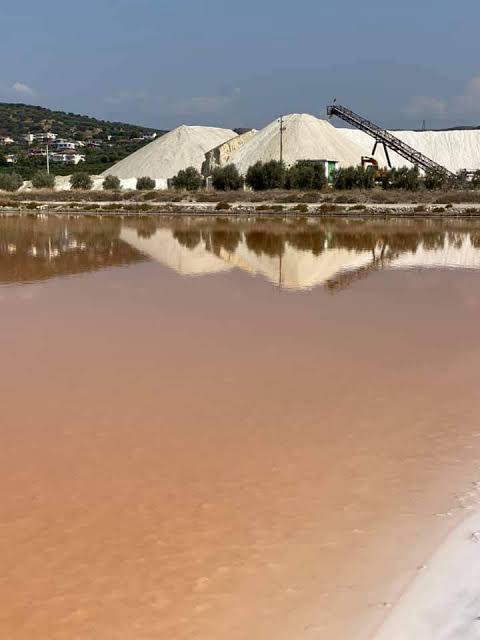
The harvest: heaps of salt and the conveyor, reflected in a pink basin. Photo: Valza Boutique Hotel -
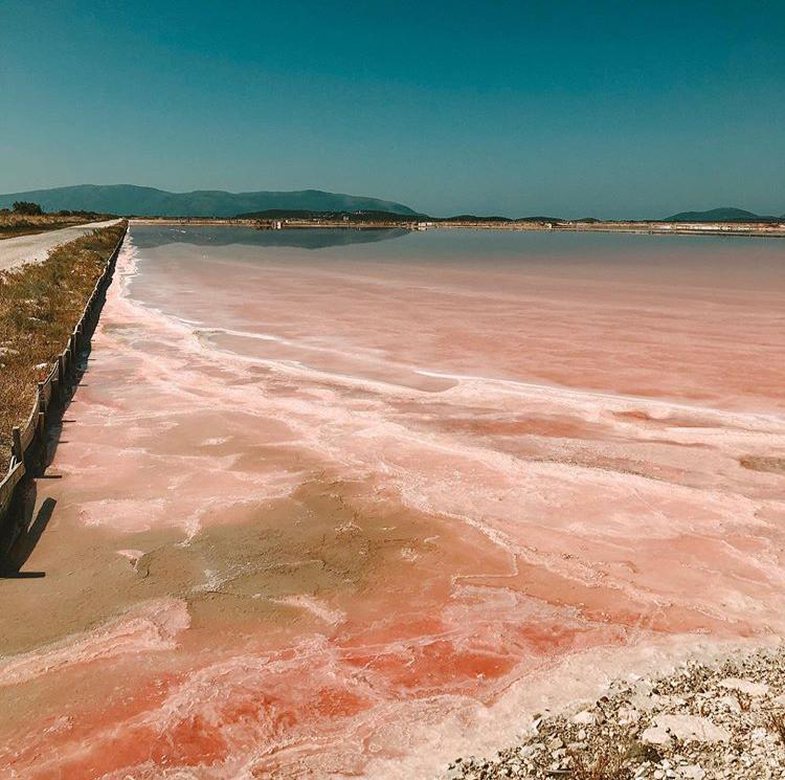
Pink brine and a crust of new salt beside the dyke road. Photo: Valza Boutique Hotel
The salt of Vlorë in dates
- 1583
The Ottoman register of Vlorë lists a quarter called Tuzla, salt-works, and a community of salt workers with a quarter named Narta.
- 1670
Evliya Çelebi describes the villagers of Zvërnec making salt instead of paying taxes, and the white salt shipped to Europe.
- 1854
Johann Georg von Hahn describes 100 workers, salt dry in 48 hours and 15,000 to 20,000 horse-loads a year, most of it for Shkodër.
- 1937
The Treccani encyclopaedia lists salt from the laguna di Arta among the industries of Valona.
- 1939–1940
An Italian military map shows the historic pans near Narta; the Italian guide to Albania links the salt pans to the port by narrow-gauge railway.
- Early 1950s
The northern part of the Narta Lagoon is turned into the modern saltworks of Skrofotinë.
- 1958
Production begins: 25,000 to 30,000 tonnes a year, with about 250 workers.
- 1967–1972
Political prisoners of Unit 309 dig canals and build an 8 km embankment between the salt pans and the marsh.
- 1975–1985
The peak: about 140,000 tonnes of salt a year and about 1,250 workers; iodised salt from 1975.
- 2009
A 35-year concession hands the works to private operators.
- 2022
The salt pans lie inside the renamed Pishë Poro–Nartë Protected Landscape.
Why are the salt pans so important for birds?
The saltworks are the heart of one of Albania’s great wetlands. According to the national agency for protected areas, the salt pans are made of many shallow pools and small islands, ideal for nesting waterbirds, and almost 88 per cent of the breeding waterbirds of the area are concentrated here. Flamingos are regular visitors, and winter counts on the Narta Lagoon as a whole have recorded more than 48,700 waterbirds, second in Albania only to Karavasta.
The salt pans and the lagoon around them are protected as part of the Pishë Poro–Nartë Protected Landscape, established in 2004 as Vjosë–Nartë and renamed and redrawn in 2022. They are not part of the Vjosa Wild River National Park created in 2023, which follows the river inland. For more on the birds of the whole lagoon, read our guide to the Narta Lagoon, its flamingos and pelicans.
-
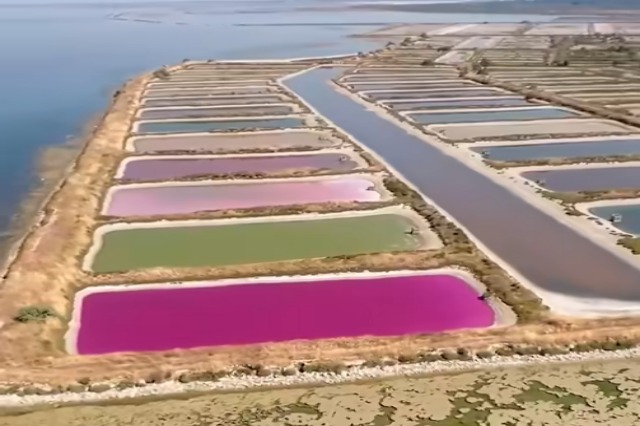
Each basin a different colour, depending on how salty it has become. Photo: Valza Boutique Hotel -
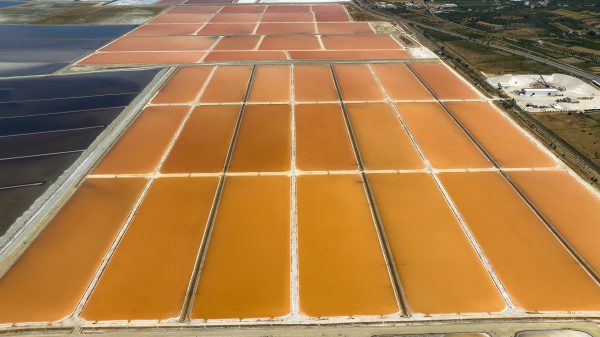
Kriporja e Nartës. Photo: Arbenllapashtica, CC BY 4.0, via Wikimedia Commons -
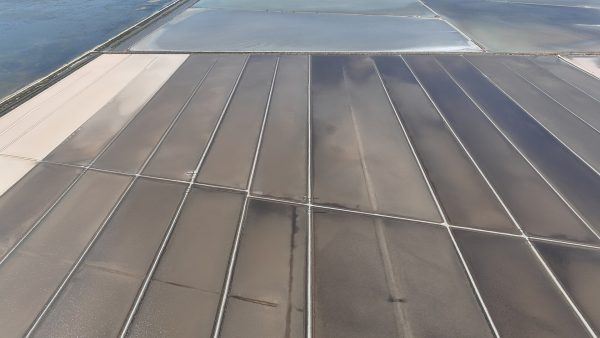
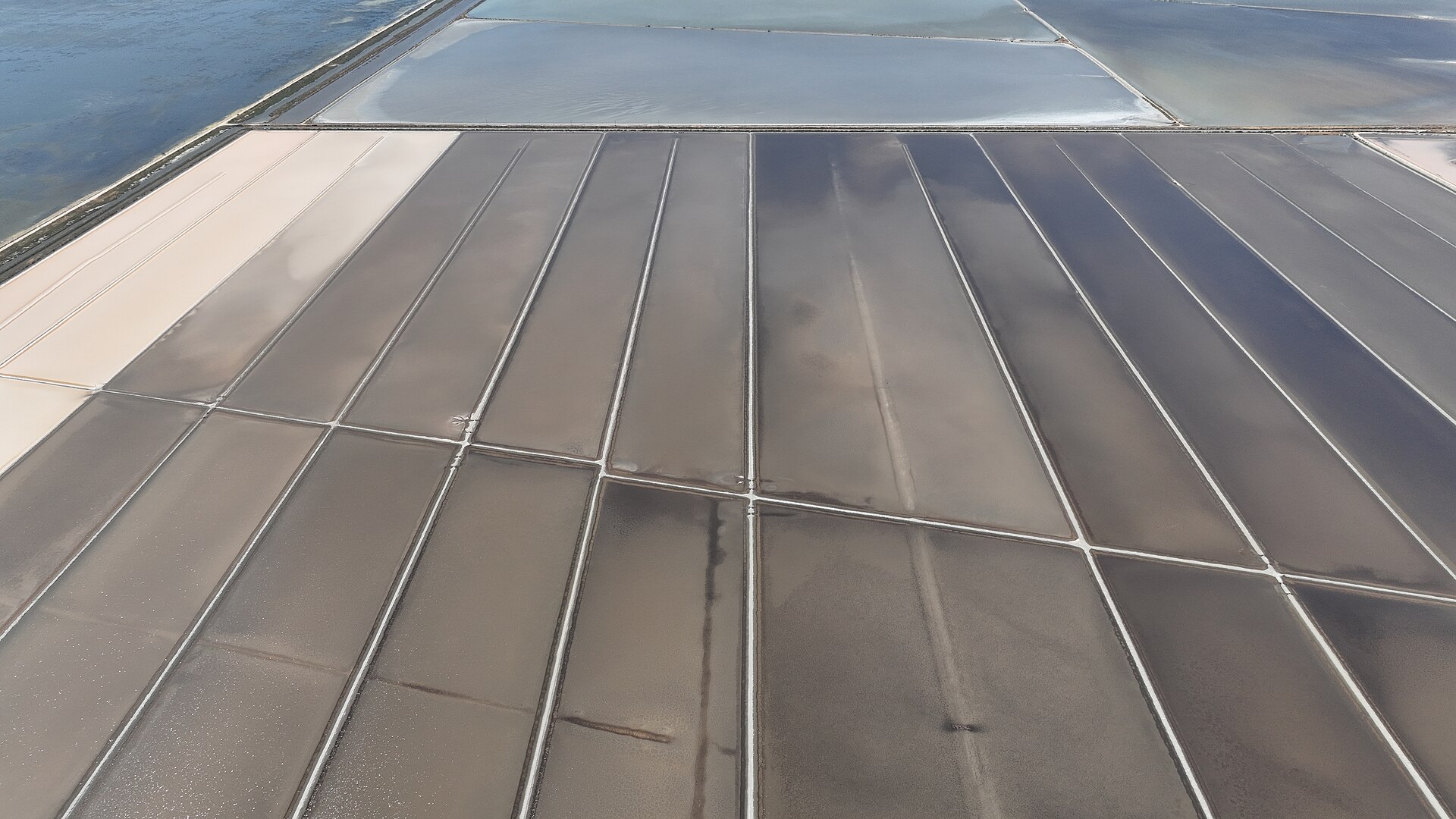
Kriporja e Nartës from above. Photo: Arbenllapashtica, CC BY 4.0, via Wikimedia Commons
How to see the pink salt pans
The saltworks are a working industrial site, not a park, and there is no official viewpoint or visitor centre. You see them from the public roads and dykes along the north of the lagoon, on the way from Vlorë towards Narta and Zvërnec. Stay on the road, do not walk into the basins or onto the salt, and keep your distance from nesting birds, especially from spring to early summer.
Come at the right moment. The pink is strongest from about August to October, on hot, still days, and it photographs best in the low light of early morning or the hour before sunset. Flamingos are easiest to see from autumn to spring. If you fly a drone, check the rules of the Albanian Civil Aviation Authority first: this is a protected landscape with nesting colonies, and the new Vlora International Airport stands right beside the lagoon.
A half-day on the lagoon
Leave Uji i Ftohtë in the late afternoon, drive north past the salt pans, then follow the lagoon road to the wooden bridge of Zvërnec and the monastery among the pines.
For photographers
Come between August and October, early or late in the day, with a zoom lens for the flamingos and the patience to wait for still water.
For birdwatchers
Winter and the migration months bring the largest numbers. Bring binoculars and a bird guide, and watch from the road.
With children
Turn it into a game: who spots the pinkest basin, the first flamingo, the biggest heap of salt.
What to bring
- Binoculars for the flamingos
- Sunglasses: the salt and the water reflect a lot of light
- A hat and water, as there is no shade along the dykes
- A camera with a zoom lens
Did you know?
-
48 hours
From seawater to dry salt in the hottest weeks, as Hahn saw it in 1854
-
130 fields
One for each house of Narta, worked in exchange for freedom from other taxes
-
140,000 tonnes
Salt produced in a year at the peak, between 1975 and 1985
-
88 per cent
Share of the area’s breeding waterbirds that nest in the salt pans
Test yourself: how well do you know the salt of Vlorë?
1. What makes the basins of Narta turn pink?
Show the answer
Salt-loving microbes and algae. Red pigments of the haloarchaea and the orange beta-carotene of the alga Dunaliella salina colour the saltiest basins.
2. How did the villagers of Narta and Zvërnec pay their taxes?
Show the answer
With their work in the salt pans. Evliya Çelebi in 1670 and Hahn in 1854 both describe villagers who made salt instead of paying the usual taxes.
3. What did the Italians call the Narta Lagoon?
Show the answer
The laguna di Arta. Hahn already called Narta “Palaia Arta” in 1854, and Italian encyclopaedias used the name Arta.
Are the salt pans of Vlorë worth the drive?
Yes, if…
you come between August and October, like landscapes that look painted, love birds, or want to see a part of Vlorë’s history that most visitors drive past.
Maybe not, if…
you expect a visitor site with paths and a café: this is a working saltworks you watch from the road, and outside the season the colours can be grey.
The fix is simple: combine it with the Narta Lagoon and Zvërnec, and come in the late afternoon.
Go deeper
Our corner of Vlorë
Valza Boutique Hotel is in Uji i Ftohtë, at the calm southern end of Vlorë, about 30 minutes from the salt pans, so you can be on the lagoon road for the late-afternoon light and back in time for dinner. On the hotel’s sixth-floor rooftop, Eden by Valza looks across the Bay of Vlora, the same sea that has filled the basins of Narta for centuries. When you are ready to plan your stay, see our rooms and suites.